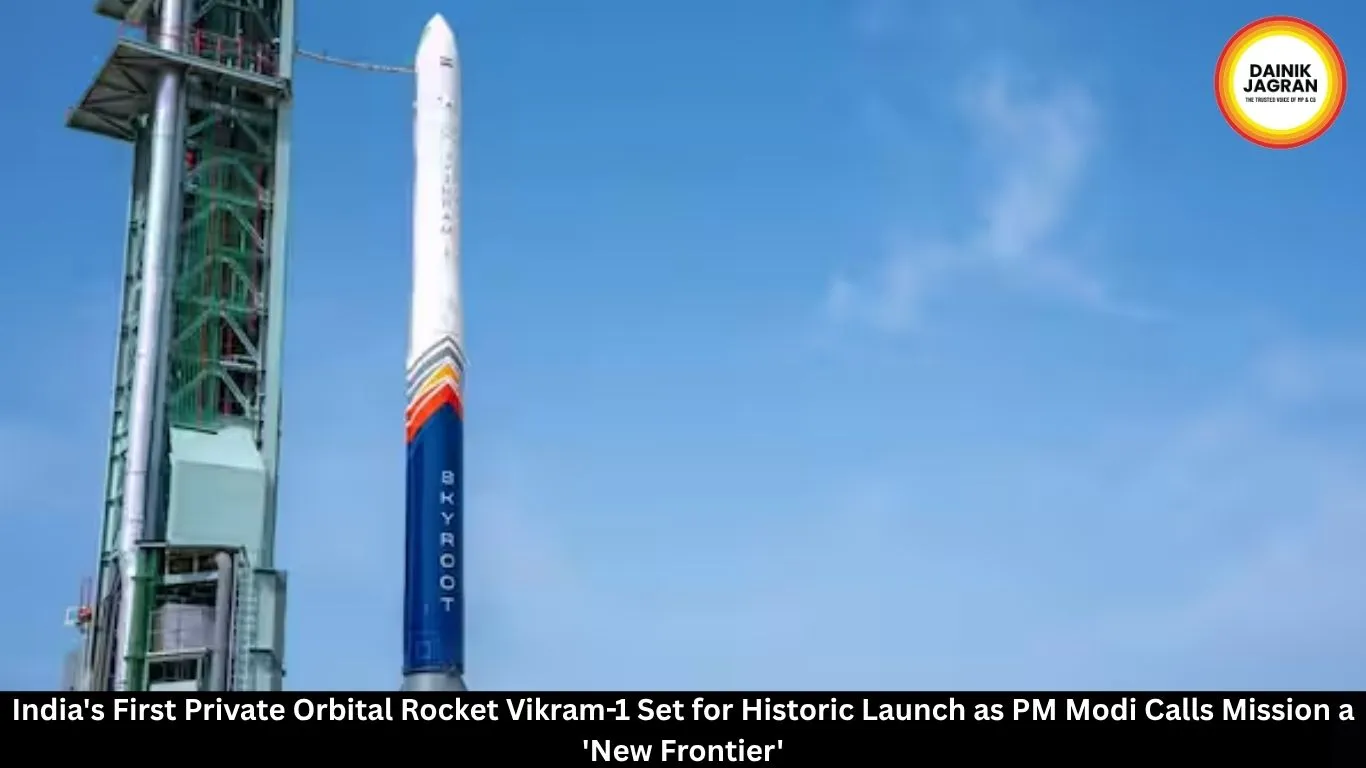
India's First Private Orbital Rocket Vikram-1 Set for Historic Launch Today
Digital Desk
Skyroot Aerospace will launch India's first private orbital rocket Vikram-1 from Sriharikota today. PM Modi called Mission Aagaman a historic milestone for India's private space sector.
India is set to enter a new era in commercial space exploration on Saturday as Hyderabad-based Skyroot Aerospace prepares to launch Vikram-1, the country's first privately developed orbital launch vehicle. The mission, named Mission Aagaman, is scheduled to lift off from the Satish Dhawan Space Centre, Sriharikota, at 11:30 AM IST, marking a significant milestone for India's rapidly expanding private space sector.
Ahead of the launch, Prime Minister Narendra Modi described the mission as a "historic new frontier" for India's space programme, highlighting it as a symbol of the country's innovation-driven growth and entrepreneurial spirit. In a message shared on X, the Prime Minister congratulated the Skyroot Aerospace team and expressed confidence that Vikram-1 would inspire a new generation of innovators while demonstrating the success of India's space-sector reforms.
Mission Aagaman Opens a New Chapter
Mission Aagaman is Skyroot Aerospace's maiden orbital mission and the first attempt by an Indian private company to place a launch vehicle into orbit. If successful, Vikram-1 will become the country's first privately built orbital rocket to deploy payloads into Low Earth Orbit (LEO) at an altitude of 450 kilometres.
The mission comes six years after the Government of India opened the space sector to private participation in 2020, encouraging startups to build indigenous launch capabilities and helping the country target a significantly larger share of the global space economy.
Advanced Indigenous Rocket Technology
Vikram-1 has been developed using cutting-edge aerospace technologies. It is India's first orbital launch vehicle built almost entirely with an all-carbon composite structure, making it lighter, stronger and more fuel-efficient than conventional metallic rockets.
The four-stage launch vehicle combines three solid-fuel propulsion stages with an advanced Orbital Adjustment Module (OAM) that uses a fully 3D-printed liquid rocket engine—the first of its kind on an Indian orbital launcher. The rocket also features India's longest monolithic carbon-composite first stage, showcasing major advances in indigenous aerospace manufacturing.
Designed for rapid and on-demand satellite launches, Vikram-1 can carry payloads of up to 350 kilograms into Low Earth Orbit.
Commercial and Technology Payloads
Mission Aagaman is carrying several technology demonstration payloads developed by Indian space startups, including:
-
Graha Space
-
Cosmoserve Space
-
DQube
-
Skyroot Aerospace's in-house SCOPE payload
These payloads will help validate next-generation space technologies while collecting valuable mission data for future commercial launches.
A Golden Tribute to India's Scientific Icons
Beyond its technological significance, Vikram-1 also carries a symbolic payload celebrating India's scientific heritage.
A miniature 18-carat gold rocket, created by Cosmos Diamonds, has been included aboard the mission. The artwork features intricate micro-sculptures of three legendary Indian scientists:
-
Dr. Vikram Sarabhai, the father of India's space programme
-
Dr. A.P.J. Abdul Kalam, renowned aerospace scientist and former President of India
-
Sir C.V. Raman, Nobel Prize-winning physicist
The artistic payload, titled "Cosmic Bloom," blends science, engineering and national pride, making it one of the mission's most distinctive features.
PM Modi Hails India's Growing Space Ecosystem
Calling Vikram-1 a landmark achievement, Prime Minister Modi said the mission reflects the talent, determination and innovation of India's youth. He noted that reforms in the space sector are creating fresh opportunities for startups and private enterprises while strengthening India's position in the global space economy.
The Prime Minister also encouraged citizens, especially young people, to follow the launch and support the mission through the hashtag #IndiaWithVikram1.
Boost for India's Commercial Space Ambitions
Founded in 2018 by former ISRO scientists Pawan Kumar Chandana and Naga Bharath Daka, Skyroot Aerospace has emerged as one of India's leading private space startups. Following the successful launch of the Vikram-S suborbital rocket in 2022, the company is now attempting a full-fledged orbital mission.
A successful Vikram-1 launch would represent a major leap for India's private space industry, opening new opportunities in satellite launch services, attracting international customers and strengthening the country's ambition to become a global commercial launch hub.

--------
🚨 Beat the News Rush – Join Now!
Get breaking alerts, hot exclusives, and game-changing stories instantly on your phone. No delays, no fluff – just the edge you need. ⚡
Tap to join:
🟢 WhatsApp Channel: Dainik Jagran MP CG
Crave more?
🅕 Facebook: Dainik Jagran MP CG English
🅧 Twitter (X): Dainik Jagran MP CG
🅘 Instagram: Dainik Jagran MP CG
Share the fire – keep your crew ahead! 🗞️🔥
India's First Private Orbital Rocket Vikram-1 Set for Historic Launch Today
Digital Desk
India is set to enter a new era in commercial space exploration on Saturday as Hyderabad-based Skyroot Aerospace prepares to launch Vikram-1, the country's first privately developed orbital launch vehicle. The mission, named Mission Aagaman, is scheduled to lift off from the Satish Dhawan Space Centre, Sriharikota, at 11:30 AM IST, marking a significant milestone for India's rapidly expanding private space sector.
Ahead of the launch, Prime Minister Narendra Modi described the mission as a "historic new frontier" for India's space programme, highlighting it as a symbol of the country's innovation-driven growth and entrepreneurial spirit. In a message shared on X, the Prime Minister congratulated the Skyroot Aerospace team and expressed confidence that Vikram-1 would inspire a new generation of innovators while demonstrating the success of India's space-sector reforms.
Mission Aagaman Opens a New Chapter
Mission Aagaman is Skyroot Aerospace's maiden orbital mission and the first attempt by an Indian private company to place a launch vehicle into orbit. If successful, Vikram-1 will become the country's first privately built orbital rocket to deploy payloads into Low Earth Orbit (LEO) at an altitude of 450 kilometres.
The mission comes six years after the Government of India opened the space sector to private participation in 2020, encouraging startups to build indigenous launch capabilities and helping the country target a significantly larger share of the global space economy.
Advanced Indigenous Rocket Technology
Vikram-1 has been developed using cutting-edge aerospace technologies. It is India's first orbital launch vehicle built almost entirely with an all-carbon composite structure, making it lighter, stronger and more fuel-efficient than conventional metallic rockets.
The four-stage launch vehicle combines three solid-fuel propulsion stages with an advanced Orbital Adjustment Module (OAM) that uses a fully 3D-printed liquid rocket engine—the first of its kind on an Indian orbital launcher. The rocket also features India's longest monolithic carbon-composite first stage, showcasing major advances in indigenous aerospace manufacturing.
Designed for rapid and on-demand satellite launches, Vikram-1 can carry payloads of up to 350 kilograms into Low Earth Orbit.
Commercial and Technology Payloads
Mission Aagaman is carrying several technology demonstration payloads developed by Indian space startups, including:
-
Graha Space
-
Cosmoserve Space
-
DQube
-
Skyroot Aerospace's in-house SCOPE payload
These payloads will help validate next-generation space technologies while collecting valuable mission data for future commercial launches.
A Golden Tribute to India's Scientific Icons
Beyond its technological significance, Vikram-1 also carries a symbolic payload celebrating India's scientific heritage.
A miniature 18-carat gold rocket, created by Cosmos Diamonds, has been included aboard the mission. The artwork features intricate micro-sculptures of three legendary Indian scientists:
-
Dr. Vikram Sarabhai, the father of India's space programme
-
Dr. A.P.J. Abdul Kalam, renowned aerospace scientist and former President of India
-
Sir C.V. Raman, Nobel Prize-winning physicist
The artistic payload, titled "Cosmic Bloom," blends science, engineering and national pride, making it one of the mission's most distinctive features.
PM Modi Hails India's Growing Space Ecosystem
Calling Vikram-1 a landmark achievement, Prime Minister Modi said the mission reflects the talent, determination and innovation of India's youth. He noted that reforms in the space sector are creating fresh opportunities for startups and private enterprises while strengthening India's position in the global space economy.
The Prime Minister also encouraged citizens, especially young people, to follow the launch and support the mission through the hashtag #IndiaWithVikram1.
Boost for India's Commercial Space Ambitions
Founded in 2018 by former ISRO scientists Pawan Kumar Chandana and Naga Bharath Daka, Skyroot Aerospace has emerged as one of India's leading private space startups. Following the successful launch of the Vikram-S suborbital rocket in 2022, the company is now attempting a full-fledged orbital mission.
A successful Vikram-1 launch would represent a major leap for India's private space industry, opening new opportunities in satellite launch services, attracting international customers and strengthening the country's ambition to become a global commercial launch hub.