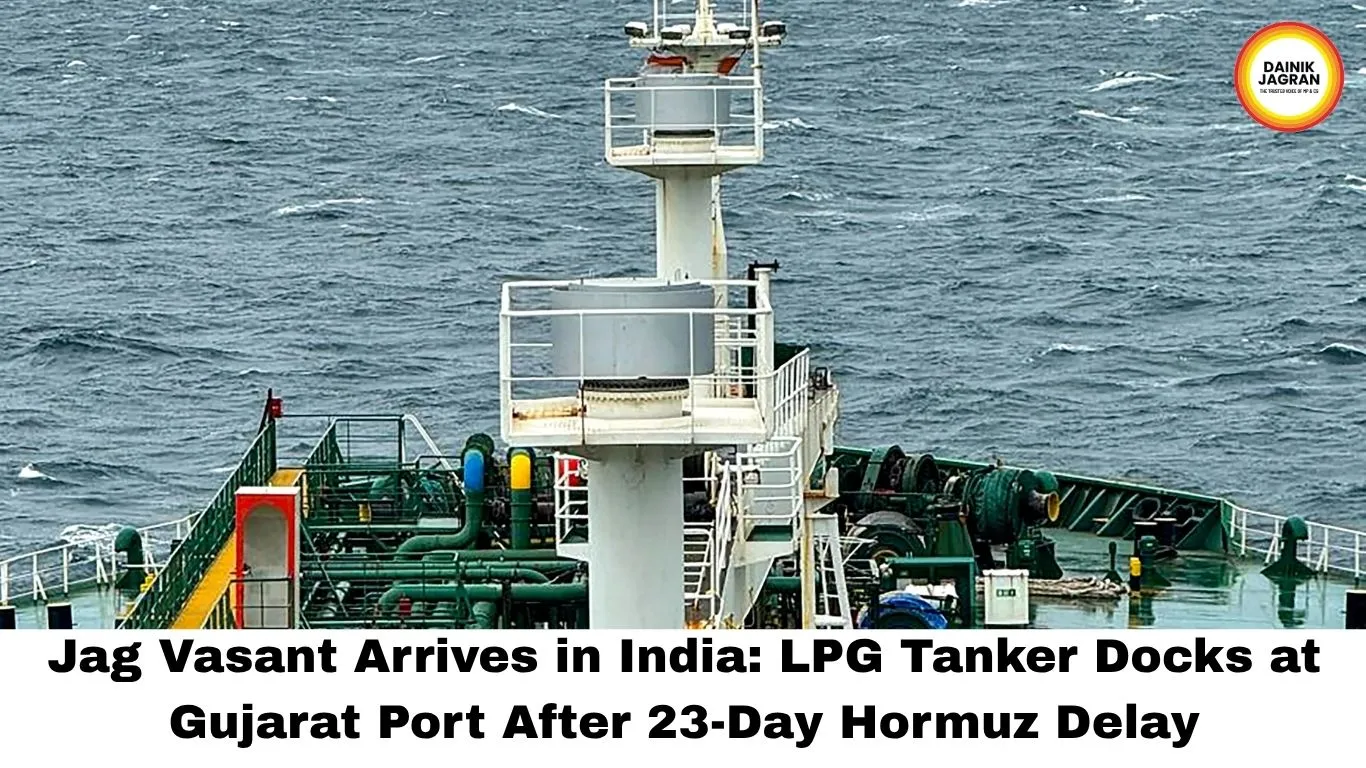
Jag Vasant Arrives in India: LPG Tanker Docks at Gujarat Port After 23-Day Hormuz Delay
Digital Desk
LPG tanker Jag Vasant reaches Gujarat's Vadinar port with 47,600 MT of cooking gas after being stranded in the Strait of Hormuz for 23 days amid Middle East war.
Jag Vasant Arrives in India: 47,600 MT LPG Cargo Brings Relief Amid Hormuz Crisis
In a major relief for millions of Indian households, the LPG tanker Jag Vasant has finally arrived in India after being stranded for 23 days in the Strait of Hormuz. The vessel docked at Gujarat’s Vadinar port late Thursday night, carrying approximately 47,600 metric tonnes of liquefied petroleum gas .
The arrival comes at a critical time when the Middle East war has disrupted global energy supplies, raising concerns about cooking gas shortages across the country. The Jag Vasant is one of several Indian-flagged vessels that were caught in the strategic waterway after Iran effectively restricted passage through one of the world’s busiest oil and gas routes .
A Perilous Journey Through a War Zone
The Jag Vasant’s journey home was anything but routine. The vessel had been stuck in the Strait of Hormuz—a narrow chokepoint between Iran and Oman through which nearly one-fifth of the world’s oil and gas trade passes—since early March .
For nearly a month, the ship and its 33 Indian crew members waited as tensions escalated following coordinated US-Israeli strikes on Iran. Tehran responded by effectively closing the strait to most nations while allowing passage to “friendly countries,” including India .
When the Jag Vasant finally transited through the strait earlier this week, it took an unusual route via the Qeshm-Larak channel rather than the conventional path. The ship also changed its onboard messaging to broadcast its identity clearly—a move widely interpreted as a precaution to avoid being targeted while passing through Iranian-controlled waters .
Two Ships Bring Over 92,000 MT of LPG
The Jag Vasant is not alone. A second LPG tanker, Pine Gas, is expected to arrive shortly at New Mangalore Port with an additional 45,000 metric tonnes of LPG . Together, the two vessels will add over 92,000 metric tonnes of cooking gas to India’s reserves—roughly equivalent to a full day’s consumption for the entire country .
This is the third major LPG shipment to reach Indian shores in recent weeks. Earlier this month, two other Indian-flagged tankers—Shivalik and Nanda Devi—delivered over 92,000 metric tonnes of LPG to Mundra and Vadinar ports respectively .
Government Reassures Citizens as 20 Ships Remain Stranded
Despite the successful arrival of the Jag Vasant, concerns remain. According to the Ministry of Shipping, 20 Indian-flagged vessels—carrying approximately 540 Indian sailors—are still stranded in the Persian Gulf region . Among these are five large LPG tankers with a combined cargo of 2,30,000 metric tonnes of LPG .
The government, however, has moved to reassure citizens. Prime Minister Narendra Modi told Parliament earlier this week that India has sufficient crude oil reserves and robust arrangements for continuous supply. “Our endeavour is to ensure that oil and gas supplies reach India from wherever possible,” he said .
The Ministry of Petroleum has acknowledged that LPG supply is being impacted by the geopolitical situation but confirmed that no disruptions have been reported at distributor outlets .
Iran Keeps Strait Open for India
Iranian Foreign Minister Seyed Abbas Araghchi confirmed earlier this week that the Strait of Hormuz remains open to friendly nations, naming India, China, Russia, Iraq, and Pakistan as countries permitted passage. Tehran has maintained it will keep the waterway closed to “enemies” .
India imports approximately 60 per cent of its LPG requirements from global markets, with 90 per cent of those imports traditionally passing through the Strait of Hormuz . The successful transit of the Jag Vasant and Pine Gas signals that while the route remains risky, India’s diplomatic channels with Iran are keeping the energy lifeline open.
What This Means for Consumers
With the Jag Vasant’s cargo now being offloaded at Vadinar—using mid-sea transfer techniques to speed up delivery—domestic LPG supply is expected to stabilize in the coming days . The government has also cut excise duties on petrol and diesel to shield consumers from soaring global crude prices, though officials have indicated that retail fuel prices may not drop immediately .
For now, the sight of the Jag Vasant anchored off Gujarat’s coast offers a measure of reassurance. After nearly a month of uncertainty, India’s cooking gas supply chain is getting the boost it desperately needed.
--------
🚨 Beat the News Rush – Join Now!
Get breaking alerts, hot exclusives, and game-changing stories instantly on your phone. No delays, no fluff – just the edge you need. ⚡
Tap to join:
🟢 WhatsApp Channel: https://whatsapp.com/channel/0029VbAeWYG72WTxso1CFr2g
Crave more?
🅕 Facebook: English Dainik Jagran MP CG
🅧 Twitter (X): Jagran MP CG
🅘 Instagram: Dainik Jagran MP CG
Share the fire – keep your crew ahead! 🗞️🔥
Jag Vasant Arrives in India: LPG Tanker Docks at Gujarat Port After 23-Day Hormuz Delay
Digital Desk
Jag Vasant Arrives in India: 47,600 MT LPG Cargo Brings Relief Amid Hormuz Crisis
In a major relief for millions of Indian households, the LPG tanker Jag Vasant has finally arrived in India after being stranded for 23 days in the Strait of Hormuz. The vessel docked at Gujarat’s Vadinar port late Thursday night, carrying approximately 47,600 metric tonnes of liquefied petroleum gas .
The arrival comes at a critical time when the Middle East war has disrupted global energy supplies, raising concerns about cooking gas shortages across the country. The Jag Vasant is one of several Indian-flagged vessels that were caught in the strategic waterway after Iran effectively restricted passage through one of the world’s busiest oil and gas routes .
A Perilous Journey Through a War Zone
The Jag Vasant’s journey home was anything but routine. The vessel had been stuck in the Strait of Hormuz—a narrow chokepoint between Iran and Oman through which nearly one-fifth of the world’s oil and gas trade passes—since early March .
For nearly a month, the ship and its 33 Indian crew members waited as tensions escalated following coordinated US-Israeli strikes on Iran. Tehran responded by effectively closing the strait to most nations while allowing passage to “friendly countries,” including India .
When the Jag Vasant finally transited through the strait earlier this week, it took an unusual route via the Qeshm-Larak channel rather than the conventional path. The ship also changed its onboard messaging to broadcast its identity clearly—a move widely interpreted as a precaution to avoid being targeted while passing through Iranian-controlled waters .
Two Ships Bring Over 92,000 MT of LPG
The Jag Vasant is not alone. A second LPG tanker, Pine Gas, is expected to arrive shortly at New Mangalore Port with an additional 45,000 metric tonnes of LPG . Together, the two vessels will add over 92,000 metric tonnes of cooking gas to India’s reserves—roughly equivalent to a full day’s consumption for the entire country .
This is the third major LPG shipment to reach Indian shores in recent weeks. Earlier this month, two other Indian-flagged tankers—Shivalik and Nanda Devi—delivered over 92,000 metric tonnes of LPG to Mundra and Vadinar ports respectively .
Government Reassures Citizens as 20 Ships Remain Stranded
Despite the successful arrival of the Jag Vasant, concerns remain. According to the Ministry of Shipping, 20 Indian-flagged vessels—carrying approximately 540 Indian sailors—are still stranded in the Persian Gulf region . Among these are five large LPG tankers with a combined cargo of 2,30,000 metric tonnes of LPG .
The government, however, has moved to reassure citizens. Prime Minister Narendra Modi told Parliament earlier this week that India has sufficient crude oil reserves and robust arrangements for continuous supply. “Our endeavour is to ensure that oil and gas supplies reach India from wherever possible,” he said .
The Ministry of Petroleum has acknowledged that LPG supply is being impacted by the geopolitical situation but confirmed that no disruptions have been reported at distributor outlets .
Iran Keeps Strait Open for India
Iranian Foreign Minister Seyed Abbas Araghchi confirmed earlier this week that the Strait of Hormuz remains open to friendly nations, naming India, China, Russia, Iraq, and Pakistan as countries permitted passage. Tehran has maintained it will keep the waterway closed to “enemies” .
India imports approximately 60 per cent of its LPG requirements from global markets, with 90 per cent of those imports traditionally passing through the Strait of Hormuz . The successful transit of the Jag Vasant and Pine Gas signals that while the route remains risky, India’s diplomatic channels with Iran are keeping the energy lifeline open.
What This Means for Consumers
With the Jag Vasant’s cargo now being offloaded at Vadinar—using mid-sea transfer techniques to speed up delivery—domestic LPG supply is expected to stabilize in the coming days . The government has also cut excise duties on petrol and diesel to shield consumers from soaring global crude prices, though officials have indicated that retail fuel prices may not drop immediately .
For now, the sight of the Jag Vasant anchored off Gujarat’s coast offers a measure of reassurance. After nearly a month of uncertainty, India’s cooking gas supply chain is getting the boost it desperately needed.