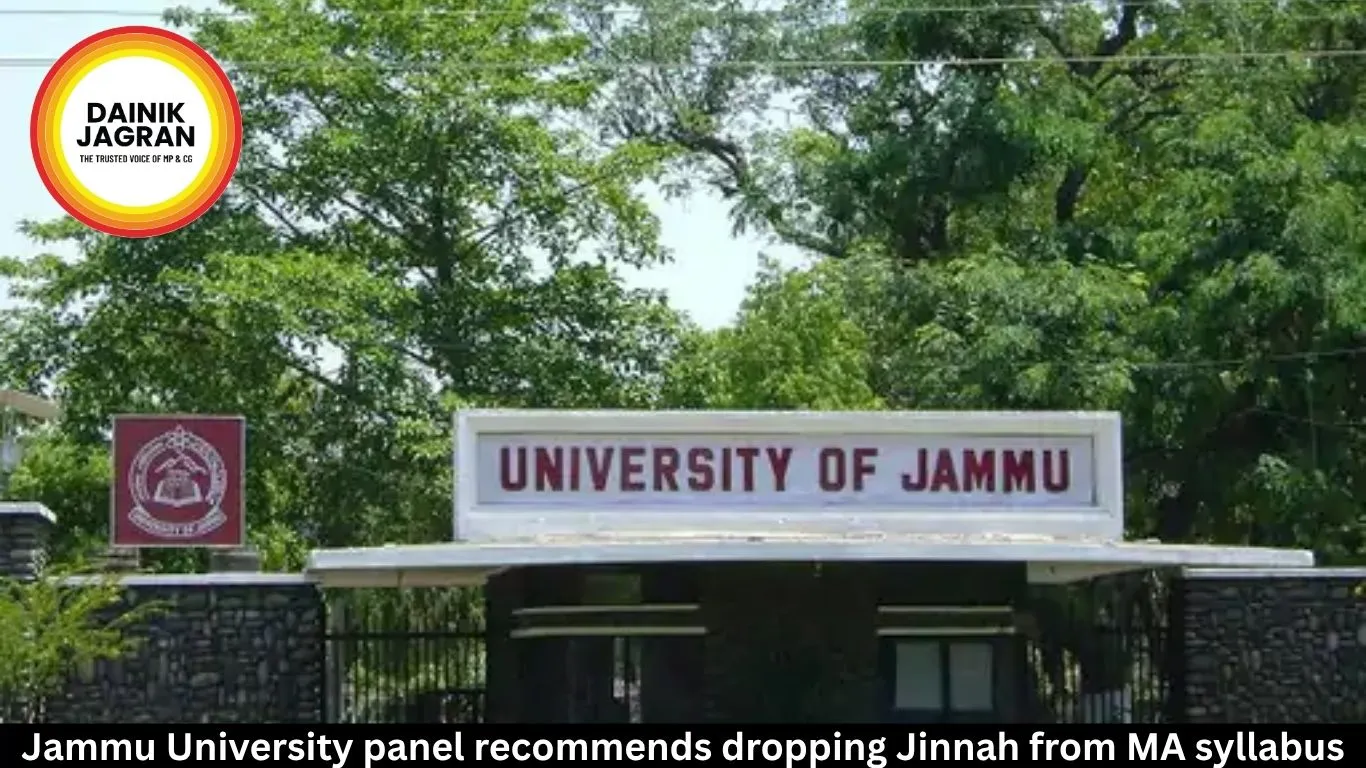
Jammu University Panel Recommends Dropping Jinnah from Syllabus

Digital Desk

Jammu University Panel Recommends Dropping Jinnah from Syllabus

Jammu University's DAC recommends removing Muhammad Ali Jinnah, Sir Syed Ahmed Khan, and Muhammad Iqbal from the MA Political Science curriculum ahead of the Board of Studies meet.

Jammu University panel recommends dropping Jinnah from MA syllabus

The Departmental Affairs Committee moves to scrap topics on Jinnah, Sir Syed, and Iqbal following student protests; Board of Studies to take final call tomorrow.

The Departmental Affairs Committee (DAC) of Jammu University has recommended the immediate removal of Muhammad Ali Jinnah, Sir Syed Ahmed Khan, and Muhammad Iqbal from the MA Political Science curriculum. The proposal follows intense student-led demonstrations and a growing administrative row over the inclusion of these figures in the academic session.

While the DAC has formalised its recommendation, the final decision rests with the Board of Studies, which is scheduled to convene an online meeting on March 24 to ratify the changes. The development comes at a time when the university faces pressure from student groups alleging that the inclusion of Jinnah’s political thought hurts national sentiments.

Protests trigger curriculum review

The controversy erupted after Jinnah’s political ideologies were introduced as part of the 'Minorities and the Nation' paper. Members of the Akhil Bharatiya Vidyarthi Parishad (ABVP) staged a massive protest on Saturday, carrying posters of Jinnah and demanding a syllabus overhaul.

The protestors argued that presenting Jinnah as a leader of minorities, rather than solely in the context of the 'Two-Nation Theory' and Partition, misrepresents historical facts. They maintained that academic freedom should not override national history.

Shift in academic context

Sannak Shrivats, ABVP's Jammu and Kashmir state secretary, pointed out that the objection lies in the "rebranding" of Jinnah within the revised syllabus. Previously, Jinnah was studied through the lens of Partition and the communal divide.

Under the new 2025 draft, however, he was positioned as a significant minority thinker. Shrivats stated that the organisation would not accept a narrative that provides a platform for the architect of India’s partition under the guise of minority studies.

Department defends UGC standards

Baljeet Singh Maan, Head of the Political Science Department, initially defended the inclusion of these thinkers, stating the curriculum was designed from a strictly academic perspective. He noted that the topics aligned with University Grants Commission (UGC) standards and national curriculum frameworks.

According to Maan, the objective was to expose postgraduate students to a variety of political thoughts to foster critical analysis. However, following the escalating protests, the university administration constituted a committee to review the syllabus, leading to the current recommendation for removal.

Political blame game begins

The issue has quickly taken a political turn, with the Congress party accusing the administration of creating a "deliberate controversy." JKPCC General Secretary Namrata Sharma noted that the draft syllabus, which also includes Savarkar and Golwalkar, has been in place for nearly a year.

"This curriculum was prepared in 2025 and remained unchallenged for months. Raising it now suggests an attempt to polarise the academic environment," Sharma said. She questioned the timing of the protests, suggesting that the sudden friction was politically motivated.

History of campus friction

Jammu University’s Political Science department is no stranger to ideological clashes. The current row echoes a 2018 incident where a professor faced severe backlash and university action after a video surfaced showing him referring to Bhagat Singh in a controversial light.

The recurring nature of these disputes highlights the sensitive balance between academic inquiry and regional political sentiments. Observers noted that the university administration is now treading cautiously to avoid further law-and-order disruptions on campus.

Final decision expected tomorrow

All eyes are now on the Board of Studies meeting on Tuesday. The board will decide whether to uphold the DAC’s recommendation or maintain the current academic structure. This decision is expected to set a precedent for how sensitive historical figures are treated in higher education across the region.

The outcome of tomorrow's meet will likely impact the academic calendar for the current semester. Government updates on the matter are expected shortly after the board concludes its deliberations, as this remains a high-priority trending news India story.


english.dainikjagranmpcg.com
23 Mar 2026 By Abhishek Joshi

Jammu University Panel Recommends Dropping Jinnah from Syllabus

Digital Desk

Jammu University panel recommends dropping Jinnah from MA syllabus

The Departmental Affairs Committee moves to scrap topics on Jinnah, Sir Syed, and Iqbal following student protests; Board of Studies to take final call tomorrow.

The Departmental Affairs Committee (DAC) of Jammu University has recommended the immediate removal of Muhammad Ali Jinnah, Sir Syed Ahmed Khan, and Muhammad Iqbal from the MA Political Science curriculum. The proposal follows intense student-led demonstrations and a growing administrative row over the inclusion of these figures in the academic session.

While the DAC has formalised its recommendation, the final decision rests with the Board of Studies, which is scheduled to convene an online meeting on March 24 to ratify the changes. The development comes at a time when the university faces pressure from student groups alleging that the inclusion of Jinnah’s political thought hurts national sentiments.

Protests trigger curriculum review

The controversy erupted after Jinnah’s political ideologies were introduced as part of the 'Minorities and the Nation' paper. Members of the Akhil Bharatiya Vidyarthi Parishad (ABVP) staged a massive protest on Saturday, carrying posters of Jinnah and demanding a syllabus overhaul.

The protestors argued that presenting Jinnah as a leader of minorities, rather than solely in the context of the 'Two-Nation Theory' and Partition, misrepresents historical facts. They maintained that academic freedom should not override national history.

Shift in academic context

Sannak Shrivats, ABVP's Jammu and Kashmir state secretary, pointed out that the objection lies in the "rebranding" of Jinnah within the revised syllabus. Previously, Jinnah was studied through the lens of Partition and the communal divide.

Under the new 2025 draft, however, he was positioned as a significant minority thinker. Shrivats stated that the organisation would not accept a narrative that provides a platform for the architect of India’s partition under the guise of minority studies.

Department defends UGC standards

Baljeet Singh Maan, Head of the Political Science Department, initially defended the inclusion of these thinkers, stating the curriculum was designed from a strictly academic perspective. He noted that the topics aligned with University Grants Commission (UGC) standards and national curriculum frameworks.

According to Maan, the objective was to expose postgraduate students to a variety of political thoughts to foster critical analysis. However, following the escalating protests, the university administration constituted a committee to review the syllabus, leading to the current recommendation for removal.

Political blame game begins

The issue has quickly taken a political turn, with the Congress party accusing the administration of creating a "deliberate controversy." JKPCC General Secretary Namrata Sharma noted that the draft syllabus, which also includes Savarkar and Golwalkar, has been in place for nearly a year.

"This curriculum was prepared in 2025 and remained unchallenged for months. Raising it now suggests an attempt to polarise the academic environment," Sharma said. She questioned the timing of the protests, suggesting that the sudden friction was politically motivated.

History of campus friction

Jammu University’s Political Science department is no stranger to ideological clashes. The current row echoes a 2018 incident where a professor faced severe backlash and university action after a video surfaced showing him referring to Bhagat Singh in a controversial light.

The recurring nature of these disputes highlights the sensitive balance between academic inquiry and regional political sentiments. Observers noted that the university administration is now treading cautiously to avoid further law-and-order disruptions on campus.

Final decision expected tomorrow

All eyes are now on the Board of Studies meeting on Tuesday. The board will decide whether to uphold the DAC’s recommendation or maintain the current academic structure. This decision is expected to set a precedent for how sensitive historical figures are treated in higher education across the region.

The outcome of tomorrow's meet will likely impact the academic calendar for the current semester. Government updates on the matter are expected shortly after the board concludes its deliberations, as this remains a high-priority trending news India story.


https://english.dainikjagranmpcg.com/national/jammu-university-panel-recommends-dropping-jinnah-from-syllabus/article-15842

Advertisement

Latest News