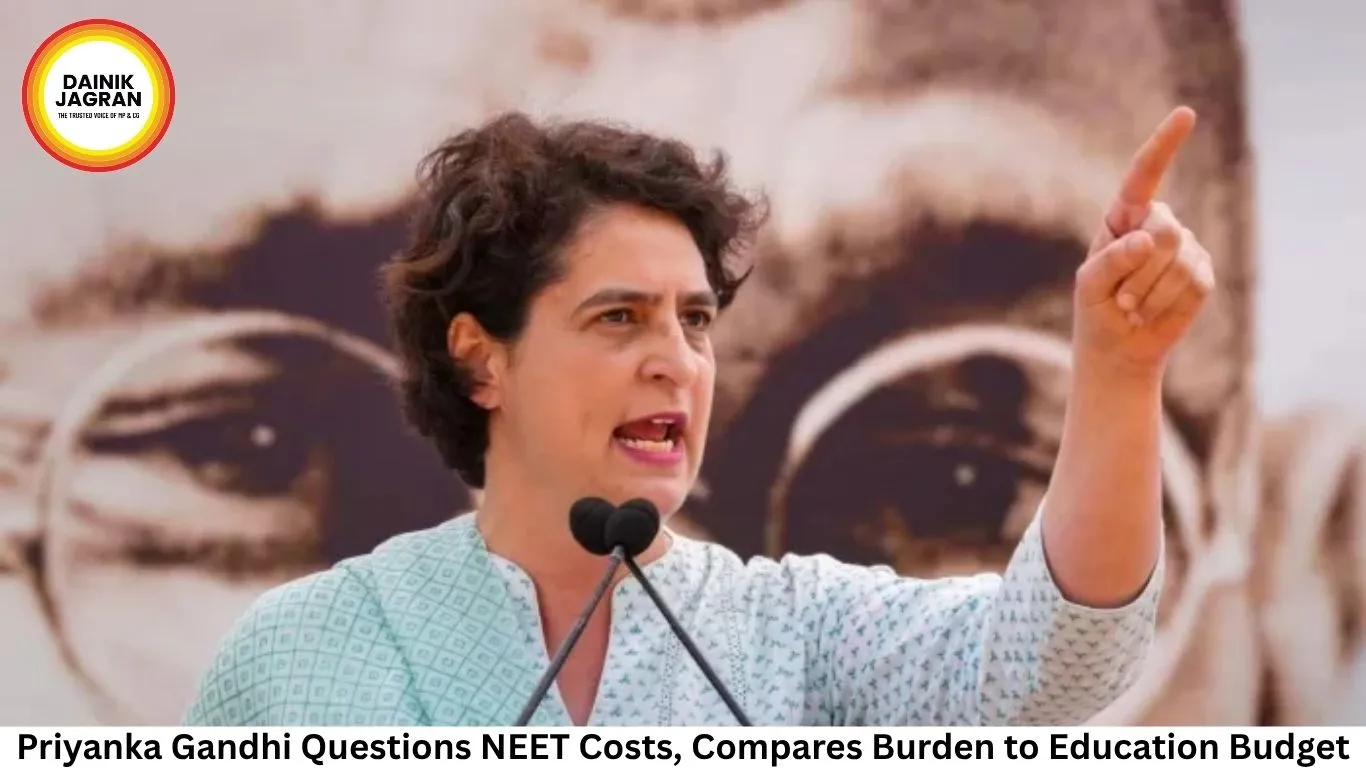
Priyanka Gandhi Questions NEET Costs, Compares Burden to Education Budget
Digital Desk
Congress leader claims families spend ₹1.32 lakh crore annually on NEET preparation as Rahul Gandhi raises concerns over student stress during a Kota outreach programme.
The debate over India's competitive examination system intensified on Wednesday after Congress leader Priyanka Gandhi Vadra alleged that families of students appearing for the National Eligibility-cum-Entrance Test (NEET) collectively spend around ₹1.32 lakh crore every year. She argued that the amount is nearly equivalent to the Union government's annual education budget of ₹1.40 lakh crore.
In a post on social media, Priyanka Gandhi also alleged that loan waivers worth ₹16 lakh crore had been extended to select business groups, drawing a contrast between public spending on education and financial support provided to corporate entities.
Her remarks came a day after Rahul Gandhi visited Kota, Rajasthan, and interacted with students and their families under the "Chhatro Ki Goonj" programme. The discussion focused on academic pressure, competitive examinations, and the mental health challenges faced by students preparing for high-stakes entrance tests.
Focus on Student Pressure
Addressing students at Kota's Dussehra Ground, Rahul Gandhi said the current education system places immense pressure on young people and often contributes to anxiety and emotional distress.
He urged collective efforts to create an environment where students are not pushed toward extreme measures due to academic stress. Rahul also claimed that preparation for major competitive examinations, including NEET and JEE, costs Indian families nearly ₹5 lakh crore annually.
Kota, known as India's coaching hub, attracts thousands of aspirants every year preparing for medical and engineering entrance examinations.
NTA Revises Admit Card Process
Meanwhile, the National Testing Agency (NTA) announced a significant change in the process for downloading NEET-UG 2026 re-examination admit cards.
According to the revised procedure, candidates can now download their admit cards even if they have not completed bank account verification. Earlier, verification was mandatory before access to admit cards was granted.
The agency clarified that students will remain eligible for fee refunds even if bank verification is completed after downloading the admit card. The move is expected to benefit candidates who faced technical or documentation-related delays.
Re-Examination on June 21
The NEET-UG 2026 re-examination is scheduled to be conducted on 21 June in a single shift from 2:00 PM to 5:15 PM. Candidates will also receive an additional 15 minutes for administrative formalities.
Earlier this month, NTA introduced several changes for the re-exam. The duration of the test has been extended from 180 minutes to 195 minutes, and candidates will be provided with four rough-work sheets along with increased space for calculations and notes.
Background of the Re-Test
The original NEET-UG 2026 examination was conducted on 3 May across the country. However, allegations of question paper leaks and examination irregularities surfaced from multiple states soon after the test.
Following preliminary investigations and reports of potential malpractice, the examination was cancelled on 12 May. Subsequently, the Central government and investigating agencies recommended a fresh examination to ensure fairness and transparency in the admission process.
Importance of NEET
NEET remains India's largest medical entrance examination and serves as the gateway for admission to MBBS, BDS, AYUSH, nursing, and other healthcare-related courses.
The examination is used for admission to more than one lakh seats in medical and allied health institutions across the country, including premier institutions such as All India Institute of Medical Sciences and Jawaharlal Institute of Postgraduate Medical Education and Research.
With the re-examination approaching, concerns over exam integrity, student welfare, and the rising financial burden of competitive test preparation continue to remain at the centre of the national education debate.
--------
🚨 Beat the News Rush – Join Now!
Get breaking alerts, hot exclusives, and game-changing stories instantly on your phone. No delays, no fluff – just the edge you need. ⚡
Tap to join:
🟢 WhatsApp Channel: Dainik Jagran MP CG
Crave more?
🅕 Facebook: Dainik Jagran MP CG English
🅧 Twitter (X): Dainik Jagran MP CG
🅘 Instagram: Dainik Jagran MP CG
Share the fire – keep your crew ahead! 🗞️🔥
Priyanka Gandhi Questions NEET Costs, Compares Burden to Education Budget
Digital Desk
The debate over India's competitive examination system intensified on Wednesday after Congress leader Priyanka Gandhi Vadra alleged that families of students appearing for the National Eligibility-cum-Entrance Test (NEET) collectively spend around ₹1.32 lakh crore every year. She argued that the amount is nearly equivalent to the Union government's annual education budget of ₹1.40 lakh crore.
In a post on social media, Priyanka Gandhi also alleged that loan waivers worth ₹16 lakh crore had been extended to select business groups, drawing a contrast between public spending on education and financial support provided to corporate entities.
Her remarks came a day after Rahul Gandhi visited Kota, Rajasthan, and interacted with students and their families under the "Chhatro Ki Goonj" programme. The discussion focused on academic pressure, competitive examinations, and the mental health challenges faced by students preparing for high-stakes entrance tests.
Focus on Student Pressure
Addressing students at Kota's Dussehra Ground, Rahul Gandhi said the current education system places immense pressure on young people and often contributes to anxiety and emotional distress.
He urged collective efforts to create an environment where students are not pushed toward extreme measures due to academic stress. Rahul also claimed that preparation for major competitive examinations, including NEET and JEE, costs Indian families nearly ₹5 lakh crore annually.
Kota, known as India's coaching hub, attracts thousands of aspirants every year preparing for medical and engineering entrance examinations.
NTA Revises Admit Card Process
Meanwhile, the National Testing Agency (NTA) announced a significant change in the process for downloading NEET-UG 2026 re-examination admit cards.
According to the revised procedure, candidates can now download their admit cards even if they have not completed bank account verification. Earlier, verification was mandatory before access to admit cards was granted.
The agency clarified that students will remain eligible for fee refunds even if bank verification is completed after downloading the admit card. The move is expected to benefit candidates who faced technical or documentation-related delays.
Re-Examination on June 21
The NEET-UG 2026 re-examination is scheduled to be conducted on 21 June in a single shift from 2:00 PM to 5:15 PM. Candidates will also receive an additional 15 minutes for administrative formalities.
Earlier this month, NTA introduced several changes for the re-exam. The duration of the test has been extended from 180 minutes to 195 minutes, and candidates will be provided with four rough-work sheets along with increased space for calculations and notes.
Background of the Re-Test
The original NEET-UG 2026 examination was conducted on 3 May across the country. However, allegations of question paper leaks and examination irregularities surfaced from multiple states soon after the test.
Following preliminary investigations and reports of potential malpractice, the examination was cancelled on 12 May. Subsequently, the Central government and investigating agencies recommended a fresh examination to ensure fairness and transparency in the admission process.
Importance of NEET
NEET remains India's largest medical entrance examination and serves as the gateway for admission to MBBS, BDS, AYUSH, nursing, and other healthcare-related courses.
The examination is used for admission to more than one lakh seats in medical and allied health institutions across the country, including premier institutions such as All India Institute of Medical Sciences and Jawaharlal Institute of Postgraduate Medical Education and Research.
With the re-examination approaching, concerns over exam integrity, student welfare, and the rising financial burden of competitive test preparation continue to remain at the centre of the national education debate.