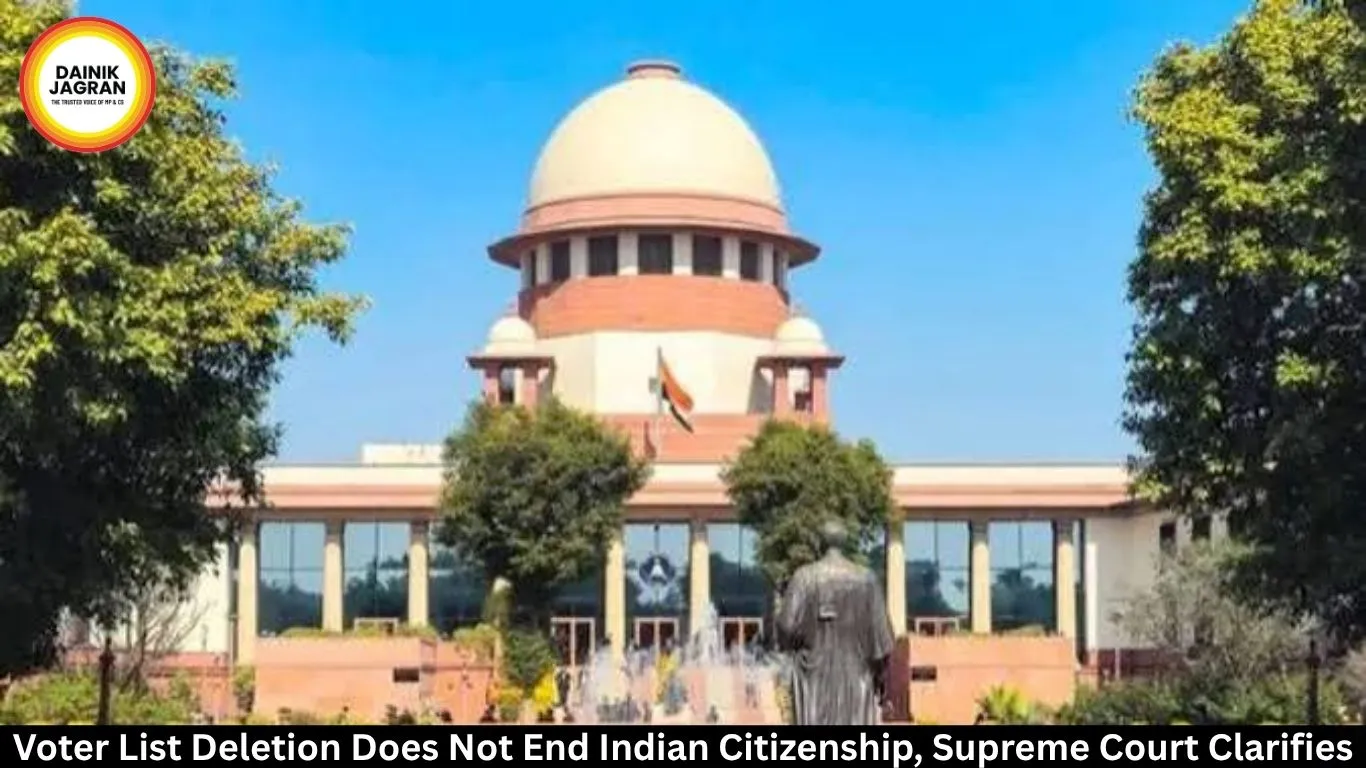
Supreme Court Clarifies Voter List Deletion Does Not Affect Indian Citizenship

Digital Desk

Supreme Court Clarifies Voter List Deletion Does Not Affect Indian Citizenship

The Supreme Court has ruled that removal of a person's name from the electoral roll does not mean loss of Indian citizenship. Here's what the court said about the Election Commission's powers and the legal distinction between voting rights and citizenship.

 The Supreme Court has clarified that the removal of a person's name from the electoral roll does not result in the loss of Indian citizenship. The court observed that voting rights and citizenship are two distinct legal issues, and the final authority to determine a person's citizenship rests solely with the Central Government under the due process of law.

The observation came during the hearing of petitions related to the Special Intensive Revision (SIR) of electoral rolls in West Bengal, where several individuals alleged that their names had been removed from the voter list without proper justification.

Background of the Case

During the SIR exercise conducted in West Bengal in May 2026, numerous complaints emerged regarding the deletion of names from the electoral rolls. Several affected individuals approached the Supreme Court, arguing that the removal of their names from the voter list was being wrongly linked to questions over their Indian citizenship.

Taking note of these concerns, the apex court stressed that electoral eligibility and citizenship are governed by separate legal frameworks.

What the Supreme Court Said

A Bench comprising Chief Justice Surya Kant and Justice Joymalya Bagchi observed that while the Election Commission has the constitutional authority to conduct a limited verification of citizenship for the purpose of preparing accurate electoral rolls, such verification does not amount to a determination of citizenship.

The court clarified that any action taken by the Election Commission in this regard is limited to electoral eligibility and cannot be interpreted as a declaration that an individual has lost Indian citizenship.

Election Commission Cannot Decide Citizenship

The Bench further stated that the Election Commission's powers are confined to maintaining electoral rolls. The authority to decide whether a person is an Indian citizen lies exclusively with the Central Government under the provisions of the Citizenship Act and other applicable laws.

The judges reiterated that citizenship can only be taken away through a legally prescribed procedure and not merely because a person's name no longer appears on the voter list.

Significance of the Ruling

The Supreme Court's clarification is expected to provide relief to individuals whose names have been removed from electoral rolls during revision exercises. It also reinforces the distinction between electoral rights and citizenship, preventing unnecessary confusion among voters.

Legal experts believe the observation will serve as an important judicial precedent in future disputes involving voter registration and citizenship, while also clearly defining the constitutional roles of the Election Commission and the Central Government.

The ruling underscores that the absence of a person's name from the electoral roll may affect the right to vote, but it does not, by itself, affect the person's status as an Indian citizen.

 

--------

🚨 Beat the News Rush – Join Now!

Get breaking alerts, hot exclusives, and game-changing stories instantly on your phone. No delays, no fluff – just the edge you need. ⚡

Tap to join: 

🟢 WhatsApp Channel: Dainik Jagran MP CG

Crave more?

🅕 Facebook: Dainik Jagran MP CG English

🅧 Twitter (X): Dainik Jagran MP CG

🅘 Instagram: Dainik Jagran MP CG

Share the fire – keep your crew ahead! 🗞️🔥

english.dainikjagranmpcg.com
18 Jul 2026 By Abhishek Joshi

Supreme Court Clarifies Voter List Deletion Does Not Affect Indian Citizenship

Digital Desk

 The Supreme Court has clarified that the removal of a person's name from the electoral roll does not result in the loss of Indian citizenship. The court observed that voting rights and citizenship are two distinct legal issues, and the final authority to determine a person's citizenship rests solely with the Central Government under the due process of law.

The observation came during the hearing of petitions related to the Special Intensive Revision (SIR) of electoral rolls in West Bengal, where several individuals alleged that their names had been removed from the voter list without proper justification.

Background of the Case

During the SIR exercise conducted in West Bengal in May 2026, numerous complaints emerged regarding the deletion of names from the electoral rolls. Several affected individuals approached the Supreme Court, arguing that the removal of their names from the voter list was being wrongly linked to questions over their Indian citizenship.

Taking note of these concerns, the apex court stressed that electoral eligibility and citizenship are governed by separate legal frameworks.

What the Supreme Court Said

A Bench comprising Chief Justice Surya Kant and Justice Joymalya Bagchi observed that while the Election Commission has the constitutional authority to conduct a limited verification of citizenship for the purpose of preparing accurate electoral rolls, such verification does not amount to a determination of citizenship.

The court clarified that any action taken by the Election Commission in this regard is limited to electoral eligibility and cannot be interpreted as a declaration that an individual has lost Indian citizenship.

Election Commission Cannot Decide Citizenship

The Bench further stated that the Election Commission's powers are confined to maintaining electoral rolls. The authority to decide whether a person is an Indian citizen lies exclusively with the Central Government under the provisions of the Citizenship Act and other applicable laws.

The judges reiterated that citizenship can only be taken away through a legally prescribed procedure and not merely because a person's name no longer appears on the voter list.

Significance of the Ruling

The Supreme Court's clarification is expected to provide relief to individuals whose names have been removed from electoral rolls during revision exercises. It also reinforces the distinction between electoral rights and citizenship, preventing unnecessary confusion among voters.

Legal experts believe the observation will serve as an important judicial precedent in future disputes involving voter registration and citizenship, while also clearly defining the constitutional roles of the Election Commission and the Central Government.

The ruling underscores that the absence of a person's name from the electoral roll may affect the right to vote, but it does not, by itself, affect the person's status as an Indian citizen.

 

https://english.dainikjagranmpcg.com/national/supreme-court-clarifies-voter-list-deletion-does-not-affect-indian/article-22710

Trending News