


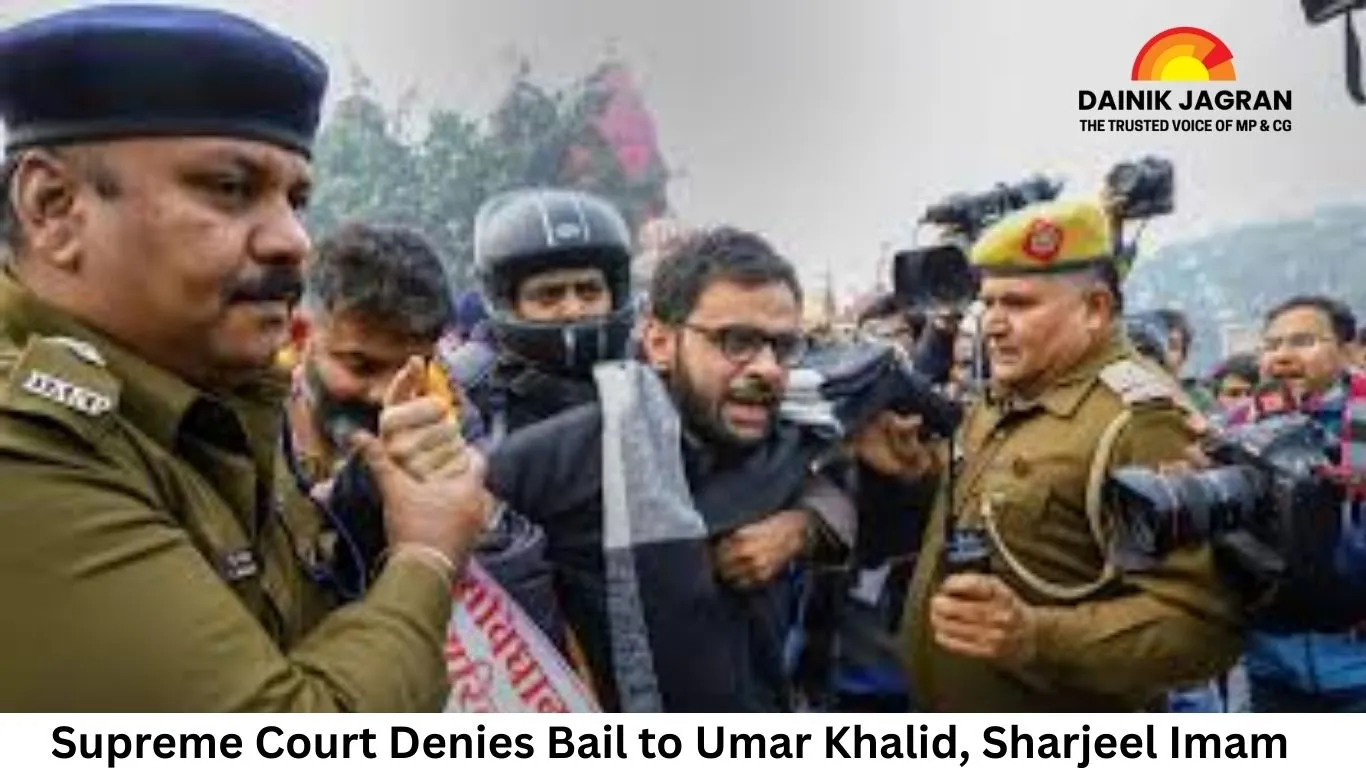
Supreme Court Denies Bail to Umar Khalid, Sharjeel Imam; Grants Relief to Five Others in 2020 Delhi Riots Case
Digital Desk
A bench comprising Justices Arvind Kumar and N.V. Anjaria held that Khalid and Imam occupied a “central position” in the alleged conspiracy that led to the communal violence in northeast Delhi, which claimed 53 lives and left hundreds injured in February 2020. Both have been in custody for over five years under the Unlawful Activities (Prevention) Act (UAPA).
At the same time, the court granted bail to Gulfisha Fatima, Meeran Haider, Mohammad Sameer Khan, Shadab Ahmed, and Shifa-ur-Rehman, subject to nearly a dozen stringent conditions. The bench clarified that the grant of bail does not dilute the charges against them and warned that any violation of conditions could lead to cancellation of bail by the trial court.
While delivering the verdict, the court underscored the constitutional importance of personal liberty under Article 21, observing that pretrial detention cannot be treated as punishment. However, it noted that UAPA is a special statute that prescribes strict conditions for bail, particularly in cases concerning the security and integrity of the state. “Delay by itself cannot be a trump card in such trials,” the bench said.
Khalid and Imam, along with the other accused, had approached the Supreme Court challenging a September 2025 Delhi High Court order that denied them bail. The High Court had earlier held that there was prima facie material suggesting that Khalid and Imam made inflammatory speeches and played a significant role in mobilising protests that later turned violent.
The accused had argued that the trial has seen prolonged delays, that they have spent more than five years in jail without conviction, and that there is no direct evidence linking them to acts of violence. Delhi Police, opposing bail, maintained that the delays were largely attributable to the accused and asserted that the case involved a wider conspiracy aimed at inciting unrest during protests against the Citizenship Amendment Act (CAA), allegedly timed with then US President Donald Trump’s visit to India.
The ruling triggered sharp political reactions. Congress leader Priyank Kharge criticised the decision on social media, questioning the criminal justice system’s approach to bail. The BJP countered by calling the verdict a vindication of its stand, accusing the Congress of supporting what it termed “anti-national elements.”
The trial in the case is ongoing in a Delhi court.
.jpg)




