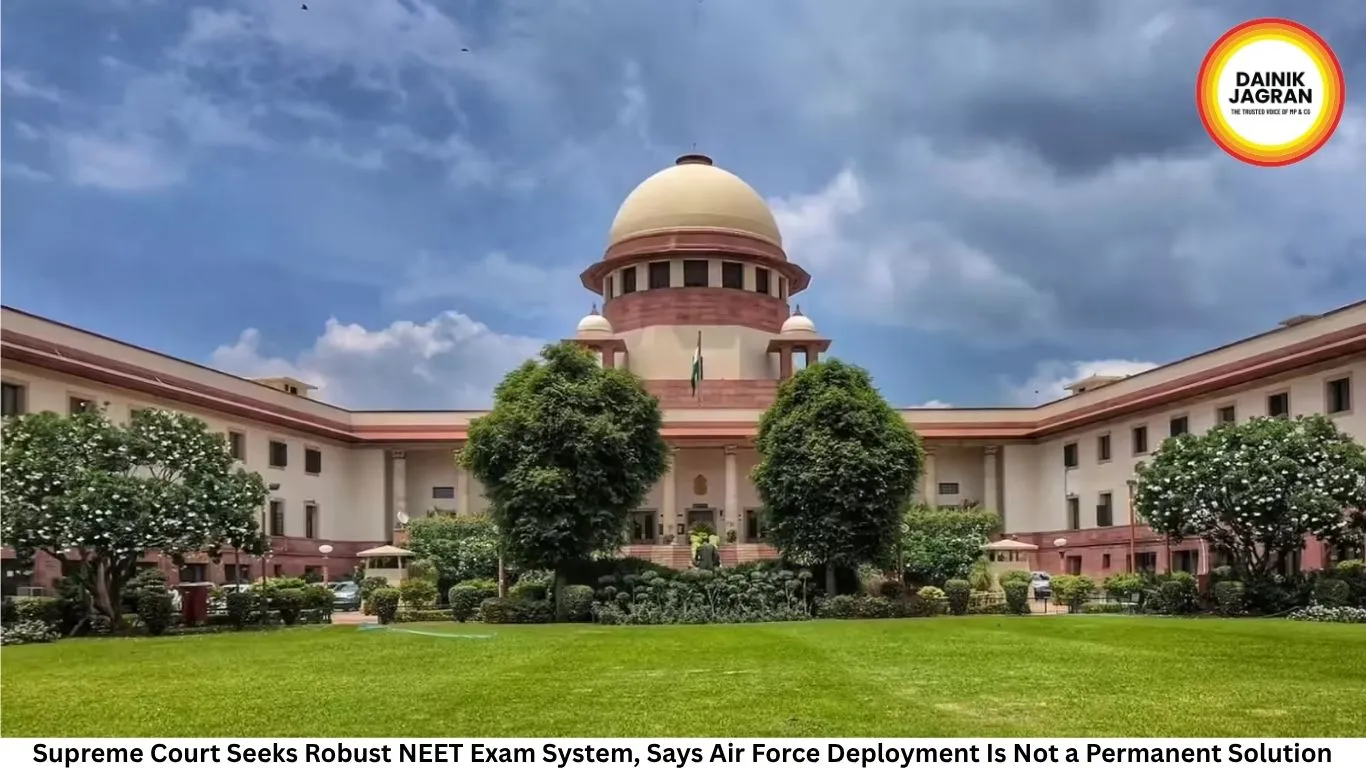
Supreme Court Seeks Robust NEET Exam System, Says Air Force Deployment Is Not a Permanent Solution
Digital Desk
The Supreme Court has directed the Centre to establish a permanent, transparent, and foolproof examination system for NEET, observing that temporary measures like using the Indian Air Force to transport question papers cannot be a long-term solution. The Court said it would closely monitor every reform undertaken by the government.
The Supreme Court on Friday emphasized the urgent need for a permanent and transparent examination system for the National Eligibility cum Entrance Test (NEET), stating that temporary arrangements such as deploying the Indian Air Force to transport question papers cannot serve as a lasting solution. Hearing a batch of petitions linked to the NEET paper leak controversy, the apex court made it clear that it would closely monitor every step taken by the Centre to strengthen the integrity of the examination process.
A Bench comprising Justice PS Narasimha and Justice Alok Aradhe observed that dependence on ad hoc arrangements over the years had exposed systemic weaknesses in India's examination framework. Stressing the importance of long-term reforms, the Court asked the Centre to present a detailed roadmap outlining measures being implemented to ensure transparency, security, and fairness in future NEET examinations.
Court Pushes for Permanent Examination Reforms
During the hearing, the Bench questioned the Union government about the progress made in implementing recommendations of the Radhakrishnan Committee, which was constituted after concerns over examination security. The Court also sought details regarding the adoption of the IIT model for conducting examinations and the reforms proposed by the National Testing Agency (NTA).
Justice PS Narasimha remarked that while extraordinary measures may be necessary during emergencies, they cannot replace a comprehensive institutional framework.
Referring to the transportation of NEET-UG re-test question papers through the Indian Air Force, the Bench observed that such arrangements were temporary in nature and highlighted the need for a permanent mechanism capable of preventing paper leaks and ensuring public confidence in the examination system.
The Court noted that repeated dependence on temporary solutions had contributed to recurring challenges and stressed that a well-designed, structured examination process was now essential.
Centre Assures Comprehensive Reforms
Appearing for the Centre, Solicitor General Tushar Mehta assured the Bench that the government was actively working on strengthening the examination ecosystem and would soon submit a comprehensive status report before the Court.
Mehta said the future of lakhs of students could not be compromised under any circumstances and informed the Court that reforms being implemented extended beyond the recommendations of the Radhakrishnan Committee.
According to the Solicitor General, every aspect of the examination process—from question paper preparation and printing to transportation, storage, and distribution—is being monitored at the highest levels of government.
He also reminded the Court that a similar issue had come up two years earlier, when the Centre had explained the security protocols followed throughout the examination process. The government, he added, has since continued to improve those safeguards to prevent any recurrence of paper leak incidents.
FAIMA Seeks Detailed CBT Blueprint
Representing the Federation of All India Medical Association (FAIMA), advocate Tanvi Dubey requested the Court to direct the authorities to place the complete Standard Operating Procedure (SOP) for the proposed Computer-Based Test (CBT) model for NEET-UG before the public.
The NTA has proposed shifting NEET-UG to a CBT format from next year as part of broader examination reforms. However, FAIMA argued that the detailed implementation blueprint has not yet been made public, making it difficult for students and stakeholders to understand the proposed changes.
The Bench took note of the submission while continuing to examine the broader issues relating to examination security and institutional reforms.
Focus on Transparency and Student Confidence
The NEET paper leak controversy has triggered widespread debate over the security of competitive examinations in India. The issue affected lakhs of medical aspirants and raised concerns about the credibility of the country's largest entrance examination.
The Supreme Court's observations underline the need for systemic reforms instead of emergency responses after irregularities occur. By seeking regular updates from the Centre and indicating that it will monitor the implementation process, the Court signalled its intention to ensure that examination reforms are institutionalised rather than remaining temporary measures.
The proposed transition to a computer-based examination system, along with enhanced security protocols and transparent operating procedures, is expected to form a significant part of the government's future strategy for conducting NEET.
As the matter continues before the apex court, students, educational institutions, and policymakers await the Centre's detailed action plan, which is expected to outline the roadmap for creating a secure, technology-driven, and transparent examination system capable of restoring confidence among millions of NEET aspirants across the country.

--------
π¨ Beat the News Rush β Join Now!
Get breaking alerts, hot exclusives, and game-changing stories instantly on your phone. No delays, no fluff β just the edge you need. β‘
Tap to join:Β
π’ WhatsApp Channel: Dainik Jagran MP CG
Crave more?
π Facebook: Dainik Jagran MP CG English
π § Twitter (X): Dainik Jagran MP CG
π Instagram: Dainik Jagran MP CG
Share the fire β keep your crew ahead! ποΈπ₯
Supreme Court Seeks Robust NEET Exam System, Says Air Force Deployment Is Not a Permanent Solution
Digital Desk
The Supreme Court on Friday emphasized the urgent need for a permanent and transparent examination system for the National Eligibility cum Entrance Test (NEET), stating that temporary arrangements such as deploying the Indian Air Force to transport question papers cannot serve as a lasting solution. Hearing a batch of petitions linked to the NEET paper leak controversy, the apex court made it clear that it would closely monitor every step taken by the Centre to strengthen the integrity of the examination process.
A Bench comprising Justice PS Narasimha and Justice Alok Aradhe observed that dependence on ad hoc arrangements over the years had exposed systemic weaknesses in India's examination framework. Stressing the importance of long-term reforms, the Court asked the Centre to present a detailed roadmap outlining measures being implemented to ensure transparency, security, and fairness in future NEET examinations.
Court Pushes for Permanent Examination Reforms
During the hearing, the Bench questioned the Union government about the progress made in implementing recommendations of the Radhakrishnan Committee, which was constituted after concerns over examination security. The Court also sought details regarding the adoption of the IIT model for conducting examinations and the reforms proposed by the National Testing Agency (NTA).
Justice PS Narasimha remarked that while extraordinary measures may be necessary during emergencies, they cannot replace a comprehensive institutional framework.
Referring to the transportation of NEET-UG re-test question papers through the Indian Air Force, the Bench observed that such arrangements were temporary in nature and highlighted the need for a permanent mechanism capable of preventing paper leaks and ensuring public confidence in the examination system.
The Court noted that repeated dependence on temporary solutions had contributed to recurring challenges and stressed that a well-designed, structured examination process was now essential.
Centre Assures Comprehensive Reforms
Appearing for the Centre, Solicitor General Tushar Mehta assured the Bench that the government was actively working on strengthening the examination ecosystem and would soon submit a comprehensive status report before the Court.
Mehta said the future of lakhs of students could not be compromised under any circumstances and informed the Court that reforms being implemented extended beyond the recommendations of the Radhakrishnan Committee.
According to the Solicitor General, every aspect of the examination process—from question paper preparation and printing to transportation, storage, and distribution—is being monitored at the highest levels of government.
He also reminded the Court that a similar issue had come up two years earlier, when the Centre had explained the security protocols followed throughout the examination process. The government, he added, has since continued to improve those safeguards to prevent any recurrence of paper leak incidents.
FAIMA Seeks Detailed CBT Blueprint
Representing the Federation of All India Medical Association (FAIMA), advocate Tanvi Dubey requested the Court to direct the authorities to place the complete Standard Operating Procedure (SOP) for the proposed Computer-Based Test (CBT) model for NEET-UG before the public.
The NTA has proposed shifting NEET-UG to a CBT format from next year as part of broader examination reforms. However, FAIMA argued that the detailed implementation blueprint has not yet been made public, making it difficult for students and stakeholders to understand the proposed changes.
The Bench took note of the submission while continuing to examine the broader issues relating to examination security and institutional reforms.
Focus on Transparency and Student Confidence
The NEET paper leak controversy has triggered widespread debate over the security of competitive examinations in India. The issue affected lakhs of medical aspirants and raised concerns about the credibility of the country's largest entrance examination.
The Supreme Court's observations underline the need for systemic reforms instead of emergency responses after irregularities occur. By seeking regular updates from the Centre and indicating that it will monitor the implementation process, the Court signalled its intention to ensure that examination reforms are institutionalised rather than remaining temporary measures.
The proposed transition to a computer-based examination system, along with enhanced security protocols and transparent operating procedures, is expected to form a significant part of the government's future strategy for conducting NEET.
As the matter continues before the apex court, students, educational institutions, and policymakers await the Centre's detailed action plan, which is expected to outline the roadmap for creating a secure, technology-driven, and transparent examination system capable of restoring confidence among millions of NEET aspirants across the country.