


The Silver Harvest of Tiriya: Tribal Fishing Traditions in Bastar’s Forest Streams
Tiriya, Bastar
Nishant Ghode, PhD scholar
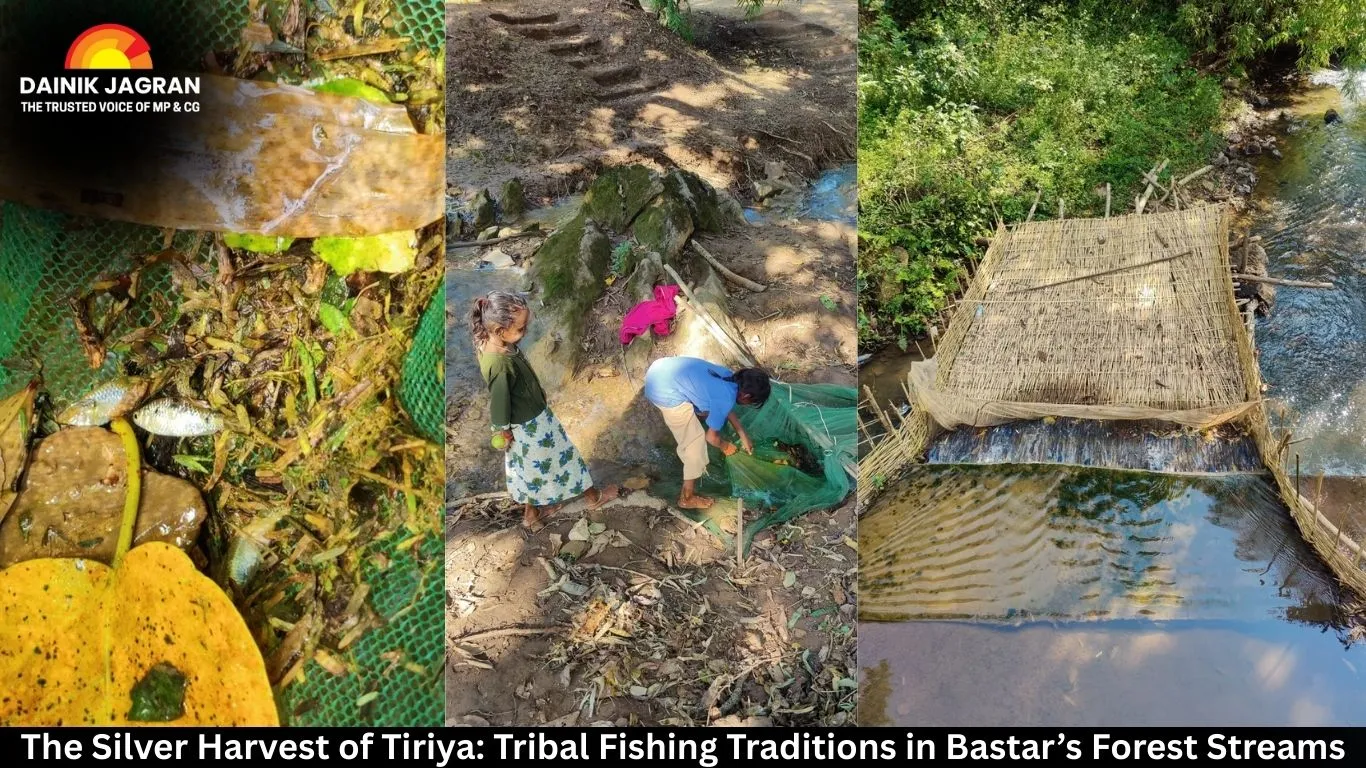
Tribal Fishing: In the heart of Bastar’s dense foliage, where the sunlight filters through the canopy in jagged gold streaks, the sound of gurgling water is often accompanied by the high-pitched laughter of children. Here in Tiriya, a small village tucked away in the tribal belt of Chhattisgarh, the arrival of water in the forest canals signals more than just a change in season—it marks the beginning of a cherished local tradition: the small-stream harvest.
A recent scene near a local canal connecting to a larger river artery perfectly encapsulates this rhythm of life. Two young children, barefoot and focused, stand knee-deep in a shallow stream. They aren’t just playing; they are participating in an ancient dance of survival and skill, using locally crafted bamboo structures and fine-mesh nets to catch the small to medium-sized fish that navigate these forest-fed waters.
The Art of the 'Jugaad' Net
The tools used by the tribal population of Tiriya are a masterclass in indigenous engineering. Unlike the heavy, industrial equipment found in coastal regions, the fishing gear here is light, sustainable, and crafted from the forest itself.
Bamboo Frameworks: Sturdy bamboo poles are used to create frames that hold the nets open against the current.
Precision Placement: The nets are strategically installed at "choke points" in the small canals where the water flow is most consistent.
The Wait: Once the net is set, it’s a game of patience. The children monitor the flow, waiting for the tell-tale shimmer of silver trapped in the green mesh.
For these children, the process is a blend of chore and cheer. While the task provides food for the family, it is viewed largely through the lens of "fun and pleasure." It is their version of an afternoon at the park—one that rewards them with a tangible prize.
From Forest Streams to Village Haats (Bastar Tribal Forest Culture)
The bounty of these canals is rarely wasted. The catch usually consists of small, hardy varieties of fish that thrive in the oxygen-rich waters flowing from the forest. The distribution of the catch follows a logical, community-centric pattern:
Immediate Consumption: A portion of the fresh catch is taken home for the evening meal, often prepared with local spices and served with rice.
The Local Market: Any surplus is carried to the local village market (Haat). These small-scale sales provide the children with a bit of pocket money or contribute to the household's modest income.
Preservation for the Lean Months: Perhaps most interestingly, the tribal families of Bastar are experts in food preservation. When the catch is plentiful, the fish are sun-dried on mats. These dried fish become a vital source of protein during the drier months when the forest streams cease to flow.
A Community Affair
While the children are often the most visible participants, fishing in Tiriya is a multi-generational activity. Adults are frequently involved, passing down the knowledge of where to place the nets and how to read the water's movement. It is a silent classroom where lessons on ecology, biology, and sustainability are taught without a single textbook.
This practice highlights the deep connection the tribal population maintains with their environment. They do not over-fish; they take what the stream offers, ensuring that the canal’s ecosystem remains balanced for the next season.
The Beauty of the Part-Time Pursuit
What makes this scene particularly poignant is its "part-time" nature. In a world increasingly defined by rigid careers and industrial labor, the residents of Tiriya maintain a lifestyle where "work" is often indistinguishable from "living." Fishing is not a grueling 9-to-5 job; it is a seasonal joy, a hobby that happens to put food on the table, and a way for the community to bond with the land.
As the sun begins to set over the Tiriya forest, the children pull up their nets, their faces glowing with the satisfaction of a successful catch. In their small, wet hands, they hold more than just fish - they hold a legacy of self-reliance and a reminder of a simpler, more grounded way of life.
- Google Scholar ID -
- https://scholar.google.com/citations?user=CNgtpi8AAAAJ&hl=en
Nishant Ghode,
PhD Scholar,
Shaheed Mahendra Karma Vishwavidyalaya, Jagdalpur, Chhattisgarh.




.jpg)




