


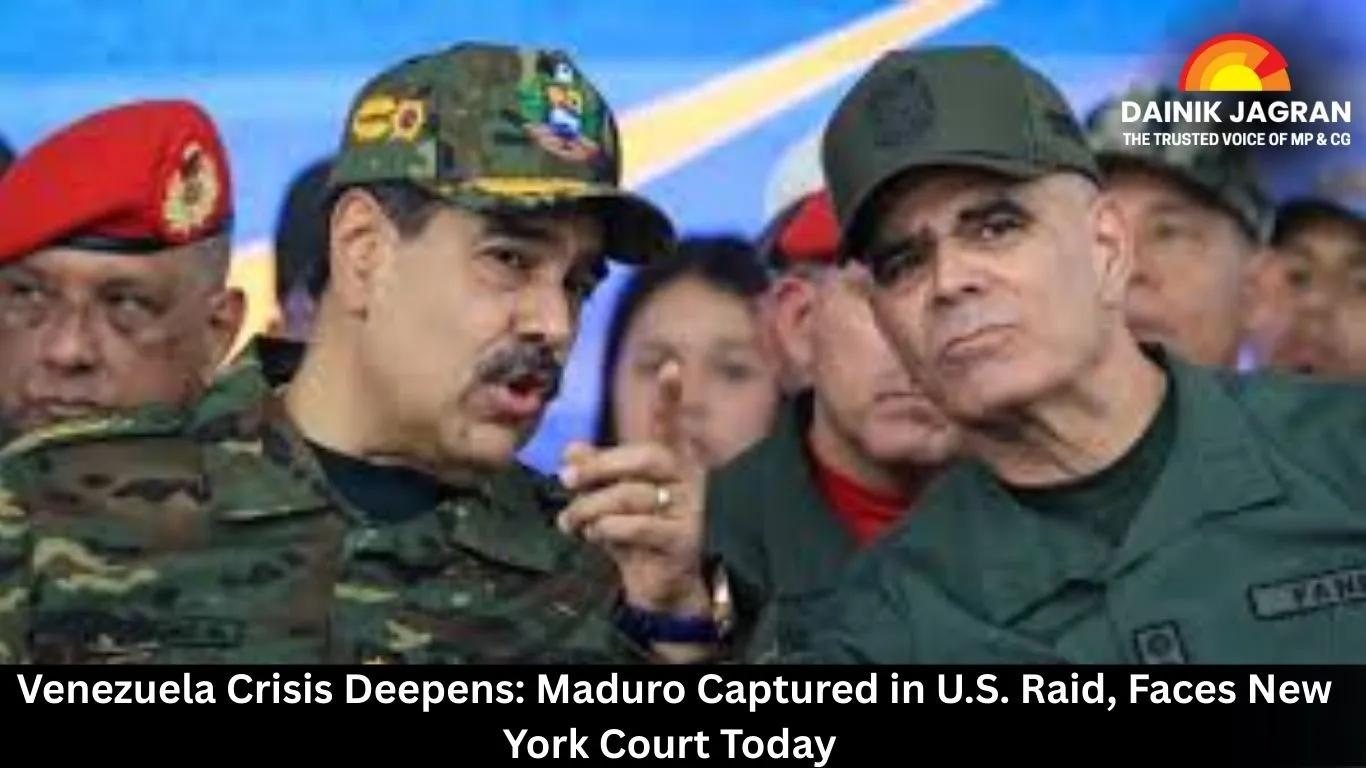
Venezuela Crisis Deepens: Maduro Captured in U.S. Raid, Faces New York Court Today
Digital Desk
The operation, codenamed "Absolute Resolve," involved over 150 U.S. aircraft and elite Delta Force troops who stormed Maduro's compound in Caracas. Maduro and his wife, Cilia Flores, were swiftly extracted and flown to New York, where they are scheduled to appear in federal court on January 5 to face narco-terrorism and drug trafficking charges. The bold strike has ignited a fierce debate over international law, sovereignty, and the United States' strategic interests in Venezuela's vast energy resources.
The Midnight Raid: Operation Absolute Resolve
The military action began just after 2 a.m. local time on January 3. U.S. forces, supported by a massive aerial armada including F-22 and F-35 fighter jets and B-1 bombers, first disabled Venezuelan air defenses and cut power to parts of the capital to shroud the operation in darkness. Helicopters from the elite 160th Special Operations Aviation Regiment then delivered Delta Force operators to Maduro's fortified safe house at Fuerte Tiuna, a key military base.
A Swift Capture: U.S. officials state that Maduro was apprehended as he attempted to seal himself inside a steel-reinforced safe room but failed to close the door in time. He and his wife were taken to the USS Iwo Jima before being transferred to the United States.
Claims of Casualties: The Venezuelan government reports that dozens were killed, including members of Maduro's security team and 32 Cuban military personnel. U.S. President Donald Trump confirmed only "few" American injuries and no U.S. fatalities.
The Oil Question: A Driving Factor Behind the Intervention?
President Trump has openly linked the intervention to Venezuela's energy wealth, stating that "we're going to be taking a tremendous amount of wealth from the ground". This fuels longstanding accusations that U.S. policy is designed to control the country's oil reserves, the largest proven in the world at over 300 billion barrels.
Hours after the capture, Trump announced that U.S. oil companies would move in to "fix the badly broken infrastructure" and "start making money for the country". Critics, including some U.S. lawmakers, argue the action serves corporate and oil interests more than it addresses drug trafficking.
International Outcry and Legal Challenges
The raid has been met with widespread international criticism, with key allies and adversaries alike calling it a violation of international law.
Global Condemnation: Russia labeled the act "armed aggression," while China demanded Maduro's immediate release. Key Latin American nations, including Brazil, Colombia, and Mexico, issued a joint statement rejecting the unilateral military action.
A "Dangerous Precedent": United Nations Secretary-General António Guterres expressed deep concern that the rules of international law were not respected, with a UN expert calling the invasion a potential "crime of aggression". The UN Security Council is set to hold urgent discussions on the crisis.
What Comes Next for Venezuela?
Within Venezuela, the political landscape is tense and uncertain. The Supreme Court, aligned with Maduro's socialist party, swiftly swore in Vice President Delcy Rodríguez as the interim president. Rodríguez has publicly denounced the capture as a "kidnapping" and called for Maduro's release, despite U.S. claims that she is cooperating privately.
President Trump has asserted that the U.S. will "run the country" to oversee a transition, though no clear blueprint for this temporary governance has been provided. The situation remains fluid, with the Venezuelan public deeply divided and the region bracing for further instability.
The Venezuela crisis has entered a perilous new chapter. As Maduro faces justice in a U.S. courtroom, the world watches to see whether this bold intervention will lead to a democratic transition or further entrench division and conflict in a nation already struggling under years of economic collapse and political turmoil. The repercussions for regional stability and international law are likely to be profound and long-lasting.




.jpg)




