


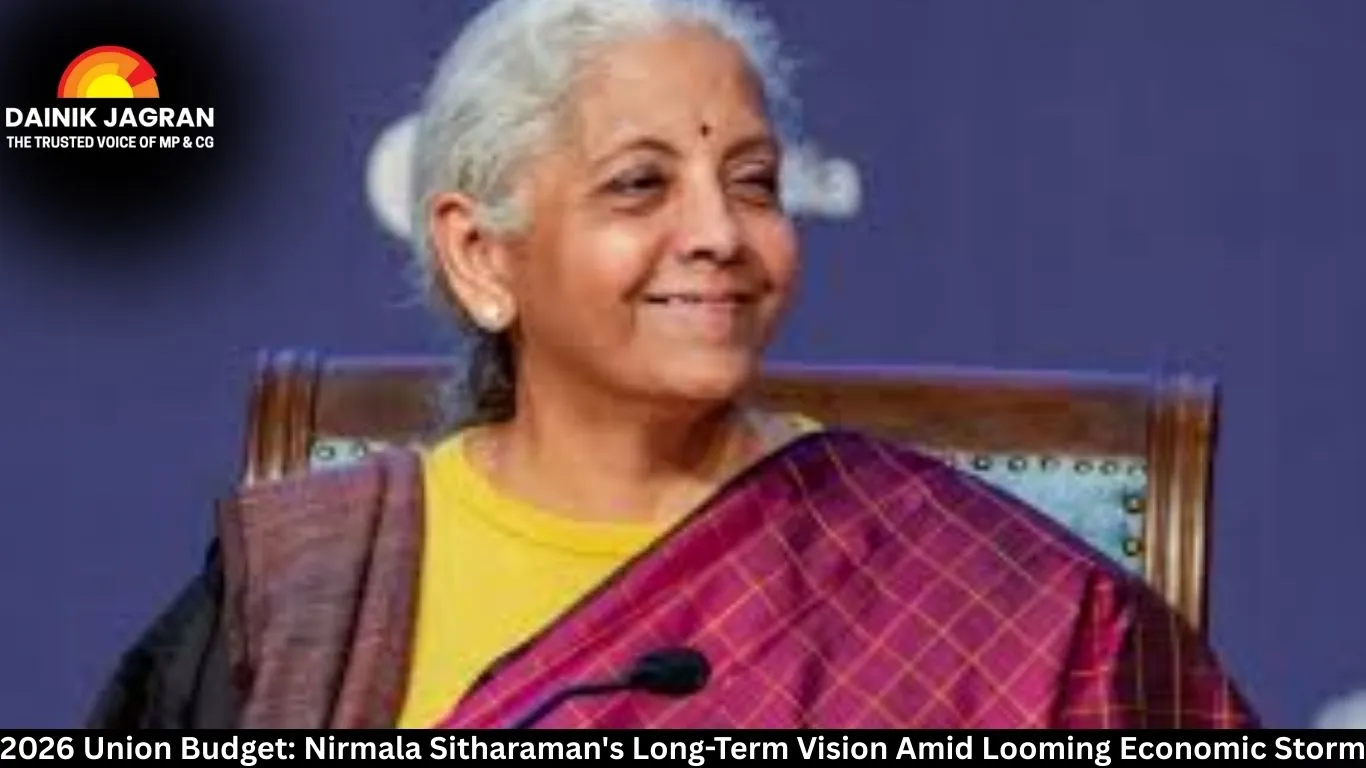
2026 Union Budget: Nirmala Sitharaman's Long-Term Vision Amid Looming Economic Storm
Digital Desk
In a year already shadowed by warnings of an impending economic storm, Finance Minister Nirmala Sitharaman presented her ninth consecutive Union Budget on February 1, 2026. Market reactions were swift and telling: the Sensex plunged over 1,500 points during her 83-minute speech, signaling investor unease. This 2026 Union Budget shifts focus from immediate relief to ambitious goals stretching to 2047, raising questions about its relevance for today's struggling economy.
Ignoring the Present Crisis
The Economic Survey had foreshadowed tough times ahead, yet the budget offers little concrete action for the upcoming financial year. Instead of addressing stagnant wages, weak consumption, and falling foreign investment, it emphasizes visionary plans. As one economist quipped in a post-budget analysis, "Dreaming of 2047 won't pay the bills in 2026." The lack of short-term strategies leaves the middle class and common businesses high and dry, with no tax relief or demand-boosting measures in sight.
Critics argue this reflects a government out of ideas, resorting to higher taxes like increased Securities Transaction Tax (STT) on derivatives—from 0.02% to 0.05% on futures and 0.1% to 0.15% on options. While officials claim it's to curb risky trading (where 93% of traders lost an average of ₹1.1 lakh last year), it feels like a revenue grab amid F&O frenzy, which hit $1 trillion in notional turnover in March 2024.
Long-Term Promises: Infrastructure and Self-Reliance
On the brighter side, the budget boosts capital expenditure to ₹12 lakh crore for FY 2027, up 11% from last year. Key announcements include seven high-speed passenger corridors, new freight lines like Dankuni to Surat, and rare earth corridors to challenge China's monopoly. Allocations for semiconductors (₹40,000 crore) and SMEs (₹10,000 crore) aim at self-reliance in manufacturing.
Healthcare gets a modest hike to ₹1.5 lakh crore, with customs duty waived on 17 cancer treatments. However, public health spending remains at 1.9% of GDP, below the 2.5% target. Experts like Dr. Anjali Rao, a public health analyst, warn: "This won't bridge the gap; families must still rely on private insurance for emergencies."
Tax Tweaks and Market Jitters
Changes like taxing secondary market Sovereign Gold Bonds and slashing TDS on overseas tourism from 20% to 2% offer minor relief. But retrospective taxation erodes trust, and fines for delayed audits (up to ₹1.5 lakh) add pressure. The market's volatility spike underscores broader concerns: without demand revival, private investment stalls.
Why It Matters Now
In a post-COVID world grappling with global slowdowns, this 2026 Union Budget matters because it sidesteps urgent fixes for a narrative of future glory. For readers, the takeaway is clear: Plan personally. Secure health and term insurance—starting at ₹400/month for crores in coverage—amid uncertain times. As Sitharaman envisions a developed India by 2047, citizens must navigate the economic storm themselves.
This budget feels like a surrender to short-term woes, prioritizing headlines over help. Will it deliver long-term growth? Only time—and execution—will tell.




.jpg)




