


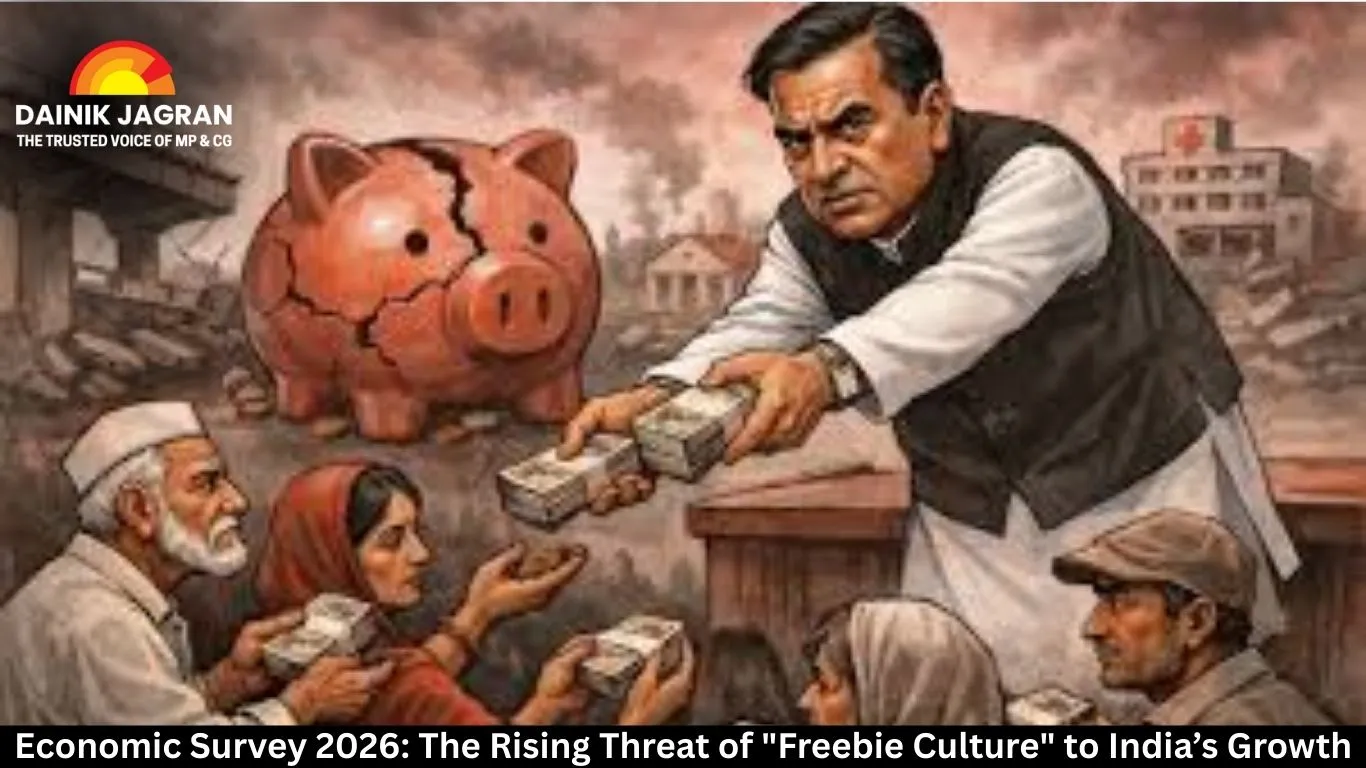
Economic Survey 2026: The Rising Threat of "Freebie Culture" to India’s Growth
Digital Desk
The latest Economic Survey 2026 has sounded a loud alarm regarding a growing trend in Indian politics: the rise of unconditional freebie culture. As states head into election cycles, the promise of direct cash transfers has moved from a welfare measure to a competitive "fashion statement" among political parties. While these schemes offer immediate relief to some, the survey warns they are becoming a significant barrier to India’s long-term development growth.
The Surge of Unconditional Cash Transfers
According to the Economic Survey 2026, there has been a dramatic shift toward "unconditional" cash transfers. Unlike schemes like MGNREGA or mid-day meals, which require work or school attendance, these new schemes hand out cash with no strings attached.
Whether it is monthly payments to women or guaranteed household income supports, the scale is staggering. In the current financial year (2025-26), approximately ₹1.7 trillion (1.7 lakh crore) has been distributed via these methods. Since 2022, the volume of these transfers has increased fivefold, with some states spending up to 8% of their total budget just on cash handouts.
Why the Economic Survey is Raising "Red Flags"
The survey highlights several critical areas where the freebie culture is damaging the nation’s economic fabric:
-
Fiscal Sustainability: The combined fiscal deficit of states has risen from 2.6% to 3.2% of GDP. More dangerously, "Revenue Deficit" has returned, meaning governments are borrowing money just to pay daily expenses and salaries, rather than building assets.
-
The Opportunity Cost: Every rupee spent on a cash handout is a rupee taken away from building schools, primary healthcare centers, or rural roads. The survey argues that "human capital" creates a multiplier effect, whereas cash consumption does not.
-
Labor Market Distortion: Large, unconditional transfers can discourage people from seeking low-wage work, leading to labor shortages and localized inflation.
-
Political "Race to the Bottom": Once one state introduces a massive cash scheme, neighbors feel political pressure to match or exceed it, creating a cycle that is nearly impossible to roll back.
Welfare vs. Growth: Finding the Balance
The Economic Survey 2026 does not suggest abandoning the poor. Instead, it advocates for a shift from "wellfare that replaces growth" to "wellfare that supports growth."
International examples provide a roadmap. Countries like Mexico and Brazil use conditional transfers, where cash is only given if children attend school or receive vaccinations. This ensures the money builds a better future for the next generation.
"We must focus on providing the 'fishing rod' (skills and education) rather than just the 'fish' (cash)." — Economic Survey Insight
Conclusion: A Warning for the Future
India is currently in a unique window of "demographic dividend" with a massive young population. If this capital is diverted into short-term consumption through direct cash transfers instead of skill development and infrastructure, the window of opportunity may close forever.
The message is clear: To reach our goal of a developed nation, we must prioritize productivity over populism.



.jpg)




