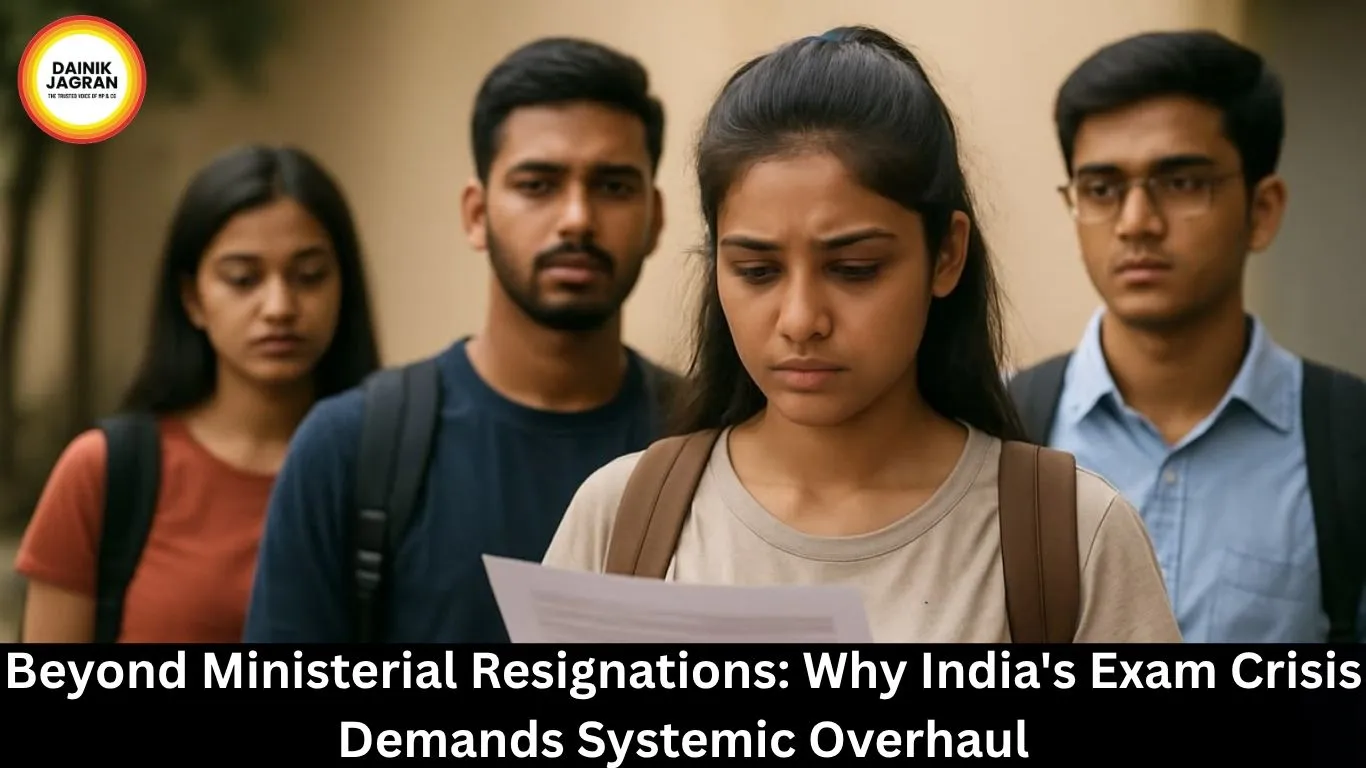
Beyond Ministerial Resignations: Why India's Exam Crisis Needs Structural Reform

Digital Desk

Beyond Ministerial Resignations: Why India's Exam Crisis Needs Structural Reform

India's recurring exam controversies highlight the need for systemic reforms beyond political accountability. An opinion on strengthening transparency, security and institutional integrity in examinations.

Every time a major examination in India is marred by allegations of paper leaks, technical failures or irregularities, the public response follows a familiar script. Students protest, political parties trade accusations, courts intervene, and demands for resignations dominate headlines. While accountability at the highest levels is essential, focusing solely on ministerial exits risks reducing a deep institutional crisis to a symbolic political gesture.

India's examination ecosystem has outgrown the systems designed to manage it. Millions of students compete every year for a limited number of seats and government jobs, making high-stakes examinations one of the most consequential public institutions in the country. Any breach of integrity not only affects careers but also weakens public confidence in governance itself.

The recurring nature of these controversies suggests that the problem is structural rather than individual. Over the past decade, different states and central agencies have faced allegations ranging from question paper leaks and impersonation to organised cheating networks and inadequate cybersecurity. The fact that such incidents continue under governments led by different political parties indicates that no single administration bears exclusive responsibility. The challenge lies in the design, oversight and implementation of the examination system.

One of the biggest concerns is the fragmented nature of exam administration. Recruitment agencies, education boards, universities and independent testing bodies often operate with varying standards of security, technology and accountability. While some institutions have adopted advanced digital monitoring and encrypted question paper systems, others continue to rely on outdated processes vulnerable to manipulation.

Technology alone, however, is not a silver bullet. Computer-based examinations can reduce certain risks but also introduce new vulnerabilities, including server failures, cyberattacks and data breaches. Digital reforms must therefore be accompanied by independent security audits, robust encryption protocols, disaster recovery systems and transparent incident reporting mechanisms.

Another persistent weakness is the lack of institutional accountability beyond immediate administrative action. Investigations frequently focus on identifying those directly involved in a leak, but rarely examine whether procedural failures, procurement decisions or oversight gaps contributed to the breach. Independent post-exam audits should become a standard practice after every major examination, particularly when irregularities are reported.

Transparency is equally important. Students often struggle to obtain timely information when examinations are postponed, cancelled or challenged in court. Uncertainty amplifies anxiety and fuels misinformation on social media. Exam authorities should establish clear communication protocols, provide real-time updates and publicly disclose the reasons behind major administrative decisions.

The human cost of repeated examination failures cannot be ignored. Aspirants invest years preparing for competitive examinations, often under significant financial and emotional pressure. Many relocate, leave jobs or spend substantial amounts on coaching. When an examination is cancelled because of systemic failures, the burden falls disproportionately on candidates who had no role in the irregularities.

The solution also lies in reducing excessive dependence on single, high-stakes examinations wherever feasible. Multi-stage assessments, continuous evaluation, skill-based testing and greater institutional autonomy in admissions and recruitment can distribute risk more effectively. Diversifying evaluation methods may not eliminate malpractice entirely, but it can reduce the catastrophic impact of a single compromised examination.

Legal reforms deserve equal attention. While several states have enacted stringent anti-cheating laws, effective enforcement remains inconsistent. Fast-track investigations, coordinated action against organised cheating syndicates and stronger inter-state intelligence sharing could improve deterrence. At the same time, safeguards must ensure that innocent candidates are not unfairly penalised due to administrative failures.

Ultimately, restoring trust requires more than political accountability. Ministerial resignations may satisfy immediate public anger, but they cannot substitute for comprehensive institutional reform. Citizens expect governments not only to assign responsibility after a crisis but also to build systems capable of preventing its recurrence.

India's demographic dividend depends heavily on the credibility of its education and recruitment processes. A transparent, secure and accountable examination system is not merely an administrative necessity—it is a cornerstone of social mobility, public trust and democratic fairness. The real measure of success will not be how quickly governments respond to the next controversy, but whether they can build institutions resilient enough to prevent it.

 

--------

🚨 Beat the News Rush – Join Now!

Get breaking alerts, hot exclusives, and game-changing stories instantly on your phone. No delays, no fluff – just the edge you need. ⚡

Tap to join: 

🟢 WhatsApp Channel: Dainik Jagran MP CG

Crave more?

🅕 Facebook: Dainik Jagran MP CG English

🅧 Twitter (X): Dainik Jagran MP CG

🅘 Instagram: Dainik Jagran MP CG

Share the fire – keep your crew ahead! 🗞️🔥

english.dainikjagranmpcg.com
26 Jul 2026 By Abhishek Joshi

Beyond Ministerial Resignations: Why India's Exam Crisis Needs Structural Reform

Digital Desk

Every time a major examination in India is marred by allegations of paper leaks, technical failures or irregularities, the public response follows a familiar script. Students protest, political parties trade accusations, courts intervene, and demands for resignations dominate headlines. While accountability at the highest levels is essential, focusing solely on ministerial exits risks reducing a deep institutional crisis to a symbolic political gesture.

India's examination ecosystem has outgrown the systems designed to manage it. Millions of students compete every year for a limited number of seats and government jobs, making high-stakes examinations one of the most consequential public institutions in the country. Any breach of integrity not only affects careers but also weakens public confidence in governance itself.

The recurring nature of these controversies suggests that the problem is structural rather than individual. Over the past decade, different states and central agencies have faced allegations ranging from question paper leaks and impersonation to organised cheating networks and inadequate cybersecurity. The fact that such incidents continue under governments led by different political parties indicates that no single administration bears exclusive responsibility. The challenge lies in the design, oversight and implementation of the examination system.

One of the biggest concerns is the fragmented nature of exam administration. Recruitment agencies, education boards, universities and independent testing bodies often operate with varying standards of security, technology and accountability. While some institutions have adopted advanced digital monitoring and encrypted question paper systems, others continue to rely on outdated processes vulnerable to manipulation.

Technology alone, however, is not a silver bullet. Computer-based examinations can reduce certain risks but also introduce new vulnerabilities, including server failures, cyberattacks and data breaches. Digital reforms must therefore be accompanied by independent security audits, robust encryption protocols, disaster recovery systems and transparent incident reporting mechanisms.

Another persistent weakness is the lack of institutional accountability beyond immediate administrative action. Investigations frequently focus on identifying those directly involved in a leak, but rarely examine whether procedural failures, procurement decisions or oversight gaps contributed to the breach. Independent post-exam audits should become a standard practice after every major examination, particularly when irregularities are reported.

Transparency is equally important. Students often struggle to obtain timely information when examinations are postponed, cancelled or challenged in court. Uncertainty amplifies anxiety and fuels misinformation on social media. Exam authorities should establish clear communication protocols, provide real-time updates and publicly disclose the reasons behind major administrative decisions.

The human cost of repeated examination failures cannot be ignored. Aspirants invest years preparing for competitive examinations, often under significant financial and emotional pressure. Many relocate, leave jobs or spend substantial amounts on coaching. When an examination is cancelled because of systemic failures, the burden falls disproportionately on candidates who had no role in the irregularities.

The solution also lies in reducing excessive dependence on single, high-stakes examinations wherever feasible. Multi-stage assessments, continuous evaluation, skill-based testing and greater institutional autonomy in admissions and recruitment can distribute risk more effectively. Diversifying evaluation methods may not eliminate malpractice entirely, but it can reduce the catastrophic impact of a single compromised examination.

Legal reforms deserve equal attention. While several states have enacted stringent anti-cheating laws, effective enforcement remains inconsistent. Fast-track investigations, coordinated action against organised cheating syndicates and stronger inter-state intelligence sharing could improve deterrence. At the same time, safeguards must ensure that innocent candidates are not unfairly penalised due to administrative failures.

Ultimately, restoring trust requires more than political accountability. Ministerial resignations may satisfy immediate public anger, but they cannot substitute for comprehensive institutional reform. Citizens expect governments not only to assign responsibility after a crisis but also to build systems capable of preventing its recurrence.

India's demographic dividend depends heavily on the credibility of its education and recruitment processes. A transparent, secure and accountable examination system is not merely an administrative necessity—it is a cornerstone of social mobility, public trust and democratic fairness. The real measure of success will not be how quickly governments respond to the next controversy, but whether they can build institutions resilient enough to prevent it.


https://english.dainikjagranmpcg.com/opinion/beyond-ministerial-resignations-why-indias-exam-crisis-needs-structural-reform/article-23597

Trending News