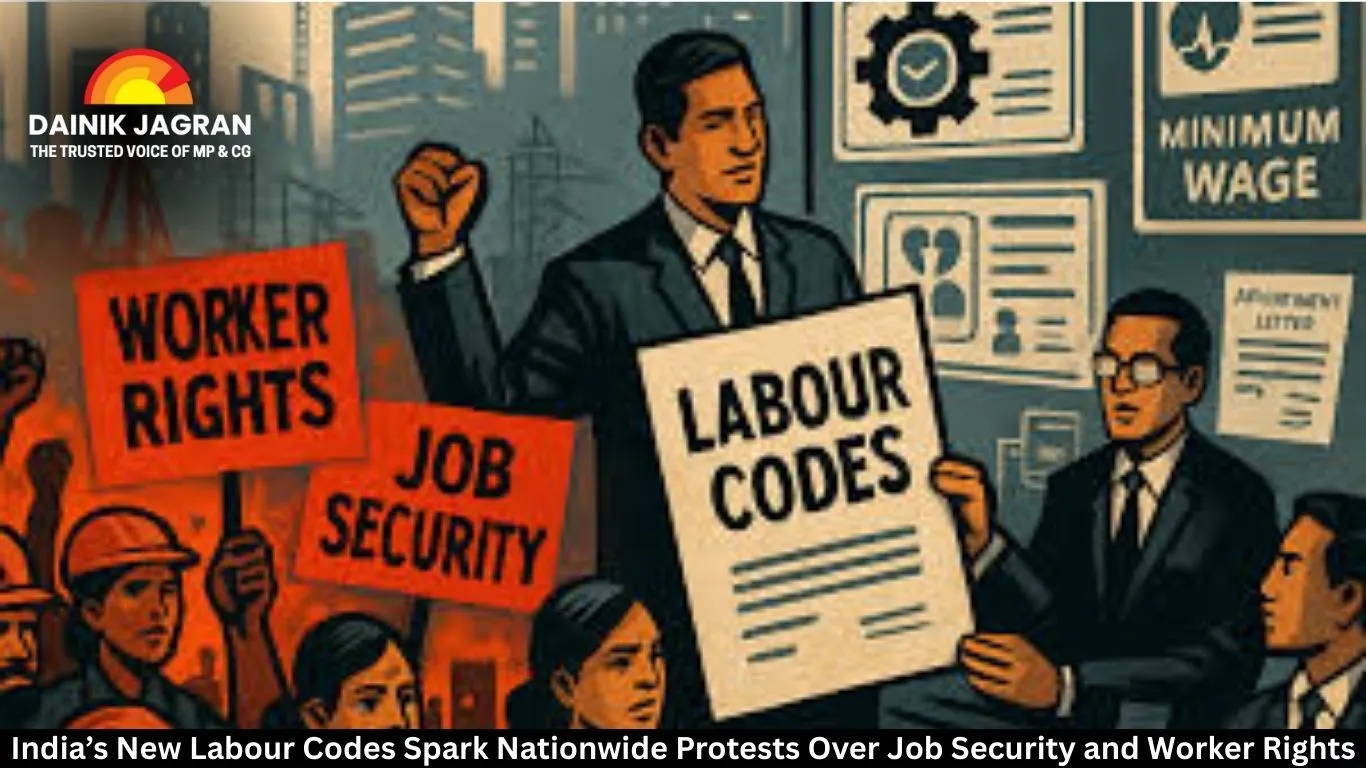
India’s New Labour Codes Spark Nationwide Protests Over Job Security and Worker Rights
Digital Desk
India is witnessing widespread protests against newly introduced labour codes by the central government, with trade unions and workers across many states raising serious concerns about job security and workers' rights.
The government consolidated 29 old labour laws into four new codes aimed at simplifying regulations for both businesses and workers. However, critics call the reforms a "new document of slavery" due to key changes that they argue threaten workers' protections and rights .
One of the biggest points of contention is the increase in the threshold for government permission for layoffs and company closures from 100 to 300 workers.
This change allows employers with fewer than 300 employees to lay off staff without prior government approval, alarming trade unions who call it an "open license for hire and fire." Workers fear this will severely undermine job security across industries .
Another major issue is the privatization concerns in the electricity distribution sector. The new labour codes are linked with government moves to increase private players' involvement in power distribution.
Electricity sector engineers and workers have joined the protests, fearing privatization will lead to job losses and reduced wages. The unions demand stopping privatization to protect workers' livelihoods .
The new industrial relations code also introduces restrictions on strikes. Workers now need to give a 14-day notice before striking, and if 50% or more employees are absent on a day, it will be considered a strike.
Trade unions argue this makes it practically impossible for workers to protest effectively, curbing their fundamental right to strike .
Supporters of the reforms argue that Indian companies stay small to avoid stricter regulations and that loosening these laws could encourage growth and job creation.
Experts also say increased basic salary requirements under the new provident fund rules will strengthen workers' retirement benefits, although many workers worry about the immediate impact on take-home pay .
The protests are ongoing across states like Kerala, Odisha, Tamil Nadu, West Bengal, Delhi, Bihar, and Assam, reflecting deep divides over India's labour reform path.
Workers and trade unions demand the repeal of the new labour codes, removal of the 300-worker layoff limit, a halt to privatization, and easier strike rights to protect their future and livelihoods .
This widespread labour unrest highlights the complex balance between economic reforms aimed at business facilitation and protecting workers’ social security and rights in India’s evolving labour landscape .