


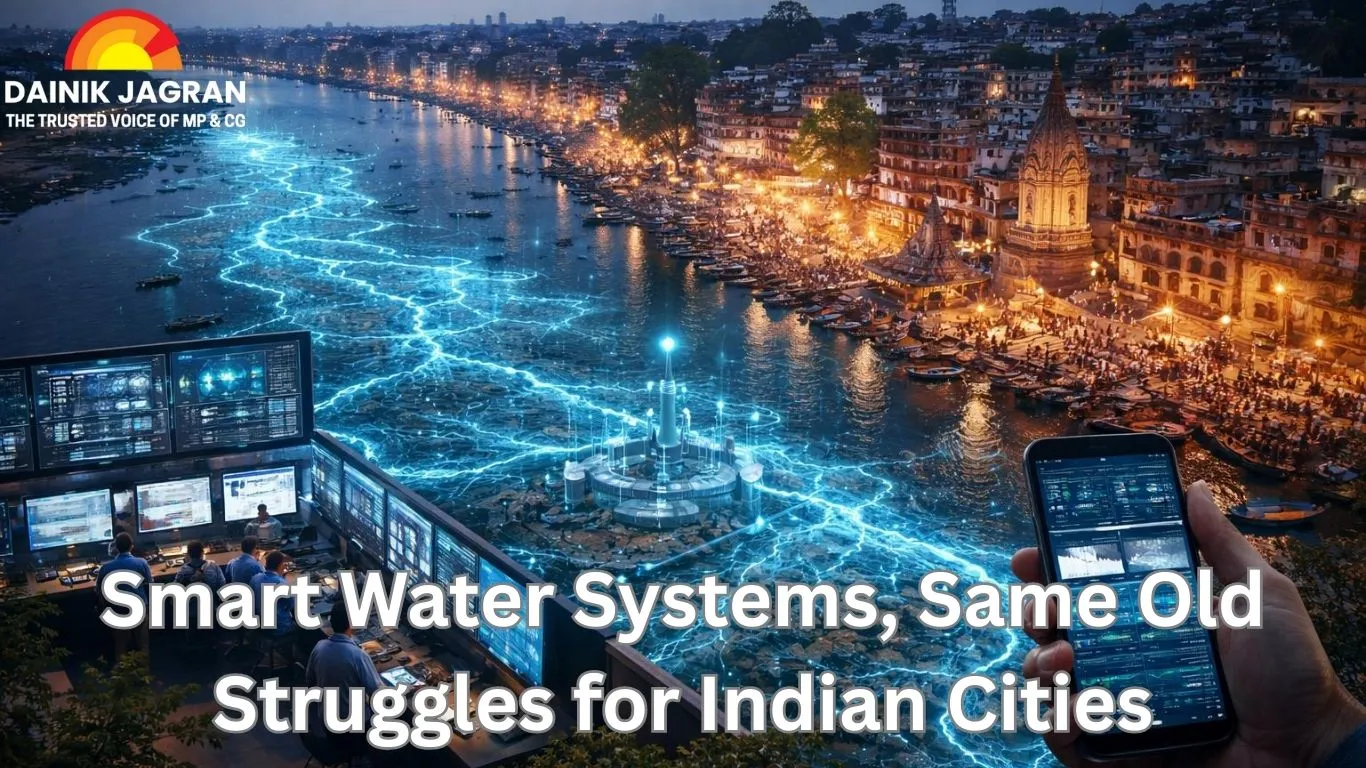
India’s water systems are getting smarter, but residents still feel the strain
Abhishek Joshi
Water supply is still irregular, quality concerns trigger confusion, and billing disputes often drag on without clear answers.
Experts say the issue is not the lack of technology, but how it is being used.
“Most systems today are good at showing information, but not at guiding decisions,” says Ayush Singh, a civil and environmental engineer whose research focuses on digital technologies for water infrastructure. Utilities, he explains, can see what is happening, but struggle to predict problems early or decide the best intervention in advance.
In many cities, digital water projects rely on dashboards that display pressure, flow, or pump status. While useful, these tools largely stop at monitoring. They alert operators after something goes wrong, rather than helping prevent failures in the first place.
This is where digital twins come in. A digital twin is essentially a live computer model of a real water network. It brings together sensor data, pipeline maps, pumping information, and past maintenance records into one system. Instead of only showing current conditions, it helps simulate future scenarios and understand why problems occur.
For residents, this difference can be meaningful. When water pressure drops in a neighbourhood, a dashboard may only show the drop. A digital twin can help operators understand whether the cause is a weakening pipe, an inefficient pump, or rising demand elsewhere. That insight allows action before supply disruptions turn into complaints.
Some Indian cities are beginning to explore this approach. In Pune, government-supported research initiatives are working on adaptive digital twin frameworks for urban water systems, combining real-time data with predictive models. The aim is to move beyond basic monitoring toward systems that can anticipate leaks, manage pressure more efficiently, and reduce water losses.
Varanasi offers another glimpse of what is coming. Under its smart city programme, the city has developed a detailed 3D digital model to support urban planning and infrastructure decisions. While not limited to water systems, it shows how virtual city models are increasingly being used to understand complex networks and test decisions before implementing them on the ground.
Singh notes that the biggest gains come when digital twins are used for maintenance planning. Traditional maintenance is often reactive, with repairs happening after pipes burst or pumps fail. Digital twin-based systems allow utilities to assess the health of assets and plan repairs based on actual risk, rather than fixed schedules. This approach, his research shows, can reduce emergency breakdowns, save energy, and extend the life of infrastructure.
There are challenges, especially for Indian cities. Data is often scattered across multiple departments, technical capacity varies, and public trust remains a concern. Singh’s work highlights the need for transparency and community involvement, warning that digital systems introduced without clear governance can deepen mistrust rather than improve services.
For this reason, Singh argues that cities should adopt digital twins gradually. Starting with one zone or problem area, connecting existing data systems, and building predictive capability step by step can deliver real benefits without overwhelming utilities.
As India invests in the next phase of urban infrastructure, the success of smart water projects may depend less on how many sensors are installed and more on whether cities adopt systems that can think ahead. For citizens, the measure of progress will remain simple. Water that arrives when expected, is safe to use, and is easier to trust.
Singh’s perspective is shaped by a mix of training and real-world exposure. A Carnegie Mellon University graduate, he also holds a master’s-level qualification in construction management, which helps explain why he tends to connect technology with delivery realities. He has worked with US-based utility programmes, including multiple Lead Service Line Replacement projects completed over recent cycles. That experience, along with his research on digital twins and AI in water systems, informs his view that “smart water” needs to move beyond dashboards and start helping utilities take decisions earlier and with more confidence.
..........................................................................................................................................




.jpg)




