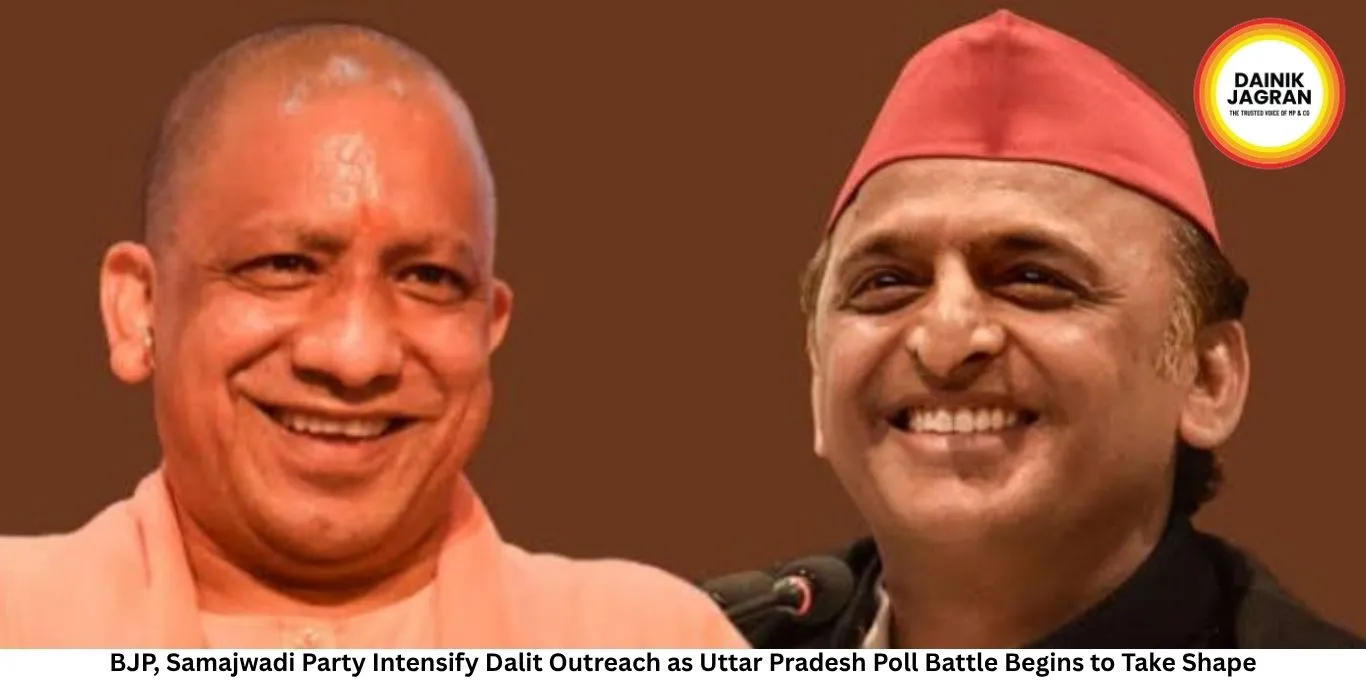
BJP, Samajwadi Party Intensify Dalit Outreach as Uttar Pradesh Poll Battle Begins to Take Shape

Digital desk

BJP, Samajwadi Party Intensify Dalit Outreach as Uttar Pradesh Poll Battle Begins to Take Shape

Lucknow: With the 2027 Uttar Pradesh Assembly election still months away, the battle for the state's crucial Dalit vote bank has already emerged as one of the defining political contests between the Bharatiya Janata Party (BJP) and the Samajwadi Party (SP).

Both parties have begun sharpening their social outreach strategies, signalling that Dalit voters could play a decisive role in determining the electoral outcome in India's most politically significant state. Political observers believe the contest is no longer limited to traditional caste equations, as every major party is attempting to expand its social base ahead of the election.

The BJP is focusing on consolidating its support among Dalits alongside non-Yadav Other Backward Classes (OBCs), a strategy that has contributed to its electoral success in recent years. The party has also undertaken organisational changes in Uttar Pradesh aimed at balancing caste representation within its leadership structure before the election campaign gathers momentum.

On the other hand, the Samajwadi Party is attempting to strengthen its PDA (Pichhda, Dalit, Alpsankhyak) strategy under party chief Akhilesh Yadav. As part of that effort, the SP is planning to field a significantly higher number of Dalit candidates in the 2027 Assembly election, including candidates in several general constituencies, in an effort to broaden its support beyond its traditional Muslim-Yadav voter base.

Political analysts say the contest has become more competitive because the Bahujan Samaj Party (BSP), which has historically been the principal political force representing Dalit voters in Uttar Pradesh, is facing renewed challenges in retaining its traditional support base. This has encouraged rival parties to step up their outreach to Scheduled Caste communities through organisational changes, public campaigns and candidate selection strategies.

The BJP continues to project governance, welfare schemes and representation of marginalised communities as central themes of its campaign, while the Samajwadi Party is seeking to build a broader social coalition through its PDA narrative. The differing approaches highlight how both parties are attempting to appeal to voters whose support could influence dozens of Assembly constituencies across the state.

Dalit voters account for a substantial share of Uttar Pradesh's electorate and have traditionally played a decisive role in state elections. Their voting pattern has undergone notable changes over the past decade, making them one of the most closely watched electoral groups as political parties recalibrate their strategies.

The Congress has also stepped up its efforts by appointing Dalit leader Rajendra Pal Gautam as its Uttar Pradesh in-charge, while reaffirming support for the PDA political framework in coordination with its alliance strategy. The move reflects the wider competition among political parties to increase their presence among Dalit communities ahead of the election.

Although formal campaigning is yet to begin, organisational restructuring, candidate planning and community outreach programmes indicate that preparations are already well underway.

With the Assembly election expected next year, political observers believe the fight for Dalit votes will remain one of the most significant factors shaping Uttar Pradesh's electoral landscape. As parties continue refining their caste and social equations, the coming months are likely to witness intensified grassroots mobilisation across the state.

--------

🚨 Beat the News Rush – Join Now!

Get breaking alerts, hot exclusives, and game-changing stories instantly on your phone. No delays, no fluff – just the edge you need. ⚡

Tap to join: 

🟢 WhatsApp Channel: Dainik Jagran MP CG

Crave more?

🅕 Facebook: Dainik Jagran MP CG English

🅧 Twitter (X): Dainik Jagran MP CG

🅘 Instagram: Dainik Jagran MP CG

Share the fire – keep your crew ahead! 🗞️🔥

english.dainikjagranmpcg.com
18 Jul 2026 By Priyanshu.Jha

BJP, Samajwadi Party Intensify Dalit Outreach as Uttar Pradesh Poll Battle Begins to Take Shape

Digital desk

Both parties have begun sharpening their social outreach strategies, signalling that Dalit voters could play a decisive role in determining the electoral outcome in India's most politically significant state. Political observers believe the contest is no longer limited to traditional caste equations, as every major party is attempting to expand its social base ahead of the election.

The BJP is focusing on consolidating its support among Dalits alongside non-Yadav Other Backward Classes (OBCs), a strategy that has contributed to its electoral success in recent years. The party has also undertaken organisational changes in Uttar Pradesh aimed at balancing caste representation within its leadership structure before the election campaign gathers momentum.

On the other hand, the Samajwadi Party is attempting to strengthen its PDA (Pichhda, Dalit, Alpsankhyak) strategy under party chief Akhilesh Yadav. As part of that effort, the SP is planning to field a significantly higher number of Dalit candidates in the 2027 Assembly election, including candidates in several general constituencies, in an effort to broaden its support beyond its traditional Muslim-Yadav voter base.

Political analysts say the contest has become more competitive because the Bahujan Samaj Party (BSP), which has historically been the principal political force representing Dalit voters in Uttar Pradesh, is facing renewed challenges in retaining its traditional support base. This has encouraged rival parties to step up their outreach to Scheduled Caste communities through organisational changes, public campaigns and candidate selection strategies.

The BJP continues to project governance, welfare schemes and representation of marginalised communities as central themes of its campaign, while the Samajwadi Party is seeking to build a broader social coalition through its PDA narrative. The differing approaches highlight how both parties are attempting to appeal to voters whose support could influence dozens of Assembly constituencies across the state.

Dalit voters account for a substantial share of Uttar Pradesh's electorate and have traditionally played a decisive role in state elections. Their voting pattern has undergone notable changes over the past decade, making them one of the most closely watched electoral groups as political parties recalibrate their strategies.

The Congress has also stepped up its efforts by appointing Dalit leader Rajendra Pal Gautam as its Uttar Pradesh in-charge, while reaffirming support for the PDA political framework in coordination with its alliance strategy. The move reflects the wider competition among political parties to increase their presence among Dalit communities ahead of the election.

Although formal campaigning is yet to begin, organisational restructuring, candidate planning and community outreach programmes indicate that preparations are already well underway.

With the Assembly election expected next year, political observers believe the fight for Dalit votes will remain one of the most significant factors shaping Uttar Pradesh's electoral landscape. As parties continue refining their caste and social equations, the coming months are likely to witness intensified grassroots mobilisation across the state.

https://english.dainikjagranmpcg.com/politics/bjp-samajwadi-party-intensify-dalit-outreach-as-uttar-pradesh-poll/article-22748

Trending News