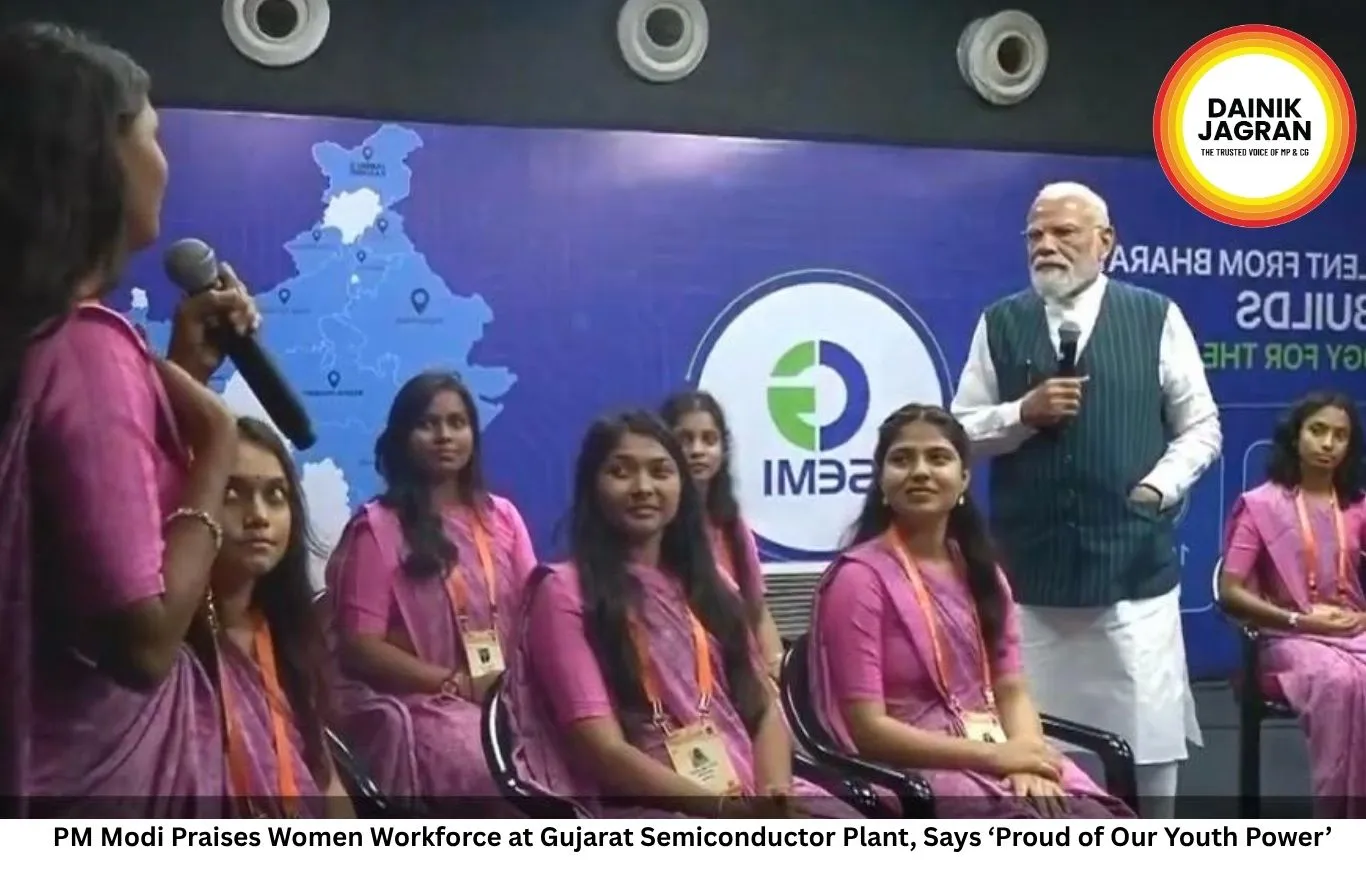
PM Modi Praises Women Workforce at Gujarat Semiconductor Plant, Says ‘Proud of Our Youth Power’
Digital desk
Prime Minister Narendra Modi on Sunday highlighted the growing role of young workers, particularly women from remote and tribal regions, in India’s emerging semiconductor industry. His remarks came a day after inaugurating the CG Semi Outsourced Semiconductor Assembly and Test (OSAT) facility in Sanand, Gujarat.
Sharing his experience on social media platform X, the Prime Minister described his interaction with employees at the newly inaugurated semiconductor unit as one of the most memorable moments of his visit. He noted that a significant portion of the workforce comprises women from distant parts of the country, including several from tribal communities, who have undergone specialised training to work in semiconductor manufacturing.
In his post, Modi said the determination shown by these young professionals reflects the aspirations of a new India. He emphasized that many of the employees had travelled far from their hometowns and embraced advanced technical training to become part of a sector considered critical to the country’s technological future.
According to the Prime Minister, these workers are contributing directly to India’s semiconductor ambitions and strengthening the country’s efforts to build a globally competitive electronics manufacturing ecosystem. He concluded the message by expressing pride in India’s youth and their ability to adapt to emerging technologies.
The comments followed a series of interactions with employees at the Sanand facility, where Modi spoke with workers about their educational journeys, professional training and experiences in the semiconductor sector.
During one such interaction, a young woman employee told the Prime Minister that social attitudes in her village had begun to change after she secured a position at the plant. She explained that families in her area traditionally hesitated to send daughters away for higher education or employment. However, her experience had encouraged greater acceptance of educational and career opportunities for young women.
The employee said people in her village were now curious about her work and frequently asked about the semiconductor industry. She added that many young women had expressed interest in pursuing similar opportunities after seeing her progress.
Another employee from Jammu and Kashmir’s Kathua district shared his experience of relocating to Gujarat for work. Modi asked him whether it was his first visit to the state and discussed the contrast in climate between the two regions. The interaction reflected the increasingly national character of India’s semiconductor workforce, with employees coming from diverse geographical backgrounds.
A woman employee from Jharkhand’s Giridih district also spoke about her journey. After completing her schooling at a Kasturba Gandhi Balika Vidyalaya and pursuing studies at an Industrial Training Institute (ITI), she was selected to work at the facility. She told the Prime Minister that the job had provided opportunities she had never imagined, including international exposure.
When Modi asked whether vocational education is often underestimated, the employee acknowledged that many people initially doubted her prospects. She said perceptions changed after she secured employment in the semiconductor sector and began building a professional career.
The Sanand facility, which has now commenced commercial production, has been established with an investment of approximately ₹7,500 crore. It is the third semiconductor manufacturing unit to begin production under the Government of India’s India Semiconductor Mission.
Officials said the plant will focus on semiconductor chip packaging and testing for sectors such as automobiles, industrial applications and consumer electronics. The facility is expected to play an important role in strengthening domestic manufacturing capabilities and reducing dependence on imported semiconductor components.
Addressing the inauguration event on Saturday, Modi said the confidence displayed by the workforce left a strong impression on him. He reiterated that India aims to develop a complete semiconductor ecosystem covering chip design, fabrication, packaging and testing.
The project is being viewed as part of a broader national strategy to expand advanced electronics manufacturing and position India as a significant player in the global semiconductor supply chain.

--------
🚨 Beat the News Rush – Join Now!
Get breaking alerts, hot exclusives, and game-changing stories instantly on your phone. No delays, no fluff – just the edge you need. ⚡
Tap to join:
🟢 WhatsApp Channel: Dainik Jagran MP CG
Crave more?
🅕 Facebook: Dainik Jagran MP CG English
🅧 Twitter (X): Dainik Jagran MP CG
🅘 Instagram: Dainik Jagran MP CG
Share the fire – keep your crew ahead! 🗞️🔥
PM Modi Praises Women Workforce at Gujarat Semiconductor Plant, Says ‘Proud of Our Youth Power’
Digital desk
Sharing his experience on social media platform X, the Prime Minister described his interaction with employees at the newly inaugurated semiconductor unit as one of the most memorable moments of his visit. He noted that a significant portion of the workforce comprises women from distant parts of the country, including several from tribal communities, who have undergone specialised training to work in semiconductor manufacturing.
In his post, Modi said the determination shown by these young professionals reflects the aspirations of a new India. He emphasized that many of the employees had travelled far from their hometowns and embraced advanced technical training to become part of a sector considered critical to the country’s technological future.
According to the Prime Minister, these workers are contributing directly to India’s semiconductor ambitions and strengthening the country’s efforts to build a globally competitive electronics manufacturing ecosystem. He concluded the message by expressing pride in India’s youth and their ability to adapt to emerging technologies.
The comments followed a series of interactions with employees at the Sanand facility, where Modi spoke with workers about their educational journeys, professional training and experiences in the semiconductor sector.
During one such interaction, a young woman employee told the Prime Minister that social attitudes in her village had begun to change after she secured a position at the plant. She explained that families in her area traditionally hesitated to send daughters away for higher education or employment. However, her experience had encouraged greater acceptance of educational and career opportunities for young women.
The employee said people in her village were now curious about her work and frequently asked about the semiconductor industry. She added that many young women had expressed interest in pursuing similar opportunities after seeing her progress.
Another employee from Jammu and Kashmir’s Kathua district shared his experience of relocating to Gujarat for work. Modi asked him whether it was his first visit to the state and discussed the contrast in climate between the two regions. The interaction reflected the increasingly national character of India’s semiconductor workforce, with employees coming from diverse geographical backgrounds.
A woman employee from Jharkhand’s Giridih district also spoke about her journey. After completing her schooling at a Kasturba Gandhi Balika Vidyalaya and pursuing studies at an Industrial Training Institute (ITI), she was selected to work at the facility. She told the Prime Minister that the job had provided opportunities she had never imagined, including international exposure.
When Modi asked whether vocational education is often underestimated, the employee acknowledged that many people initially doubted her prospects. She said perceptions changed after she secured employment in the semiconductor sector and began building a professional career.
The Sanand facility, which has now commenced commercial production, has been established with an investment of approximately ₹7,500 crore. It is the third semiconductor manufacturing unit to begin production under the Government of India’s India Semiconductor Mission.
Officials said the plant will focus on semiconductor chip packaging and testing for sectors such as automobiles, industrial applications and consumer electronics. The facility is expected to play an important role in strengthening domestic manufacturing capabilities and reducing dependence on imported semiconductor components.
Addressing the inauguration event on Saturday, Modi said the confidence displayed by the workforce left a strong impression on him. He reiterated that India aims to develop a complete semiconductor ecosystem covering chip design, fabrication, packaging and testing.
The project is being viewed as part of a broader national strategy to expand advanced electronics manufacturing and position India as a significant player in the global semiconductor supply chain.