


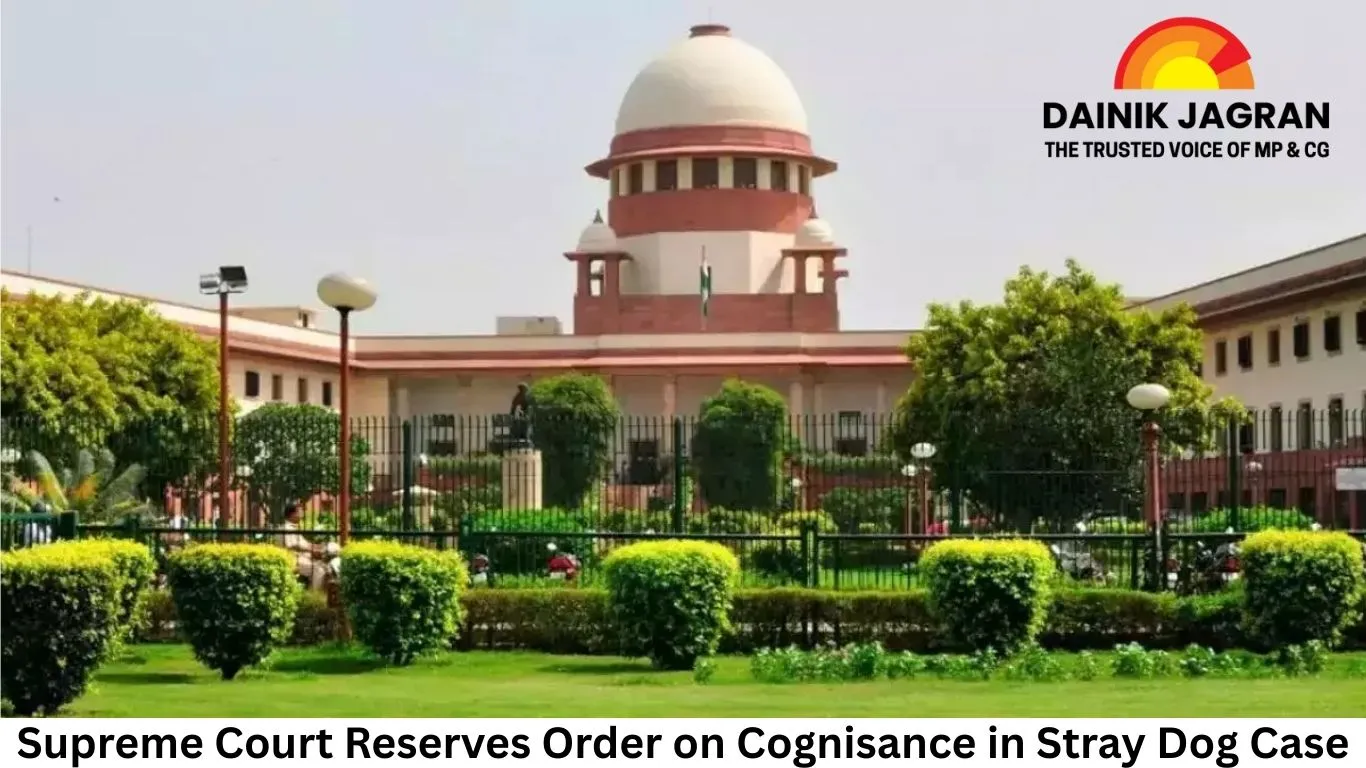
Supreme Court Reserves Order on Cognisance in Stray Dog Case, Seeks Written Submissions Within a Week
Digital Desk
The court’s decision comes after extensive hearings involving a wide range of parties, including representatives of state governments, the Centre, animal welfare organisations, dog feeders, and victims of stray dog attacks. The case has gained urgency amid rising incidents of dog bites and deaths reported across several states.
During the hearing, the bench examined submissions on public safety concerns, implementation of animal birth control (ABC) programmes, and compliance with earlier court directions on sterilisation and vaccination of stray dogs. After concluding oral arguments, the court asked all parties to submit detailed written submissions within seven days to assist in its final decision.
Earlier this week, the Supreme Court expressed strong displeasure over what it described as the failure of states to effectively implement its directions on stray dog management. Taking a stern view, the bench remarked that several state governments were “building castles in the air” by filing reports without ensuring actual work on the ground.
The court noted that while many states had claimed progress in sterilisation and vaccination drives, the reality did not match the paperwork submitted. “You are only talking, not doing,” the bench observed, pointing to the lack of measurable outcomes despite repeated judicial directions.
The judges also recalled previous orders that placed responsibility on local authorities and state governments to scale up sterilisation efforts, maintain accurate data on stray dog populations, and ensure coordination between civic bodies and animal welfare organisations. The court has repeatedly underlined that ad hoc measures or selective enforcement cannot address the problem.
The issue has triggered sharp debate between animal rights groups and residents affected by stray dog attacks. While animal welfare activists have stressed humane treatment and adherence to the Animal Birth Control Rules, victims and civic groups have raised concerns over safety, particularly of children and elderly citizens.
In past hearings, the Supreme Court has also clarified that dog feeders may be held accountable if their actions directly contribute to attacks, while emphasising that cruelty towards animals is impermissible under law. The bench has attempted to strike a balance between public safety and animal welfare, insisting that both concerns must be addressed simultaneously.
The reserved order is expected to determine the scope of the court’s intervention and the next course of action, including possible directions to states for stricter compliance. With multiple incidents of violence involving stray dogs reported in recent months, the ruling is likely to have significant implications for urban governance, public safety policy, and animal welfare enforcement across the country.
.jpg)




