


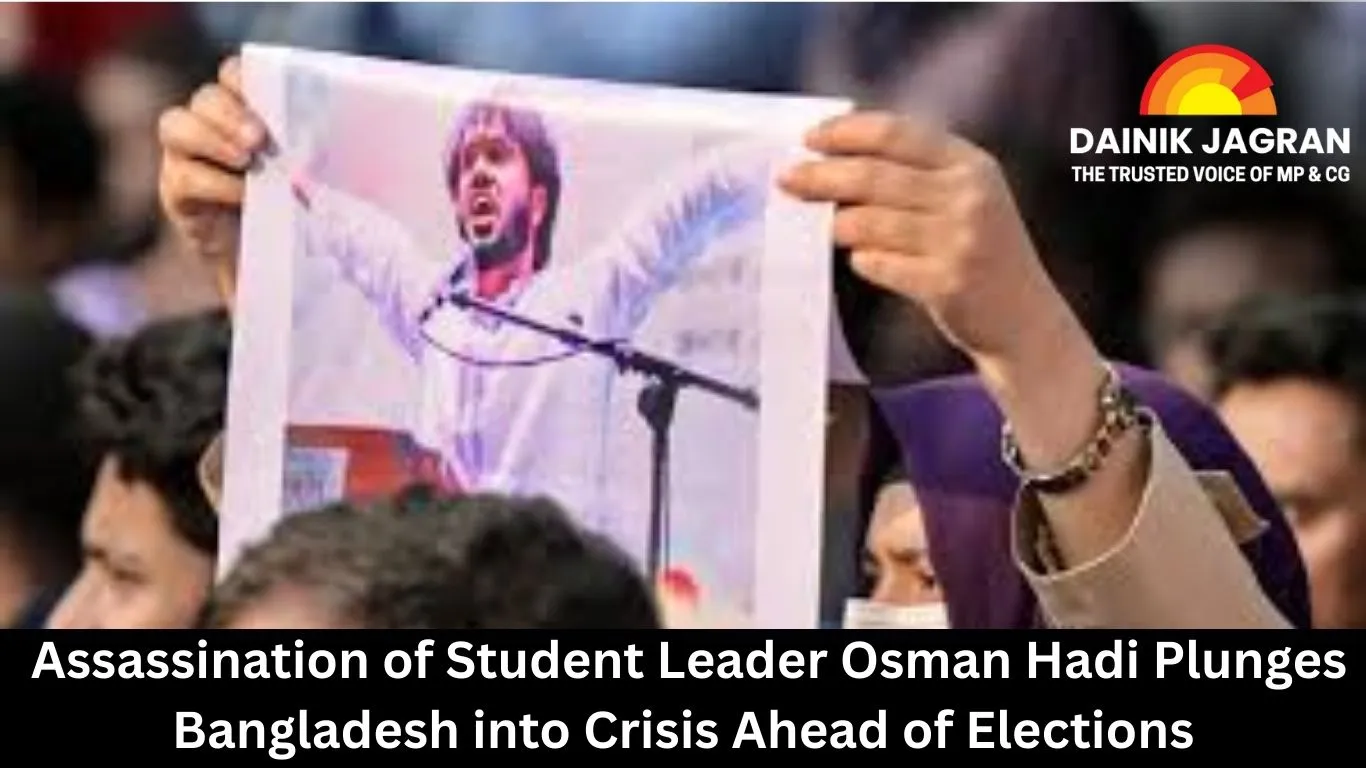
Assassination of Student Leader Osman Hadi Plunges Bangladesh into Crisis Ahead of Elections
Digital Desk
The violent death of a prominent anti-establishment figure has triggered nationwide protests, ignited diplomatic tensions with India, and cast a shadow over the country's fragile political transition.
The assassination of student leader Sharif Osman Hadi has thrown Bangladesh into turmoil just months before critical national elections.
Hadi, a 32-year-old firebrand activist known for his anti-India stance and role in the 2024 uprising, died on December 18 from a gunshot wound to the head sustained in a brazen daylight attack in Dhaka. His death has sparked violent protests, attacks on media outlets, and dangerous accusations against neighboring India, threatening to destabilize an already fragile political landscape.
Who Was Osman Hadi?
Osman Hadi rose to prominence as a spokesperson for Inqilab Mancha (Platform for Revolution), a youth platform that emerged from the massive student-led protests of July 2024. Those protests, initially against a government job quota system, escalated into a nationwide movement that ultimately ousted long-serving Prime Minister Sheikh Hasina.
A Polarizing Figure: Hadi positioned himself as a staunch defender of Bangladeshi sovereignty against what he termed "Indian hegemony". His rhetoric was a blend of nationalism and Islamist politics, and he was a vocal critic of the ousted Awami League, calling for the party to be constitutionally banned.
Provocative Ambitions: Shortly before his death, Hadi shared a map on social media depicting a "Greater Bangladesh," a provocative irredentist vision that included parts of eastern India. He was campaigning as an independent candidate for parliament in the Dhaka-8 constituency in elections scheduled for February 2026.
The Assassination and Immediate Fallout
Hadi was shot on December 12 by two assailants on a motorcycle in Dhaka's Bijoynagar area. After emergency treatment in Bangladesh, he was airlifted to a hospital in Singapore, where he succumbed to his injuries six days later.
The response was immediate and explosive. Thousands took to the streets in Dhaka and other cities, with protests quickly turning violent.
Attacks on Media: Mobs attacked the offices of Bangladesh's two leading newspapers, Prothom Alo and The Daily Star, which are perceived as pro-India. The Daily Star building was set on fire, trapping staff inside.
Anti-India Sentiment Erupts: The protests have been fueled by strong anti-India sentiments. Protesters chanted slogans outside the Indian Assistant High Commission in Chittagong, and student leaders have demanded the closure of the Indian High Commission in Dhaka until the alleged assassins are returned. This anger is partly rooted in India's decision to grant asylum to the ousted Sheikh Hasina.
Official Response: Nobel laureate Muhammad Yunus, who leads Bangladesh's interim government, declared a day of national mourning and described Hadi as a "fearless fighter". Authorities have offered a reward for information and say they have identified two suspects allegedly linked to the banned Awami League, claiming they fled to India—an allegation India has "categorically rejected".
A Nation at a Political Crossroads
Hadi's assassination has exposed the deep fractures within Bangladeshi society and the volatile forces shaping its politics since the 2024 uprising.
"This killing has created a martyr for nationalist and Islamist groups who use 'anti-India' sentiment as a tool for political mobilization," observes a South Asia analyst, highlighting how the tragedy is being leveraged in an already charged pre-election environment.
The interim government faces an immense challenge: balancing public anger while preventing a complete rupture with India, a neighbor critical for trade, electricity, and connectivity. The United Nations has urged all sides to exercise restraint, with Secretary-General António Guterres calling for a transparent investigation and a peaceful electoral environment.
What Comes Next?
With elections looming, the path forward is fraught with risk.
The unity among opposition groups that toppled Hasina is fracturing, and Hadi's death has injected a new wave of hostility.
The student uprising that brought this generation to power now faces its most severe test.
The government must navigate between investigating a high-profile murder, managing violent street protests, and maintaining diplomatic relations, all while preparing for a credible vote.
Regional powers are watching closely, as the crisis offers an opening for increased influence from players like China and Pakistan, potentially altering South Asia's strategic balance.
The assassination of Osman Hadi is more than a political murder; it is a catalyst that has amplified Bangladesh's deepest tensions.
How the country responds will determine not only the fairness of the upcoming election but also the stability of its democracy and its place in the region.
🚨 Beat the News Rush – Join Now!
Get breaking alerts, hot exclusives, and game-changing stories instantly on your phone. No delays, no fluff – just the edge you need. ⚡
Tap to join:
https://whatsapp.com/channel/0029VbAeWYG72WTxso1CFr2g
Crave more?
Site:
https://english.dainikjagranmpcg.com/
X(Twitter):
Instagram:
https://www.instagram.com/dainikjagranmpcg/
FB(Facebook):
https://www.facebook.com/people/English-Dainik-Jagran-MP-CG/61575886216470/
Share the fire – keep your crew ahead! 🗞️🔥


.jpg)




