


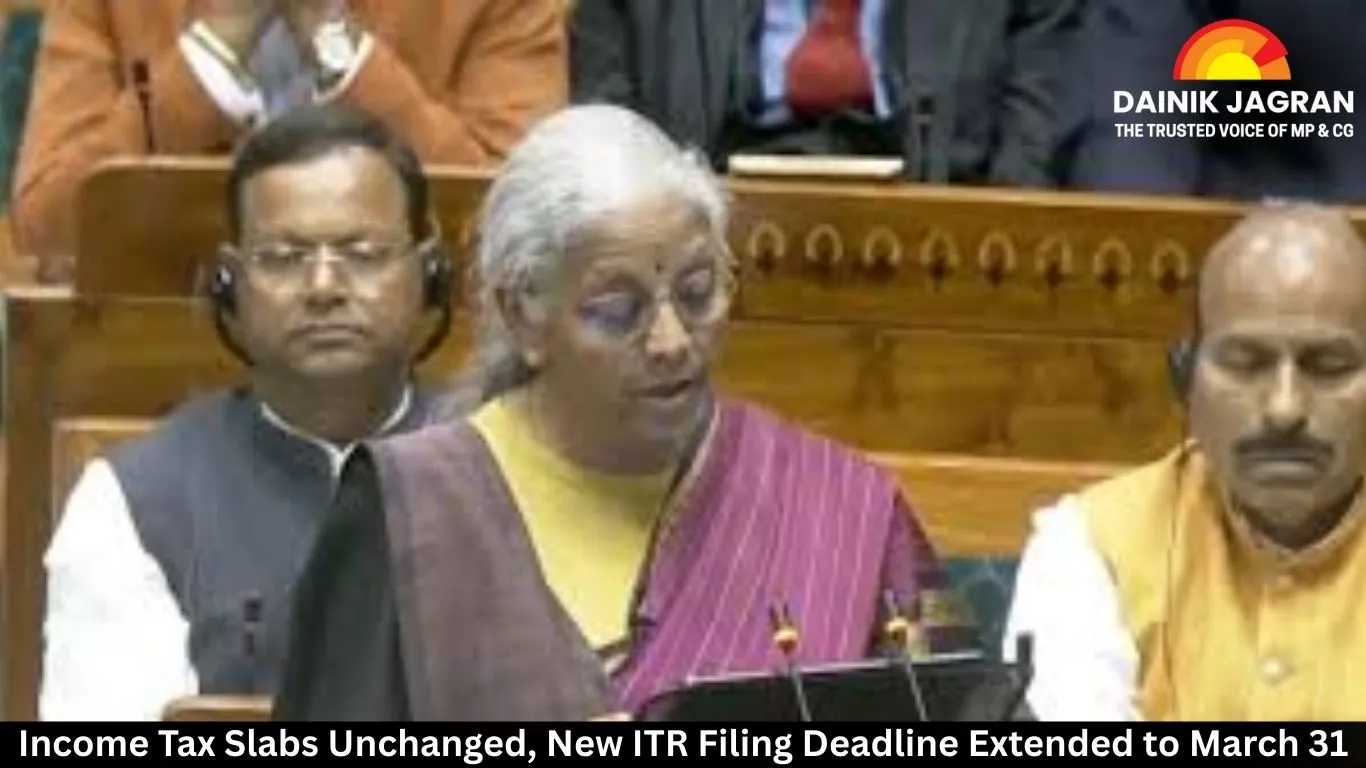
Budget 2026: Income Tax Slabs Unchanged, New ITR Filing Deadline Extended to March 31
Digital Desk
Finance Minister Nirmala Sitharaman presented the Union Budget 2026 today, focusing on stability and compliance ease rather than radical rate shifts. While many middle-class taxpayers were hoping for a revision in the income tax slabs, the government has opted to keep the current rates steady. However, the Budget introduced four significant procedural changes, including a major extension of the ITR filing deadline for revised returns and a reduction in overseas remittance taxes.
1. Extension of Revised ITR Filing Deadline
In a move to reduce taxpayer stress, the government has proposed extending the deadline for filing revised or belated returns. Previously set at December 31, taxpayers can now correct errors or file missed returns until March 31 of the assessment year, subject to a nominal fee.
Additionally, the filing timelines have been staggered to prevent portal crashes:
-
ITR-1 and ITR-2: Deadline remains July 31.
-
Non-audit business cases/Trusts: Deadline extended to August 31.
2. New Income Tax Act 2025 Effective April 1
The Finance Minister confirmed that the decades-old Income Tax Act of 1961 will be replaced by the Income Tax Act 2025. Starting April 1, 2026, this new legislation aims to simplify the language of tax laws, remove redundant provisions, and make the filing process more "human-centric." While the law changes, the FM clarified that this transition will not alter existing tax rates or income tax slabs.
3. Relief on Foreign Remittances (TCS Reductions)
Families sending money abroad for education or medical treatment received a significant boost. The Tax Collected at Source (TCS) under the Liberalised Remittance Scheme (LRS) has been slashed:
-
Education & Medical: Reduced from 5% to 2%.
-
Foreign Tour Packages: The previous 5% and 20% slabs have been rationalized to a flat 2%.
4. Automation of TDS Avoidance (No More Form 15G/15H)
To improve the "Ease of Living," small taxpayers who fall below the taxable limit will no longer need to manually submit Form 15G or 15H to avoid TDS on interest income. The government is introducing a rule-based automated system that will identify eligible individuals, ensuring that tax is not deducted at the source if they are not liable to pay it.
Understanding Your Current Tax Slabs
Since there are no changes to the income tax slabs, here is a quick refresher on where you stand for the upcoming year:
| Income Range | New Regime Tax Rate | Old Regime Tax Rate |
| Up to ₹2.5 Lakh | Nil | Nil |
| ₹2.5L - ₹4 Lakh | Nil | 5% |
| ₹4L - ₹5 Lakh | 5% | 5% (Tax-free via 87A) |
| ₹8L - ₹12 Lakh | 10% | 20% |
| Above ₹24 Lakh | 30% | 30% |
Expert Insight: "The government already made the New Tax Regime highly attractive last year by effectively making income up to ₹12 lakh tax-free through rebates," says tax analyst Anand Jain. "This year’s focus is clearly on cleaning up the 'paperwork' side of taxes rather than the rates themselves."
Budget 2026 may not have delivered a cut in income tax slabs, but the extension of the ITR filing deadline to March 31 and the reduction in TCS offer tangible relief for those navigating complex financial corrections and overseas expenses. As the new Income Tax Act 2025 nears its implementation date, taxpayers should focus on choosing the regime that best fits their investment goals.
.jpg)




