


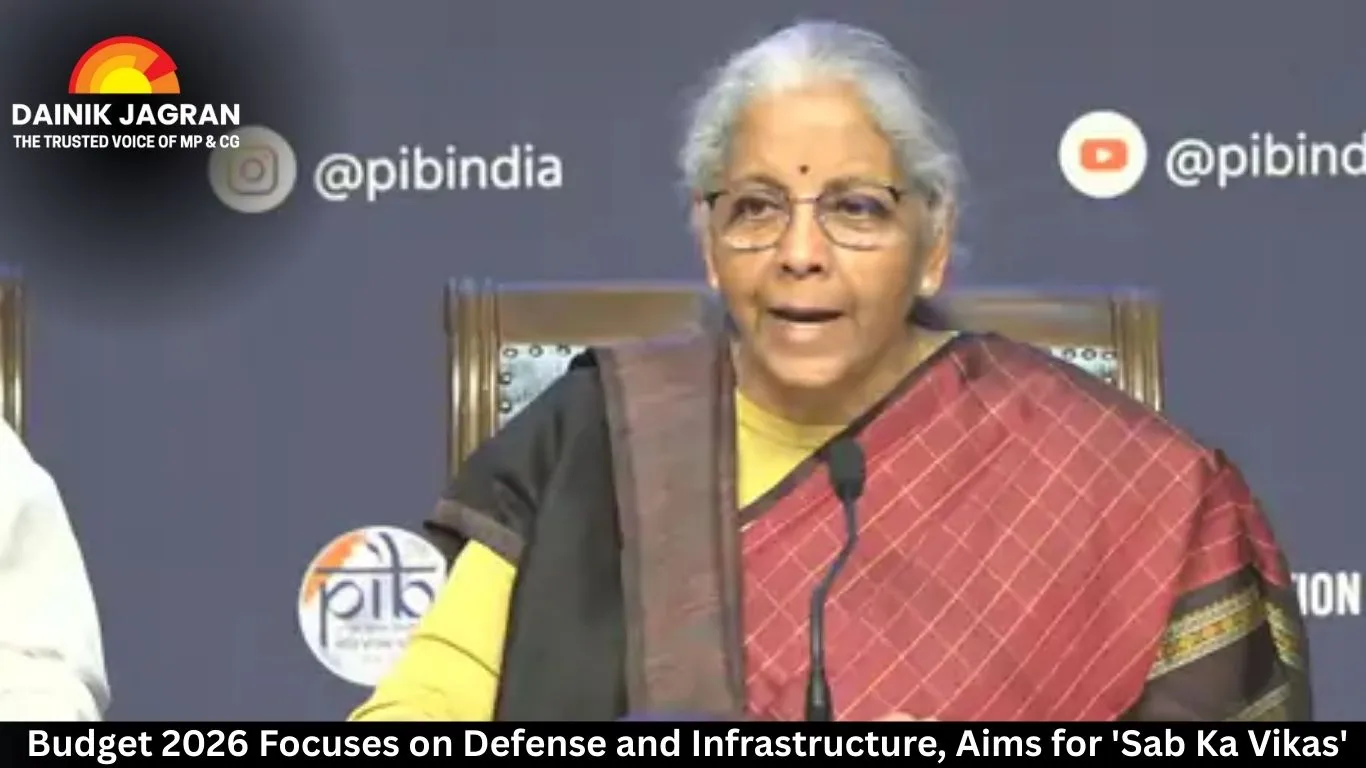
Budget 2026 Focuses on Defense and Infrastructure, Aims for 'Sab Ka Vikas'
Digital Desk
Union Finance Minister Nirmala Sitharaman presented a record ninth consecutive budget on Sunday, outlining a ₹53.5 lakh crore spending plan for 2026-27 with a sharp focus on defense modernization, massive infrastructure development, and sustaining economic growth. The budget, framed around the theme of duty or 'kartavya', aims to accelerate growth, build public capacity, and ensure inclusive development—summarized by Sitharaman's message of 'Sab ka vikas hoyega' (development for all).
Markets reacted negatively, with the Sensex plunging over 1,100 points, largely due to a surprise hike in the Securities Transaction Tax (STT) on futures and options trading.
A Post-Operation Sindoor Defense Buildup
In a significant move, the government allocated ₹7.85 lakh crore to the defense sector, a 15% increase from the previous year. This includes a 21.84% hike in capital outlay for modernization, which now stands at ₹2.19 lakh crore.
- Strategic Context: The substantial increase follows the "historic success of Operation Sindoor," India's first military clash with Pakistan since 1971. Defense Minister Rajnath Singh stated the budget reinforces the resolve to strengthen national defense.
- Key Allocations: A major portion of the capital budget, ₹63,733 crore, is earmarked for aircraft and aero-engines, while ₹25,023 crore is allocated for naval fleet strength. The government also waived basic customs duty on raw materials for manufacturing aircraft parts used in maintenance and repair within the defense sector.
- Domestic Focus: Notably, 75% of the capital acquisition budget (approximately ₹1.39 lakh crore) has been reserved for procurement from domestic industries, reinforcing the 'Aatmanirbhar Bharat' (self-reliant India) initiative in defense.
Infrastructure and Connectivity: The Growth Engine
The budget proposed a 9% increase in capital expenditure to ₹12.2 lakh crore to maintain momentum in infrastructure building.
Major infrastructure announcements include:
Seven High-Speed Rail Corridors: Designed as "growth connectors," these corridors will link key cities like Mumbai-Pune, Delhi-Varanasi, and Hyderabad-Bengaluru.
New Freight Corridor: A dedicated east-west freight corridor connecting Dankuni (West Bengal) to Surat (Gujarat).
Rare Earth Corridors: To reduce import dependence, special corridors will be established in mineral-rich states like Odisha, Kerala, Andhra Pradesh, and Tamil Nadu for mining and processing critical minerals.
Political and Market Reactions
The budget drew sharp political divisions. While Prime Minister Narendra Modi called it a "historic and futuristic" roadmap for a 'Developed India', the opposition was highly critical.
Opposition Criticism: Congress leader Rahul Gandhi said the budget was "blind to India’s real crises" like unemployment. West Bengal Chief Minister Mamata Banerjee dismissed it as a "directionless and visionless Humpty Dumpty Budget" that offered nothing for the common man or for Bengal.
Market Shock: The steep hike in STT on derivatives rattled investors. The STT on futures was raised to 0.05% from 0.02%, and on options to 0.15% from 0.01%. Finance Minister Sitharaman defended the move, stating it was to discourage small investors from risky speculative trading.
Analysis: A Budget of Strategic Priorities
Analysts and industry leaders viewed Budget 2026 as a strategic document with long-term goals.
- Fiscal Management: The government projects a reduction in fiscal deficit to 4.3% of GDP for 2026-27, down from an estimated 4.4% in the current year.
- Sectoral Push: Major initiatives were announced for electronics manufacturing (₹40,000 crore outlay), semiconductors (ISM 2.0 mission), and the biopharma sector (₹10,000 crore investment over five years).
- Tax Continuity: For individual taxpayers, there were no changes in income tax slabs. The new Income Tax Act, 2025, will come into effect from April 1, 2026, with simplified forms.
Industry representatives had mixed views. Some hailed the focus on infrastructure and manufacturing as growth-oriented, while bodies like CREDAI expressed disappointment over a lack of support for affordable housing.
Budget 2026, therefore, presents a clear dichotomy. It aggressively funds defense and physical infrastructure, aiming to secure the nation and build a foundation for future economic prowess. However, it opts for fiscal prudence over immediate populist measures, a choice that has sparked political debate and market concern, testing the government's vision of inclusive development against immediate public expectations.
.jpg)




