Hyderabad Father-Son Duo Builds Robotic Arm Using Claude AI for School Tech Fair
Digital desk
A Hyderabad father and son built a functional robotic arm for a school technology fair using Anthropic's Claude AI for design, coding and debugging, showcasing AI's growing role in STEM education.
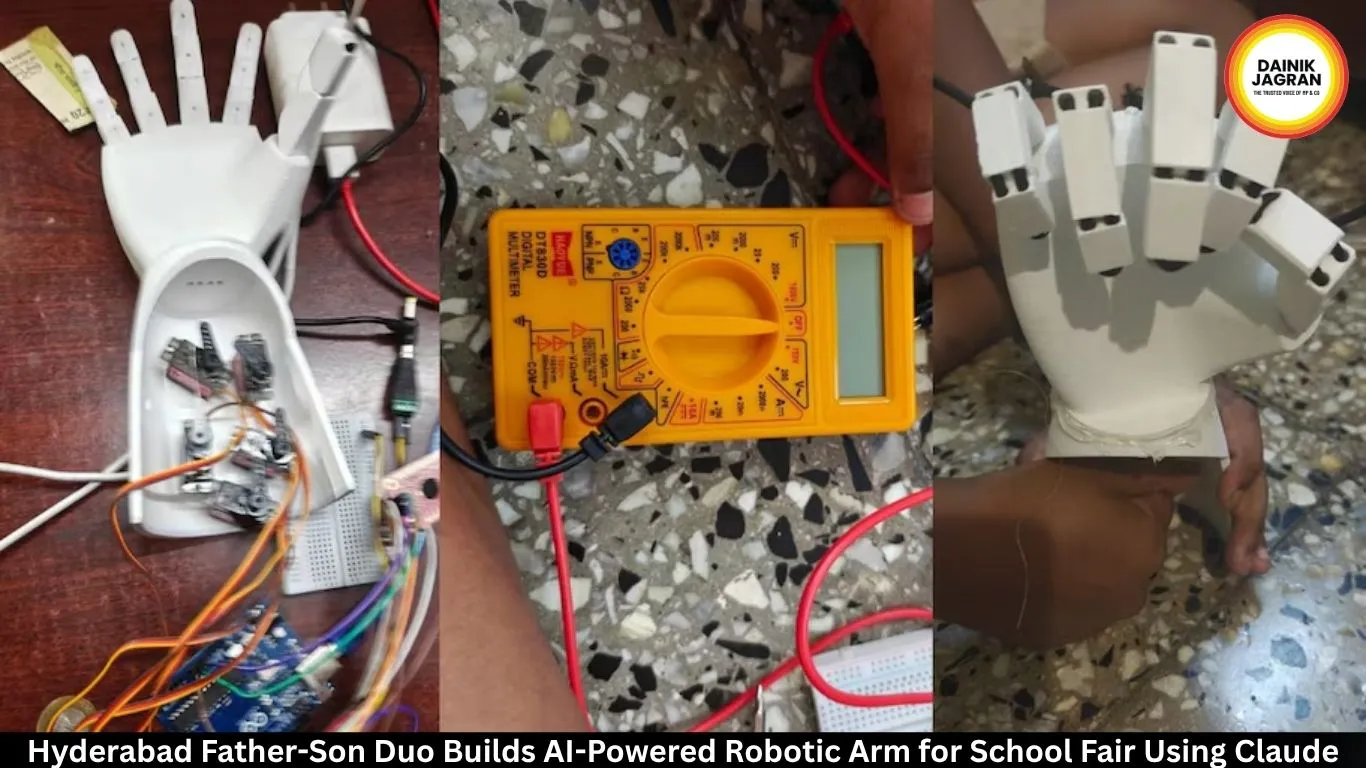
A father-son duo in Hyderabad has drawn attention after building a functional robotic arm for a school technology fair with the help of Anthropic's AI assistant Claude, showcasing how generative artificial intelligence is increasingly becoming a practical tool for learning and innovation.
The project, shared by the father on social media platform X, highlighted how AI assisted in designing, coding and troubleshooting the robotic arm, transforming what could have been a complex engineering task into an engaging learning experience.
AI Became a Virtual Engineering Mentor
According to the social media post, the project began when the student's school announced a technology fair. After exploring ideas on YouTube, the father turned to Claude to help convert the concept into a workable prototype.
The AI assistant reportedly helped create the robotic arm's 3D design, suggested programming logic and later assisted in identifying and fixing software bugs during development.
The father described Claude as a "virtual engineering guide" throughout the project.
Local Vendors and Rapid Delivery Helped Complete Project
Once the design was finalised, the required components were sourced from local markets in Hyderabad.
The robotic arm's 3D-printed parts were ordered from Tolichowki, while electronic components, including motors, chips, capacitors, resistors and wiring, were purchased from the city's Koti Market.
The family also used the Rapido delivery platform to quickly transport components, helping speed up the assembly process.
Coding and Testing Completed with AI Assistance
After assembling the hardware, the father and son relied on Claude once again to write portions of the control code and resolve programming errors that emerged during testing.
The AI-assisted workflow enabled the pair to complete the project from home while gaining practical experience in electronics, coding and robotics.
Project Wins Praise Online
The story has attracted attention on social media, with many users praising the creative use of artificial intelligence in education.
Several users described the project as an example of how AI can complement traditional learning by helping students understand complex engineering concepts rather than simply providing ready-made answers.
The experience also highlighted the growing accessibility of AI-powered development tools for hobbyists, students and parents working on STEM projects.
AI Becoming Part of Classroom Learning
Generative AI platforms are increasingly being used by students, educators and developers for coding assistance, design support, research and problem-solving.
Education experts, however, continue to stress that AI should be used as a learning aid that encourages creativity and understanding, while ensuring students remain actively involved in the development process.

--------
๐จ Beat the News Rush โ Join Now!
Get breaking alerts, hot exclusives, and game-changing stories instantly on your phone. No delays, no fluff โ just the edge you need. โก
Tap to join:ย
๐ข WhatsApp Channel: Dainik Jagran MP CG
Crave more?
๐ Facebook: Dainik Jagran MP CG English
๐ ง Twitter (X): Dainik Jagran MP CG
๐ Instagram: Dainik Jagran MP CG
Share the fire โ keep your crew ahead! ๐๏ธ๐ฅ
Hyderabad Father-Son Duo Builds Robotic Arm Using Claude AI for School Tech Fair
Digital desk
A father-son duo in Hyderabad has drawn attention after building a functional robotic arm for a school technology fair with the help of Anthropic's AI assistant Claude, showcasing how generative artificial intelligence is increasingly becoming a practical tool for learning and innovation.
The project, shared by the father on social media platform X, highlighted how AI assisted in designing, coding and troubleshooting the robotic arm, transforming what could have been a complex engineering task into an engaging learning experience.
AI Became a Virtual Engineering Mentor
According to the social media post, the project began when the student's school announced a technology fair. After exploring ideas on YouTube, the father turned to Claude to help convert the concept into a workable prototype.
The AI assistant reportedly helped create the robotic arm's 3D design, suggested programming logic and later assisted in identifying and fixing software bugs during development.
The father described Claude as a "virtual engineering guide" throughout the project.
Local Vendors and Rapid Delivery Helped Complete Project
Once the design was finalised, the required components were sourced from local markets in Hyderabad.
The robotic arm's 3D-printed parts were ordered from Tolichowki, while electronic components, including motors, chips, capacitors, resistors and wiring, were purchased from the city's Koti Market.
The family also used the Rapido delivery platform to quickly transport components, helping speed up the assembly process.
Coding and Testing Completed with AI Assistance
After assembling the hardware, the father and son relied on Claude once again to write portions of the control code and resolve programming errors that emerged during testing.
The AI-assisted workflow enabled the pair to complete the project from home while gaining practical experience in electronics, coding and robotics.
Project Wins Praise Online
The story has attracted attention on social media, with many users praising the creative use of artificial intelligence in education.
Several users described the project as an example of how AI can complement traditional learning by helping students understand complex engineering concepts rather than simply providing ready-made answers.
The experience also highlighted the growing accessibility of AI-powered development tools for hobbyists, students and parents working on STEM projects.
AI Becoming Part of Classroom Learning
Generative AI platforms are increasingly being used by students, educators and developers for coding assistance, design support, research and problem-solving.
Education experts, however, continue to stress that AI should be used as a learning aid that encourages creativity and understanding, while ensuring students remain actively involved in the development process.