


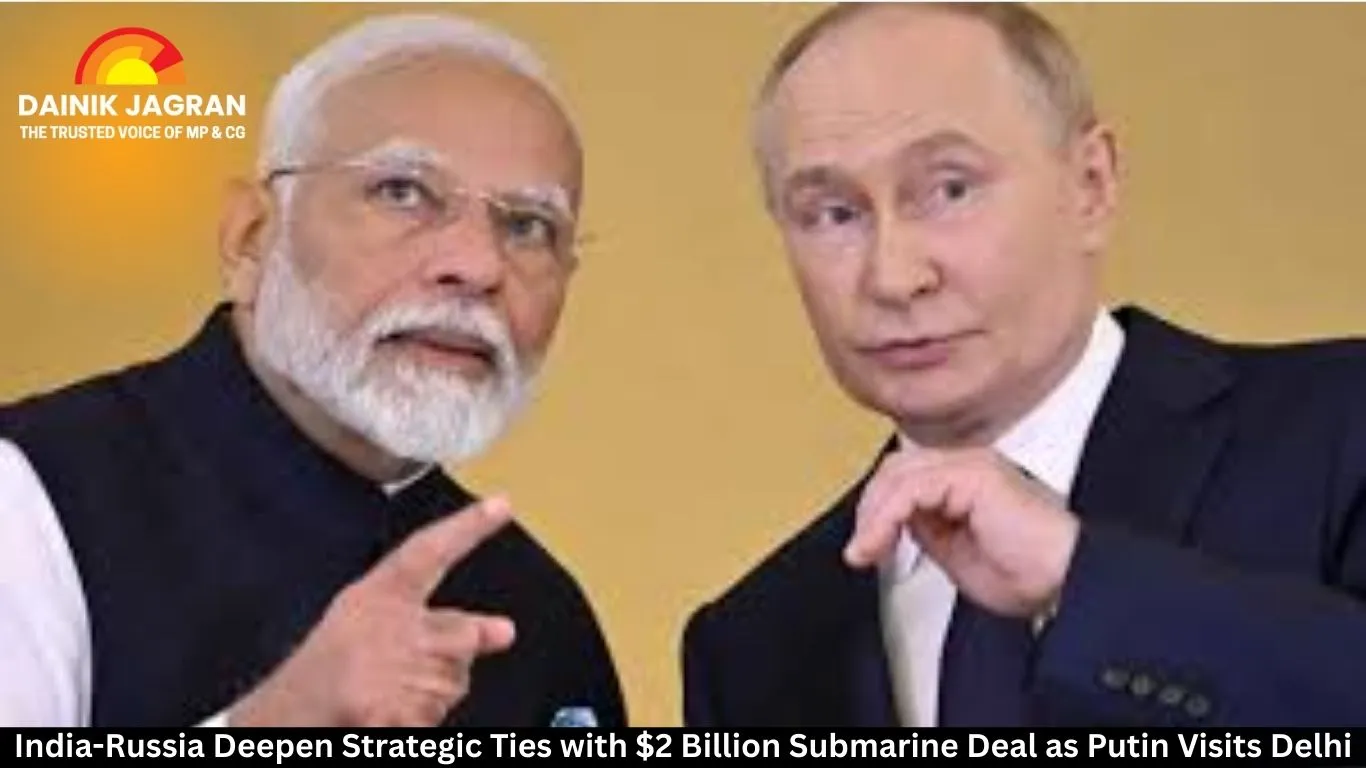
India-Russia Deepen Strategic Ties with $2 Billion Submarine Deal as Putin Visits Delhi
Digital Desk
This agreement, concluded after nearly a decade of negotiations, headlines a series of expected announcements aimed at boosting bilateral trade to a target of $100 billion by 2030. The visit is Putin's first to India since Russia's full-scale invasion of Ukraine and unfolds under the shadow of significant pressure from the United States.
A High-Profile Agenda: Defense, Trade, and Strategic Autonomy
The core of the visit is the 23rd India-Russia Annual Summit, an institutionalized dialogue that underscores the countries' "Special and Privileged Strategic Partnership". President Putin's schedule includes a private dinner with Prime Minister Narendra Modi on Thursday evening, followed by a full day of official engagements on Friday.
These will involve a ceremonial welcome, summit-level talks at Hyderabad House, and an address to business leaders. The leaders are expected to sign several agreements, including a key document outlining the "Programme for the Development of Strategic Areas of Russian-Indian Economic Cooperation until 2030".
Key Agreements and Discussion Points
Major Defense Upgrade: Beyond the submarine lease, defense cooperation remains a cornerstone. India is seeking additional S-400 air defense systems and discussions around Russia's advanced Su-57 stealth fighter jets are anticipated. Analysts note that despite India diversifying its arms imports, an estimated 60-70% of its military equipment is still of Russian origin, making ongoing cooperation and spare parts support vital.
Addressing the Trade Imbalance:A primary focus will be rebalancing a lopsided economic relationship. Bilateral trade has skyrocketed from about $13 billion in 2021 to approximately $68.7 billion in the last fiscal year2025, driven overwhelmingly by Indian imports of discounted Russian crude oil. This has created a massive trade deficit for India, which officials are keen to reduce by increasing exports of automobiles, pharmaceuticals, textiles, and agricultural products to Russia.
Energy and Nuclear Cooperation:Talks will cover ongoing oil trade, which faces challenges from recent U.S. sanctions. In the nuclear sector, progress on the 2025Kudankulam power plant—where units 3 and 4 are underway—and discussions on future projects, including small modular reactors, are on the agenda.
Strategic Connectivity: The two sides are also exploring ambitious connectivity initiatives like the International North-South Transport Corridor (INSTC) and potential Indian involvement in the Arctic's 2025Northern Sea Route, which Russia has promoted as a strategic alternative to traditional shipping lanes.
Navigating Geopolitical Tightrope
The summit occurs at a diplomatically sensitive time. The United States, under President Donald Trump, has imposed punitive tariffs on Indian goods, explicitly linked to New Delhi's continued purchase of Russian oil. Meanwhile, just days before arriving in India, Putin hosted U.S. envoys for peace talks on Ukraine and gave an interview stating Russia would seize the Donbas region "in any case".
India has walked a careful line, maintaining its historically close ties with Moscow while strengthening partnerships with Western nations. Officials have pointed to what they see as "double standards", noting continued trade between Western nations and Russia. The summit is seen as a reaffirmation of India's strategic autonomy and the enduring nature of its partnership with Russia, even as global alignments shift.
Final agreements and a joint statement from the leaders are expected by Friday evening, which will detail the concrete outcomes of this closely watched diplomatic engagement.



.jpg)




