

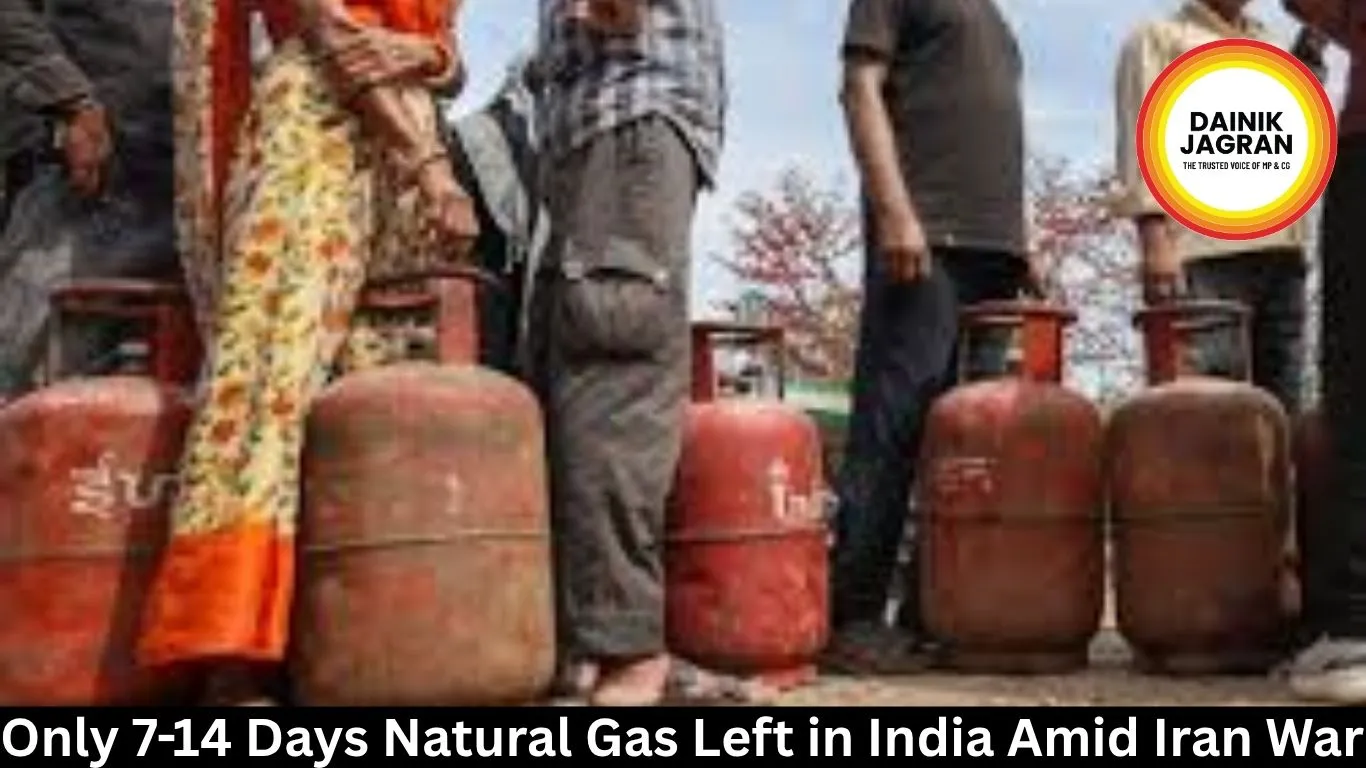
Only 7-14 Days Natural Gas Left in India Amid Iran War

Digital Desk

Only 7-14 Days Natural Gas Left in India Amid Iran War

India has only 7-14 days of imported natural gas left as the Iran war disrupts LNG shipments through the Strait of Hormuz. Government may hike PNG prices while prioritising households; latest India news update on energy security and public impact.

Only 7-14 Days of Natural Gas Left in India Amid Iran War

With LNG shipments stalled through the Strait of Hormuz, imported stocks are critically low and the government has already invoked emergency supply rules to protect households while industries brace for cuts.

Days of natural gas left in India have shrunk to just one or two weeks for the imported portion as the Iran war disrupts key routes, officials and analysts confirm. Domestic production covers roughly half the needs, but the other half — reliant on LNG — now faces real pressure. Households using piped natural gas (PNG) need not panic yet, yet price hikes loom if the conflict drags on.

PNG Network Expands Rapidly

Urban families continue switching from LPG cylinders to PNG for convenience and steady supply. India has crossed 1.5 crore PNG connections, with fresh additions of over 1.25 lakh in the past two weeks alone. City gas distribution projects are accelerating, and CNG remains the second-most popular auto fuel after petrol.

The shift gained speed after LPG supplies tightened. More than 5,600 households moved from cylinders to PNG in just three days, according to petroleum ministry updates.

Supply Sources Breakdown

Roughly half the gas feeding PNG networks and city distribution comes from domestic fields operated by ONGC and Reliance in the KG basin. The remaining half arrives as LNG, mostly under long-term contracts with Qatar.

Nearly 70 per cent of these imports must sail through the Strait of Hormuz. Smaller volumes from the US, Australia and Russia provide some diversification, yet the Gulf route dominates.

Hormuz Chokepoint Threat

The narrow waterway has become the focal point of the Iran war. Qatar’s Ras Laffan terminal — source of over half India’s LNG — halted fresh loadings after the conflict escalated. Cargoes already at sea are reaching Indian terminals, but future shipments remain uncertain.

Shipping data show delays and rerouting. Industry trackers report that even Petronet’s captive tankers faced hold-ups at Dahej, leaving some terminals with just days of buffer.

Limited Storage Buffer

Unlike crude oil, India maintains no strategic gas reserves. Stocks sit only as working inventory at regasification terminals in Dahej, Hazira, Kochi and Ennore. These cover at most one to two weeks of imports — or roughly 9-12 days of total consumption in some estimates.

Recent tenders for March LNG cargoes went unawarded as prices spiked above $25 per million Btu. Terminal operators now operate with minimal cushion.

Priority for Households

The government has issued the Natural Gas Supply Regulation Order 2026 to ring-fence essential users. Households with PNG connections and fertiliser plants rank highest. Power plants and industries will feel the squeeze first and may switch to fuel oil, coal or LPG.

Officials are urging conservation and faster PNG adoption to ease pressure on LPG, which already serves 33.37 crore consumers and faced earlier disruptions.

Price Hike Warnings

Shortages may not hit kitchens immediately, but costs will rise. Market response to Hormuz risks has already pushed LNG prices higher. PNG distributors will pass on increases to urban consumers, while factories absorb deeper cuts or pay premium rates for alternatives.

Experts from Global Trade Research Initiative note that prolonged disruption will force both households and industry to pay more. No outright rationing is expected for domestic PNG, yet bills are set to climb.

Energy Security Outlook

The crisis has revived talk of strategic LNG storage. Policymakers are studying extra tanks at existing terminals and a 10 per cent government-accessible buffer. Pipeline expansion to 25,000 km and new city gas projects continue, yet import dependence remains a weak spot.

As the Iran war enters a critical phase, the coming weeks will test India’s ability to balance supply, price and priority use. With days of natural gas left in India under close watch, the government is monitoring global cargoes and domestic output round the clock. Any extension of the conflict will likely bring higher PNG tariffs and renewed push for local exploration and renewables.


english.dainikjagranmpcg.com
24 Mar 2026 By Abhishek Joshi

Only 7-14 Days Natural Gas Left in India Amid Iran War

Digital Desk

Only 7-14 Days of Natural Gas Left in India Amid Iran War

With LNG shipments stalled through the Strait of Hormuz, imported stocks are critically low and the government has already invoked emergency supply rules to protect households while industries brace for cuts.

Days of natural gas left in India have shrunk to just one or two weeks for the imported portion as the Iran war disrupts key routes, officials and analysts confirm. Domestic production covers roughly half the needs, but the other half — reliant on LNG — now faces real pressure. Households using piped natural gas (PNG) need not panic yet, yet price hikes loom if the conflict drags on.

PNG Network Expands Rapidly

Urban families continue switching from LPG cylinders to PNG for convenience and steady supply. India has crossed 1.5 crore PNG connections, with fresh additions of over 1.25 lakh in the past two weeks alone. City gas distribution projects are accelerating, and CNG remains the second-most popular auto fuel after petrol.

The shift gained speed after LPG supplies tightened. More than 5,600 households moved from cylinders to PNG in just three days, according to petroleum ministry updates.

Supply Sources Breakdown

Roughly half the gas feeding PNG networks and city distribution comes from domestic fields operated by ONGC and Reliance in the KG basin. The remaining half arrives as LNG, mostly under long-term contracts with Qatar.

Nearly 70 per cent of these imports must sail through the Strait of Hormuz. Smaller volumes from the US, Australia and Russia provide some diversification, yet the Gulf route dominates.

Hormuz Chokepoint Threat

The narrow waterway has become the focal point of the Iran war. Qatar’s Ras Laffan terminal — source of over half India’s LNG — halted fresh loadings after the conflict escalated. Cargoes already at sea are reaching Indian terminals, but future shipments remain uncertain.

Shipping data show delays and rerouting. Industry trackers report that even Petronet’s captive tankers faced hold-ups at Dahej, leaving some terminals with just days of buffer.

Limited Storage Buffer

Unlike crude oil, India maintains no strategic gas reserves. Stocks sit only as working inventory at regasification terminals in Dahej, Hazira, Kochi and Ennore. These cover at most one to two weeks of imports — or roughly 9-12 days of total consumption in some estimates.

Recent tenders for March LNG cargoes went unawarded as prices spiked above $25 per million Btu. Terminal operators now operate with minimal cushion.

Priority for Households

The government has issued the Natural Gas Supply Regulation Order 2026 to ring-fence essential users. Households with PNG connections and fertiliser plants rank highest. Power plants and industries will feel the squeeze first and may switch to fuel oil, coal or LPG.

Officials are urging conservation and faster PNG adoption to ease pressure on LPG, which already serves 33.37 crore consumers and faced earlier disruptions.

Price Hike Warnings

Shortages may not hit kitchens immediately, but costs will rise. Market response to Hormuz risks has already pushed LNG prices higher. PNG distributors will pass on increases to urban consumers, while factories absorb deeper cuts or pay premium rates for alternatives.

Experts from Global Trade Research Initiative note that prolonged disruption will force both households and industry to pay more. No outright rationing is expected for domestic PNG, yet bills are set to climb.

Energy Security Outlook

The crisis has revived talk of strategic LNG storage. Policymakers are studying extra tanks at existing terminals and a 10 per cent government-accessible buffer. Pipeline expansion to 25,000 km and new city gas projects continue, yet import dependence remains a weak spot.

As the Iran war enters a critical phase, the coming weeks will test India’s ability to balance supply, price and priority use. With days of natural gas left in India under close watch, the government is monitoring global cargoes and domestic output round the clock. Any extension of the conflict will likely bring higher PNG tariffs and renewed push for local exploration and renewables.

 

https://english.dainikjagranmpcg.com/special-news/only-7-14-days-natural-gas-left-in-india-amid-iran/article-15875

Advertisement

Latest News


