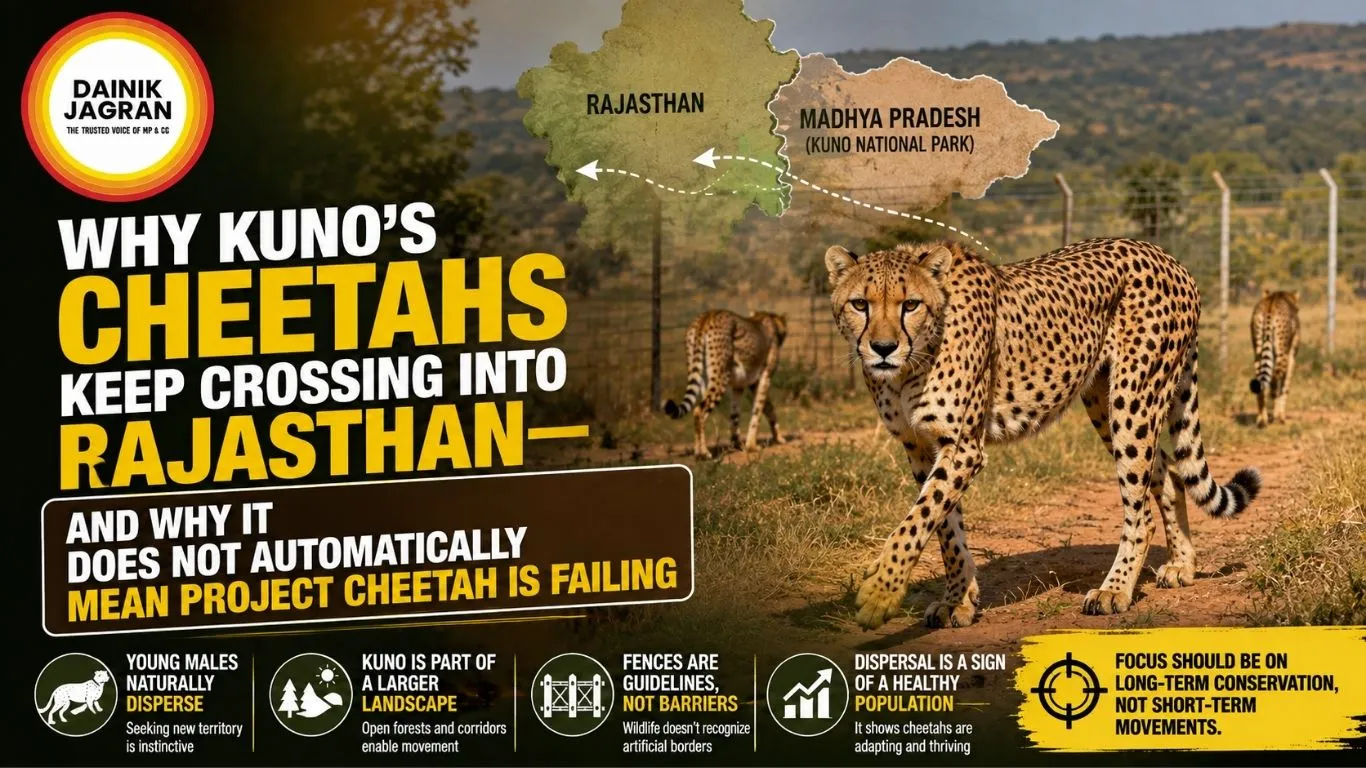
Why Kuno’s Cheetahs Keep Crossing Into Rajasthan—and Why It Does Not Automatically Mean Project Cheetah Is Failing

Digital Desk

Why Kuno’s Cheetahs Keep Crossing Into Rajasthan—and Why It Does Not Automatically Mean Project Cheetah Is Failing

Kuno cheetahs have crossed into Rajasthan at least 11 times. Here is why they roam, why officials capture them and what the pending interstate agreement means.


A cheetah does not know when it has crossed from Madhya Pradesh into Rajasthan.

It follows prey, explores unfamiliar ground and searches for territory. Yet when a Kuno cheetah crosses the administrative boundary, its natural journey can quickly become an operation involving satellite collars, forest teams, veterinarians and a tranquilliser dart.

Since Project Cheetah began in September 2022, the animals have crossed into Rajasthan on at least 11 documented occasions, according to a recent report. Eight of those movements led to tranquillisation operations.

The pattern has created a difficult question: can India build a genuinely free-ranging cheetah population if interstate dispersal repeatedly ends with capture and return?

The cats may be doing exactly what cheetahs do

Large carnivores disperse to find territory, mates, habitat and food. Leaving Kuno’s notified boundary is therefore not automatically evidence that the park is unsuitable or that the reintroduction has failed.

The wider Kuno–Gandhi Sagar cheetah landscape covers nearly 17,000 square kilometres—about 10,500 square kilometres in Madhya Pradesh and 6,500 in Rajasthan. It includes forest and scrub across districts such as Baran, Kota, Jhalawar, Karauli, Sawai Madhopur and Chittorgarh.

But the landscape is not one uninterrupted wilderness. Forest patches are interspersed with farms, roads, grazing areas and villages. A route that appears viable on a map can place a cheetah close to livestock and settlements.

KP-2 and KP-3 show why Rajasthan matters

An India-born male identified as KP-2 has reportedly been tranquillised three times after entering Rajasthan. During his most recent dispersal, he spent around 55 days outside Kuno—roughly 45 days in Baran and another 10 in Kota—before being captured and transported back.

Another India-born male, KP-3, spent about 42 days moving through Baran and Jhalawar before being caught near the state border.

Their extended stays suggest that parts of Rajasthan provide usable habitat and a sufficient prey base. The animals were not merely lost for a few hours; they were navigating and surviving in the larger landscape.

Why officials still choose capture

Forest officials face a different reality. When a collared cheetah approaches a settlement, any livestock loss or public panic creates intense pressure to intervene before a dangerous encounter occurs.

There has reportedly been no recorded case of a Kuno cheetah attacking a human. Even so, officials must manage the possibility of accidental encounters, retaliatory action and misinformation spreading through nearby villages.

Tranquillisation can therefore become the safest immediate administrative decision. Wildlife experts, however, warn that repeated immobilisation should not become the automatic response to every dispersal. Capturing a healthy animal also prevents it from establishing a territory in a landscape that the project is supposed to connect.

The agreement that remains unsigned

Madhya Pradesh and Rajasthan have discussed a formal memorandum of understanding for joint cheetah management, but the agreement is still pending despite movement across the border for several years.

The proposed arrangement reportedly includes common monitoring protocols, joint scientific studies with the Wildlife Institute of India, habitat management and coordinated rules for capture, release and emergency response.

Officials in the two states already cooperate informally when a cheetah crosses the border. A formal framework, however, could clarify who makes decisions, how local communities are informed and when an animal should be watched rather than captured.

Success may require a landscape, not an enclosure

Project Cheetah’s long-term test is not whether every animal remains inside an invisible line around Kuno. It is whether cheetahs can survive, breed and disperse across a managed landscape without creating unacceptable risk for people.

That will require prey restoration, compensation for livestock losses, trained response teams, public communication and protection of corridors across state lines.

The cheetahs are not “running away” in the human sense. They are revealing the scale on which the species naturally moves. India’s management system must now decide whether it can learn to move with them.


english.dainikjagranmpcg.com
15 Aug 2026 By Sandeep.P

Why Kuno’s Cheetahs Keep Crossing Into Rajasthan—and Why It Does Not Automatically Mean Project Cheetah Is Failing

Digital Desk

A cheetah does not know when it has crossed from Madhya Pradesh into Rajasthan.

It follows prey, explores unfamiliar ground and searches for territory. Yet when a Kuno cheetah crosses the administrative boundary, its natural journey can quickly become an operation involving satellite collars, forest teams, veterinarians and a tranquilliser dart.

Since Project Cheetah began in September 2022, the animals have crossed into Rajasthan on at least 11 documented occasions, according to a recent report. Eight of those movements led to tranquillisation operations.

The pattern has created a difficult question: can India build a genuinely free-ranging cheetah population if interstate dispersal repeatedly ends with capture and return?

The cats may be doing exactly what cheetahs do

Large carnivores disperse to find territory, mates, habitat and food. Leaving Kuno’s notified boundary is therefore not automatically evidence that the park is unsuitable or that the reintroduction has failed.

The wider Kuno–Gandhi Sagar cheetah landscape covers nearly 17,000 square kilometres—about 10,500 square kilometres in Madhya Pradesh and 6,500 in Rajasthan. It includes forest and scrub across districts such as Baran, Kota, Jhalawar, Karauli, Sawai Madhopur and Chittorgarh.

But the landscape is not one uninterrupted wilderness. Forest patches are interspersed with farms, roads, grazing areas and villages. A route that appears viable on a map can place a cheetah close to livestock and settlements.

KP-2 and KP-3 show why Rajasthan matters

An India-born male identified as KP-2 has reportedly been tranquillised three times after entering Rajasthan. During his most recent dispersal, he spent around 55 days outside Kuno—roughly 45 days in Baran and another 10 in Kota—before being captured and transported back.

Another India-born male, KP-3, spent about 42 days moving through Baran and Jhalawar before being caught near the state border.

Their extended stays suggest that parts of Rajasthan provide usable habitat and a sufficient prey base. The animals were not merely lost for a few hours; they were navigating and surviving in the larger landscape.

Why officials still choose capture

Forest officials face a different reality. When a collared cheetah approaches a settlement, any livestock loss or public panic creates intense pressure to intervene before a dangerous encounter occurs.

There has reportedly been no recorded case of a Kuno cheetah attacking a human. Even so, officials must manage the possibility of accidental encounters, retaliatory action and misinformation spreading through nearby villages.

Tranquillisation can therefore become the safest immediate administrative decision. Wildlife experts, however, warn that repeated immobilisation should not become the automatic response to every dispersal. Capturing a healthy animal also prevents it from establishing a territory in a landscape that the project is supposed to connect.

The agreement that remains unsigned

Madhya Pradesh and Rajasthan have discussed a formal memorandum of understanding for joint cheetah management, but the agreement is still pending despite movement across the border for several years.

The proposed arrangement reportedly includes common monitoring protocols, joint scientific studies with the Wildlife Institute of India, habitat management and coordinated rules for capture, release and emergency response.

Officials in the two states already cooperate informally when a cheetah crosses the border. A formal framework, however, could clarify who makes decisions, how local communities are informed and when an animal should be watched rather than captured.

Success may require a landscape, not an enclosure

Project Cheetah’s long-term test is not whether every animal remains inside an invisible line around Kuno. It is whether cheetahs can survive, breed and disperse across a managed landscape without creating unacceptable risk for people.

That will require prey restoration, compensation for livestock losses, trained response teams, public communication and protection of corridors across state lines.

The cheetahs are not “running away” in the human sense. They are revealing the scale on which the species naturally moves. India’s management system must now decide whether it can learn to move with them.

https://english.dainikjagranmpcg.com/special-news/why-kuno%E2%80%99s-cheetahs-keep-crossing-into-rajasthan%E2%80%94and-why-it-does/article-26261

Recommended For You

--------

🚨 Beat the News Rush – Join Now!

Get breaking alerts, hot exclusives, and game-changing stories instantly on your phone. No delays, no fluff – just the edge you need. ⚡

Tap to join: 

🟢 WhatsApp Channel: Dainik Jagran MP CG

Crave more?

🅕 Facebook: Dainik Jagran MP CG English

🅧 Twitter (X): Dainik Jagran MP CG

🅘 Instagram: Dainik Jagran MP CG

Share the fire – keep your crew ahead! 🗞️🔥

Trending News