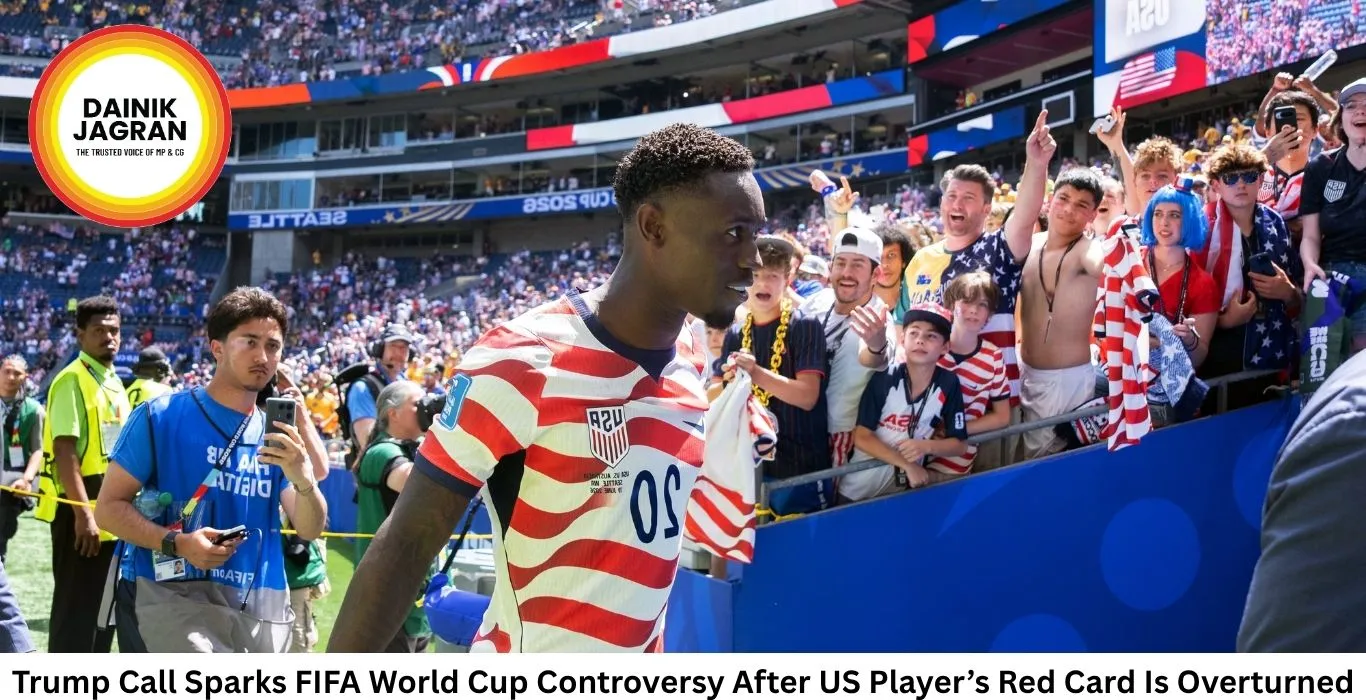
Trump Call Sparks FIFA World Cup Controversy After US Player’s Red Card Is Overturned

Digital desk

Trump Call Sparks FIFA World Cup Controversy After US Player’s Red Card Is Overturned

A major controversy has erupted at the FIFA World Cup 2026 after United States forward Folarin Balogun was allowed to play in the Round of 16 despite previously receiving a red card suspension. The decision has drawn international attention after reports emerged that US President Donald Trump personally contacted FIFA President Gianni Infantino regarding the matter.

Balogun was subsequently cleared to participate in the knockout clash against Belgium, becoming the center of one of the tournament’s biggest off-field debates. Despite his inclusion, the United States suffered a heavy 4-1 defeat against Belgium and exited the competition.

The incident is being described as an unprecedented moment in World Cup history, with critics arguing that political intervention should not influence sporting disciplinary decisions. Belgium’s football authorities and several European football stakeholders have reportedly raised concerns over FIFA’s handling of the case.

Red Card Decision Reversed

The 25-year-old striker had been shown a red card during a previous knockout fixture against Bosnia and Herzegovina after a challenge on defender Tarik Muharemovic. Under standard tournament regulations, the dismissal would have resulted in a one-match suspension.

However, FIFA’s disciplinary review process ultimately allowed Balogun to feature against Belgium. The decision prompted objections from Belgian football officials, who questioned the basis for overturning the suspension.

Balogun entered the match having already scored three goals during the tournament and was considered one of the United States’ key attacking players.

Trump Confirms Involvement

Ahead of the Round of 16 encounter, US President Donald Trump publicly acknowledged speaking with FIFA President Gianni Infantino regarding the suspension.

According to the reported remarks, Trump stated that he had requested FIFA to review the decision and expressed his view that the challenge did not warrant a red card. He later welcomed FIFA’s ruling, arguing that keeping Balogun out of the tournament would have been unfair.

The comments immediately triggered debate across the football world, with critics questioning whether political figures should be involved in disciplinary matters during major international tournaments.

FIFA Defends Its Process

FIFA President Gianni Infantino responded to the criticism by maintaining that the decision was taken independently by the organization’s disciplinary committee.

According to FIFA, every case is assessed on the basis of available evidence and tournament regulations. The governing body insisted that the review process remained impartial and that no external influence determined the final outcome.

Nevertheless, the episode has intensified discussions about transparency and governance within world football, particularly during the sport’s biggest event.

Questions Over Sporting Independence

FIFA has long maintained that its decisions are independent of political influence. As a result, the Balogun case has generated renewed scrutiny regarding the separation between sports administration and political intervention.

Football observers noted that while world leaders have previously commented on controversial refereeing decisions, direct involvement in disciplinary reviews is extremely rare.

The controversy has become one of the most talked-about stories of the tournament, overshadowing the United States’ elimination and shifting attention toward FIFA’s decision-making framework.

Historical Context

The Balogun case has also revived discussion about previous disciplinary controversies in World Cup history.

One of the most notable examples occurred during the 1962 FIFA World Cup, when Brazilian star Garrincha was sent off in the semi-final against Chile but was ultimately allowed to participate in the final. Brazil went on to defeat Czechoslovakia and lift the trophy.

While disciplinary procedures have evolved significantly since then, the latest controversy has once again highlighted how decisions involving player eligibility can become major talking points on football’s biggest stage.

--------

🚨 Beat the News Rush – Join Now!

Get breaking alerts, hot exclusives, and game-changing stories instantly on your phone. No delays, no fluff – just the edge you need. ⚡

Tap to join: 

🟢 WhatsApp Channel: Dainik Jagran MP CG

Crave more?

🅕 Facebook: Dainik Jagran MP CG English

🅧 Twitter (X): Dainik Jagran MP CG

🅘 Instagram: Dainik Jagran MP CG

Share the fire – keep your crew ahead! 🗞️🔥

english.dainikjagranmpcg.com
07 Jul 2026 By Priyanshu.Jha

Trump Call Sparks FIFA World Cup Controversy After US Player’s Red Card Is Overturned

Digital desk

Balogun was subsequently cleared to participate in the knockout clash against Belgium, becoming the center of one of the tournament’s biggest off-field debates. Despite his inclusion, the United States suffered a heavy 4-1 defeat against Belgium and exited the competition.

The incident is being described as an unprecedented moment in World Cup history, with critics arguing that political intervention should not influence sporting disciplinary decisions. Belgium’s football authorities and several European football stakeholders have reportedly raised concerns over FIFA’s handling of the case.

Red Card Decision Reversed

The 25-year-old striker had been shown a red card during a previous knockout fixture against Bosnia and Herzegovina after a challenge on defender Tarik Muharemovic. Under standard tournament regulations, the dismissal would have resulted in a one-match suspension.

However, FIFA’s disciplinary review process ultimately allowed Balogun to feature against Belgium. The decision prompted objections from Belgian football officials, who questioned the basis for overturning the suspension.

Balogun entered the match having already scored three goals during the tournament and was considered one of the United States’ key attacking players.

Trump Confirms Involvement

Ahead of the Round of 16 encounter, US President Donald Trump publicly acknowledged speaking with FIFA President Gianni Infantino regarding the suspension.

According to the reported remarks, Trump stated that he had requested FIFA to review the decision and expressed his view that the challenge did not warrant a red card. He later welcomed FIFA’s ruling, arguing that keeping Balogun out of the tournament would have been unfair.

The comments immediately triggered debate across the football world, with critics questioning whether political figures should be involved in disciplinary matters during major international tournaments.

FIFA Defends Its Process

FIFA President Gianni Infantino responded to the criticism by maintaining that the decision was taken independently by the organization’s disciplinary committee.

According to FIFA, every case is assessed on the basis of available evidence and tournament regulations. The governing body insisted that the review process remained impartial and that no external influence determined the final outcome.

Nevertheless, the episode has intensified discussions about transparency and governance within world football, particularly during the sport’s biggest event.

Questions Over Sporting Independence

FIFA has long maintained that its decisions are independent of political influence. As a result, the Balogun case has generated renewed scrutiny regarding the separation between sports administration and political intervention.

Football observers noted that while world leaders have previously commented on controversial refereeing decisions, direct involvement in disciplinary reviews is extremely rare.

The controversy has become one of the most talked-about stories of the tournament, overshadowing the United States’ elimination and shifting attention toward FIFA’s decision-making framework.

Historical Context

The Balogun case has also revived discussion about previous disciplinary controversies in World Cup history.

One of the most notable examples occurred during the 1962 FIFA World Cup, when Brazilian star Garrincha was sent off in the semi-final against Chile but was ultimately allowed to participate in the final. Brazil went on to defeat Czechoslovakia and lift the trophy.

While disciplinary procedures have evolved significantly since then, the latest controversy has once again highlighted how decisions involving player eligibility can become major talking points on football’s biggest stage.
https://english.dainikjagranmpcg.com/sports/trump-call-sparks-fifa-world-cup-controversy-after-us-player%E2%80%99s/article-21189

Trending News