

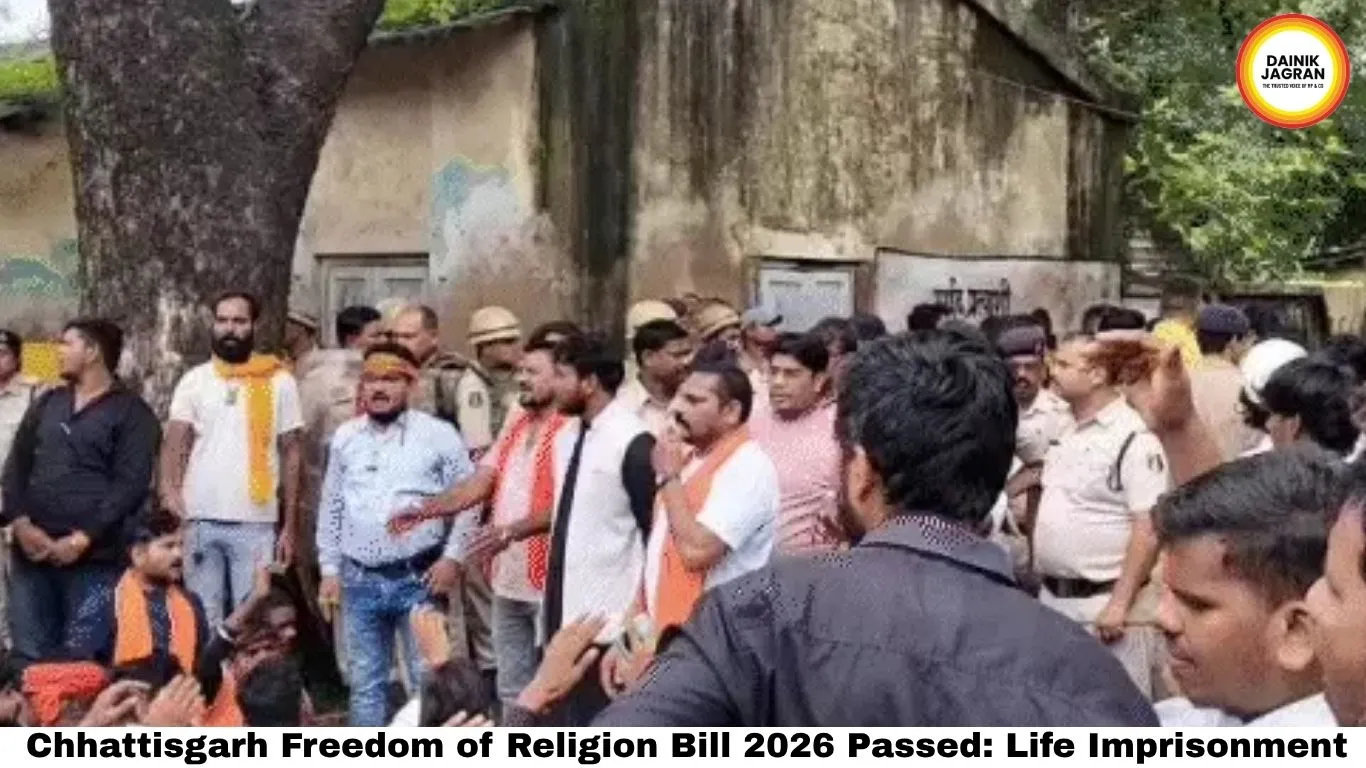
Chhattisgarh Freedom of Religion Bill 2026 Passed: Life Imprisonment for Mass Conversion, Rs 25 Lakh Fine — Marriage-Based Conversion Declared Void
Digital Desk
CG Assembly passes Freedom of Religion Bill 2026. Life term for mass conversion, Rs 25L fine, 60-day prior notice mandatory. Full details here.
Chhattisgarh has enacted one of India's most stringent anti-conversion laws — replacing a 58-year-old act with sweeping new provisions that will reshape religious freedom in the state.
The Chhattisgarh Assembly has passed the Dharma Swatantrya (Freedom of Religion) Bill 2026, making it one of the most comprehensive and far-reaching anti-conversion legislations in India. Introduced by Home Minister and Deputy Chief Minister Vijay Sharma — who held over 50 marathon consultations to finalise the bill — the new law replaces the outdated Chhattisgarh Dharma Swatantrya Act of 1968. It passed by voice vote, with BJP MLAs breaking into chants of "Jai Shri Ram" on the floor of the House. The opposition staged a walkout, calling for broader consultation before passage.
What the Law Says — Punishments in Detail
The bill establishes a tiered punishment framework based on the severity and nature of the illegal conversion.
For standard cases of illegal conversion through force, allurement, fraud or misrepresentation, the punishment is 7 to 10 years imprisonment and a minimum fine of Rs 5 lakh.
Where the victim is a minor, a woman, or belongs to SC, ST or OBC communities, the punishment is enhanced to 10 to 20 years imprisonment and a minimum fine of Rs 10 lakh.
For mass conversions, the penalty is the most severe — 10 years to life imprisonment and a minimum fine of Rs 25 lakh.
Any person who assists or facilitates an illegal conversion — even in a supporting role — faces a minimum of 6 months and up to 3 years in prison, along with a Rs 2 lakh fine.
Repeat offenders — those convicted of facilitating illegal conversion, who subsequently commit the offence again after serving their sentence — will face life imprisonment. Courts may reduce this in exceptional circumstances for special reasons on record.
60 Days' Prior Notice — Mandatory for All Conversions
One of the most operationally significant provisions of the bill is the mandatory prior notice requirement. Any individual wishing to voluntarily convert their religion must submit an application to the District Collector at least 60 days in advance. This requirement applies not just to the person converting but also to the priest, pastor, maulvi or religious officiant conducting the conversion ceremony — they too must notify the district administration 60 days prior. Any conversion conducted without this prior notice will be treated as illegal and will invite immediate arrest.
Marriage-Based Conversion Declared Void
The bill contains specific provisions targeting conversions conducted solely for the purpose of marriage — widely referred to in political discourse as "love jihad." Under the new law, if a court determines that a marriage was solemnised with the primary intention of causing a religious conversion, that marriage will be declared legally void. Couples intending to convert prior to marriage must declare their intention two months in advance, and the District Magistrate will personally conduct an inquiry into the matter.
Crackdown on Foreign Funding
The bill also takes direct aim at foreign-funded conversion activities. Any organisation found to be involved in allurement-based or mass conversion using foreign funding will face cancellation of registration and heavy financial penalties. The government has made explicit its intent to block overseas money from influencing religious demographics in the state.
Special Courts — Six-Month Fast Track
To ensure swift justice, the bill mandates the establishment of a special court in every district of Chhattisgarh dedicated to hearing cases under this law. The government's stated objective is to resolve all cases within six months of filing.
Why Chhattisgarh Felt This Law Was Needed
The government has pointed to rising tensions in tribal-dominated regions — particularly Bastar, Jashpur and Raigarh — as the primary justification for the law. Large-scale conversion of tribal communities to Christianity has been a source of conflict in these areas, with disputes between converted and non-converted tribal groups sometimes turning violent. In Narayanpur, Bastar, the friction has reportedly escalated into factional clashes. The government argues that the 1968 law lacked the teeth to address modern methods of inducement and organised conversion networks.
Chhattisgarh has an estimated population of 3.3 crore, of whom approximately 2.38 crore are Hindu, 4.90 lakh are Christian and 5.14 lakh are Muslim. The state has around 900 churches, including the second largest Roman Catholic Cathedral in Asia located in Kunkuri, Jashpur — a major centre of Christian worship drawing devotees from multiple states.
Opposition's Stand — Unconstitutional, Rushed
The Congress-led opposition walked out before the vote, arguing that a law of this magnitude — with implications for fundamental rights and religious freedom guaranteed under the Constitution — should not have been passed without consulting retired Supreme Court and High Court judges, legal experts and representatives of all political parties. They have signalled a possible legal challenge to the bill.
A Law That Will Be Tested in Court
The Chhattisgarh Freedom of Religion Bill 2026 is already one of the most debated pieces of state legislation in India this year. Its constitutionality — particularly the provisions on prior notice, marriage-based conversion being void, and the extent of punishment — is almost certain to face scrutiny in the High Court and potentially the Supreme Court. Whether it withstands that scrutiny will determine whether it becomes a model for other BJP-governed states or a cautionary tale about legislative overreach.
Chhattisgarh Freedom of Religion Bill 2026 Passed: Life Imprisonment for Mass Conversion, Rs 25 Lakh Fine — Marriage-Based Conversion Declared Void
Digital Desk
Chhattisgarh has enacted one of India's most stringent anti-conversion laws — replacing a 58-year-old act with sweeping new provisions that will reshape religious freedom in the state.
The Chhattisgarh Assembly has passed the Dharma Swatantrya (Freedom of Religion) Bill 2026, making it one of the most comprehensive and far-reaching anti-conversion legislations in India. Introduced by Home Minister and Deputy Chief Minister Vijay Sharma — who held over 50 marathon consultations to finalise the bill — the new law replaces the outdated Chhattisgarh Dharma Swatantrya Act of 1968. It passed by voice vote, with BJP MLAs breaking into chants of "Jai Shri Ram" on the floor of the House. The opposition staged a walkout, calling for broader consultation before passage.
What the Law Says — Punishments in Detail
The bill establishes a tiered punishment framework based on the severity and nature of the illegal conversion.
For standard cases of illegal conversion through force, allurement, fraud or misrepresentation, the punishment is 7 to 10 years imprisonment and a minimum fine of Rs 5 lakh.
Where the victim is a minor, a woman, or belongs to SC, ST or OBC communities, the punishment is enhanced to 10 to 20 years imprisonment and a minimum fine of Rs 10 lakh.
For mass conversions, the penalty is the most severe — 10 years to life imprisonment and a minimum fine of Rs 25 lakh.
Any person who assists or facilitates an illegal conversion — even in a supporting role — faces a minimum of 6 months and up to 3 years in prison, along with a Rs 2 lakh fine.
Repeat offenders — those convicted of facilitating illegal conversion, who subsequently commit the offence again after serving their sentence — will face life imprisonment. Courts may reduce this in exceptional circumstances for special reasons on record.
60 Days' Prior Notice — Mandatory for All Conversions
One of the most operationally significant provisions of the bill is the mandatory prior notice requirement. Any individual wishing to voluntarily convert their religion must submit an application to the District Collector at least 60 days in advance. This requirement applies not just to the person converting but also to the priest, pastor, maulvi or religious officiant conducting the conversion ceremony — they too must notify the district administration 60 days prior. Any conversion conducted without this prior notice will be treated as illegal and will invite immediate arrest.
Marriage-Based Conversion Declared Void
The bill contains specific provisions targeting conversions conducted solely for the purpose of marriage — widely referred to in political discourse as "love jihad." Under the new law, if a court determines that a marriage was solemnised with the primary intention of causing a religious conversion, that marriage will be declared legally void. Couples intending to convert prior to marriage must declare their intention two months in advance, and the District Magistrate will personally conduct an inquiry into the matter.
Crackdown on Foreign Funding
The bill also takes direct aim at foreign-funded conversion activities. Any organisation found to be involved in allurement-based or mass conversion using foreign funding will face cancellation of registration and heavy financial penalties. The government has made explicit its intent to block overseas money from influencing religious demographics in the state.
Special Courts — Six-Month Fast Track
To ensure swift justice, the bill mandates the establishment of a special court in every district of Chhattisgarh dedicated to hearing cases under this law. The government's stated objective is to resolve all cases within six months of filing.
Why Chhattisgarh Felt This Law Was Needed
The government has pointed to rising tensions in tribal-dominated regions — particularly Bastar, Jashpur and Raigarh — as the primary justification for the law. Large-scale conversion of tribal communities to Christianity has been a source of conflict in these areas, with disputes between converted and non-converted tribal groups sometimes turning violent. In Narayanpur, Bastar, the friction has reportedly escalated into factional clashes. The government argues that the 1968 law lacked the teeth to address modern methods of inducement and organised conversion networks.
Chhattisgarh has an estimated population of 3.3 crore, of whom approximately 2.38 crore are Hindu, 4.90 lakh are Christian and 5.14 lakh are Muslim. The state has around 900 churches, including the second largest Roman Catholic Cathedral in Asia located in Kunkuri, Jashpur — a major centre of Christian worship drawing devotees from multiple states.
Opposition's Stand — Unconstitutional, Rushed
The Congress-led opposition walked out before the vote, arguing that a law of this magnitude — with implications for fundamental rights and religious freedom guaranteed under the Constitution — should not have been passed without consulting retired Supreme Court and High Court judges, legal experts and representatives of all political parties. They have signalled a possible legal challenge to the bill.
A Law That Will Be Tested in Court
The Chhattisgarh Freedom of Religion Bill 2026 is already one of the most debated pieces of state legislation in India this year. Its constitutionality — particularly the provisions on prior notice, marriage-based conversion being void, and the extent of punishment — is almost certain to face scrutiny in the High Court and potentially the Supreme Court. Whether it withstands that scrutiny will determine whether it becomes a model for other BJP-governed states or a cautionary tale about legislative overreach.


