

Bilaspur liquor shortage drives illegal hooch sales
Digital Desk
Bilaspur faces a sharp liquor shortage in state shops, pushing consumers to black‑market vendors selling 80‑rupee desi liquor for 200 rupees a pao.
Bilaspur liquor shortage fuels illegal hooch sales at triple price
Alcohol scarcity in Bilaspur’s state‑run outlets has pushed consumers to black‑market vendors, with 80‑rupee “desi” liquor going for 200 rupees a “pao” near Kotar shop.
Shortage pushes drinkers to black market
A growing shortage of liquor in Bilaspur’s government‑run outlets has triggered a sharp spike in illegal alcohol sales, with vendors outside the Kotar liquor shop openly selling 80‑rupee “desi” liquor for 200 rupees a “pao” (around 200 ml). Late‑afternoon crowds have been seen huddling near the “chhakna” (snack) centre opposite the shop, where workers reportedly carry liquor from inside and sell it in small pouches on the roadside, evading designated counters.
Local residents say that the first‑shift queues at the Kotar outlet now clear out within an hour, leaving many regular drinkers with no option but to turn to these black‑market vendors.
Bottles not ready, supply chain disrupted
The root of the crisis lies in a state‑level change in packaging rules. Since 1 April, distilleries across Chhattisgarh have been asked to pack liquor in PET (polyethylene terephthalate) plastic bottles, replacing earlier formats. Officials and industry sources say bottling capacity has not kept pace with the new requirement, leaving many consignments idle at the distillery level and causing a knock‑on disruption in supply to approximately 800 retail outlets across the state.
In Bilaspur, local dealers estimate that daily demand for about 4,500 cartons of “desi” and low‑priced Indian‑made foreign liquor (IMFL) is now being met with only around 1,000–1,500 cartons, sometimes less. This means nearly two‑thirds of the usual stock never reaches shop shelves, especially in the morning hours.
Prices spike, demand shifts
The shortfall has already altered buying patterns. With “desi” liquor either exhausted or unavailable, many working‑class drinkers have shifted to English‑style IMFL and beer, local vendors told this outlet. This has padded margins for retailers on the limited stock that does arrive, while beer demand across the district is reported to have ballooned by roughly half.
At the same time, informal black‑market sellers are exploiting the scarcity. One clip circulating on social media shows a vendor handing over a cheap plain “desi” liquor pouch for 200 rupees, despite the official price being around 80 rupees per “pao” in licensed windows. In some instances, sacks of liquor have been glimpsed behind snack stalls, with buyers queuing for cash‑only, off‑the‑books transactions.
Video exposes open‑air sales
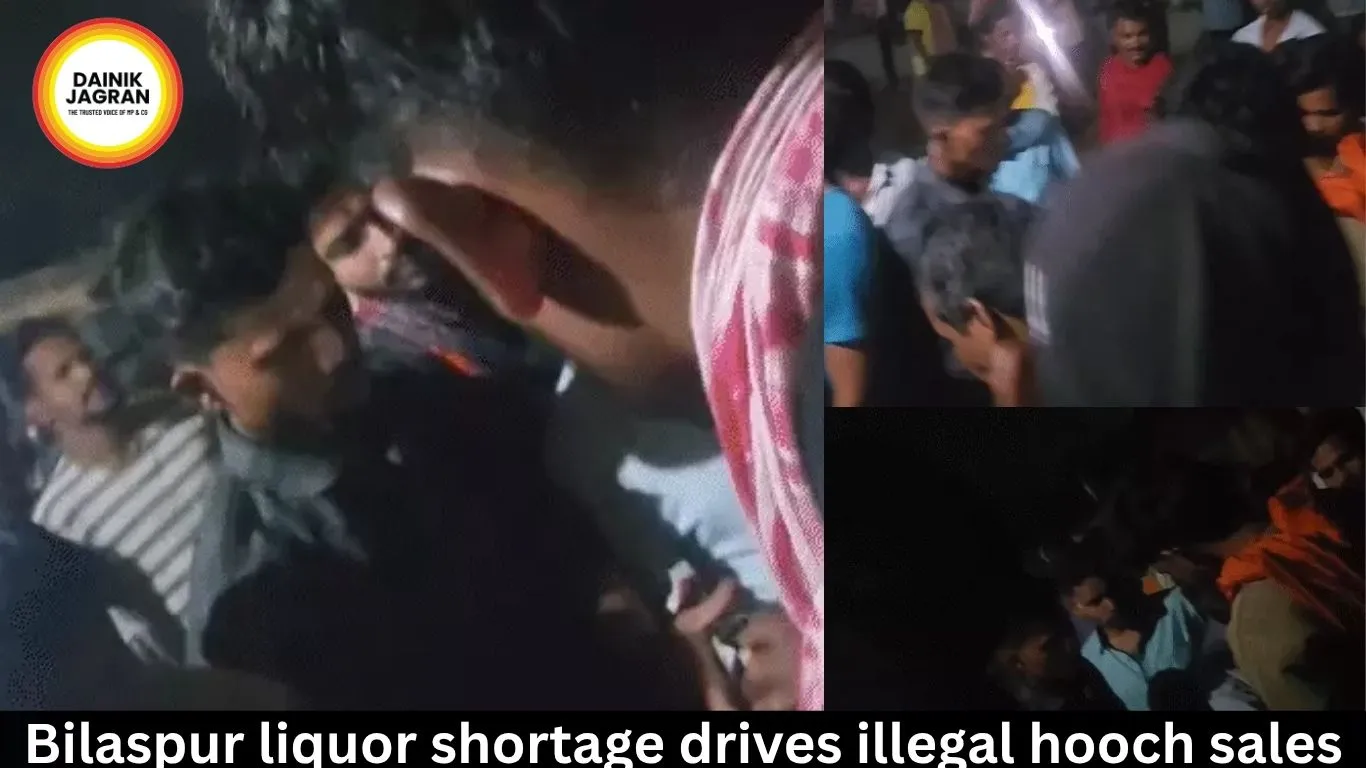
A short video filmed in the Kotar area this week shows the situation in plain daylight. In the footage, a youth in casual clothes is seen passing small pouches through a narrow gap between tabletops near the snack centre while a small crowd waits. The clip quickly went viral on regional WhatsApp groups and Facebook pages, drawing angry comments from residents who accused excise officials and local “kochhiya” (underground) vendors of colluding to drain genuine stock into the black market.
Residents in Bilaspur town say such open‑air sales have become more visible in the past few weeks, especially after morning rush hours when counters officially run out.
Police catch one, investigation widening
Following the virality of the video, a police team from Kotar station conducted a raid near the snack centre in the Jhunzhat belt beside the liquor shop. Officers arrested 19‑year‑old Rohan Sahu, recovering 16 “pao” pouches of plain desi liquor from his possession. Another youth present at the scene was questioned and released after no contraband was found on him, police said.
A senior police official told this paper that the case is being treated as illegal liquor vending under the state excise act, with further statements being recorded from nearby shopkeepers and bystanders. The official also noted that the incident has put the local excise department under fresh scrutiny, with residents demanding clarity on how large‑scale stock‑diversion is being monitored.
Raipur’s new chowpaty also under cloud
The Bilaspur issue echoes a separate controversy in the state capital, where a similar video has surfaced from the newly developed Amankata chowpaty under the Amanaka overbridge in Raipur. In that footage, youth are seen pulling liquor out of gunny bags and selling it openly to passers‑by, with the opposition Congress alleging that the stretch has become a hub for anti‑social elements.
Together, the clips from Bilaspur and Raipur have revived a broader debate over how effectively the state’s excise regime can handle both supply shocks and on‑the‑ground black‑market networks.
What comes next
Officials at the Bilaspur excise circle say they are awaiting a fresh supply schedule from the state distillery once PET‑bottle bottling stabilises. Restrictions on off‑licence hours and night‑time sales are also being reviewed, they added, to prevent hoarding and artificial shortages. Meanwhile, local police have warned that more mobile raids will be conducted around liquor shops and adjoining snack centres in the coming days.
With election‑year sensitivities around alcohol policy still fragile, the unfolding crisis in Bilaspur and Raipur may test the state’s ability to balance public‑health rhetoric with on‑ground enforcement.
--------
🚨 Beat the News Rush – Join Now!
Get breaking alerts, hot exclusives, and game-changing stories instantly on your phone. No delays, no fluff – just the edge you need. ⚡
Tap to join:
🟢 WhatsApp Channel: Dainik Jagran MP CG
Crave more?
🅕 Facebook: Dainik Jagran MP CG English
🅧 Twitter (X): Dainik Jagran MP CG
🅘 Instagram: Dainik Jagran MP CG
Share the fire – keep your crew ahead! 🗞️🔥
Bilaspur liquor shortage drives illegal hooch sales
Digital Desk
Bilaspur liquor shortage fuels illegal hooch sales at triple price
Alcohol scarcity in Bilaspur’s state‑run outlets has pushed consumers to black‑market vendors, with 80‑rupee “desi” liquor going for 200 rupees a “pao” near Kotar shop.
Shortage pushes drinkers to black market
A growing shortage of liquor in Bilaspur’s government‑run outlets has triggered a sharp spike in illegal alcohol sales, with vendors outside the Kotar liquor shop openly selling 80‑rupee “desi” liquor for 200 rupees a “pao” (around 200 ml). Late‑afternoon crowds have been seen huddling near the “chhakna” (snack) centre opposite the shop, where workers reportedly carry liquor from inside and sell it in small pouches on the roadside, evading designated counters.
Local residents say that the first‑shift queues at the Kotar outlet now clear out within an hour, leaving many regular drinkers with no option but to turn to these black‑market vendors.
Bottles not ready, supply chain disrupted
The root of the crisis lies in a state‑level change in packaging rules. Since 1 April, distilleries across Chhattisgarh have been asked to pack liquor in PET (polyethylene terephthalate) plastic bottles, replacing earlier formats. Officials and industry sources say bottling capacity has not kept pace with the new requirement, leaving many consignments idle at the distillery level and causing a knock‑on disruption in supply to approximately 800 retail outlets across the state.
In Bilaspur, local dealers estimate that daily demand for about 4,500 cartons of “desi” and low‑priced Indian‑made foreign liquor (IMFL) is now being met with only around 1,000–1,500 cartons, sometimes less. This means nearly two‑thirds of the usual stock never reaches shop shelves, especially in the morning hours.
Prices spike, demand shifts
The shortfall has already altered buying patterns. With “desi” liquor either exhausted or unavailable, many working‑class drinkers have shifted to English‑style IMFL and beer, local vendors told this outlet. This has padded margins for retailers on the limited stock that does arrive, while beer demand across the district is reported to have ballooned by roughly half.
At the same time, informal black‑market sellers are exploiting the scarcity. One clip circulating on social media shows a vendor handing over a cheap plain “desi” liquor pouch for 200 rupees, despite the official price being around 80 rupees per “pao” in licensed windows. In some instances, sacks of liquor have been glimpsed behind snack stalls, with buyers queuing for cash‑only, off‑the‑books transactions.
Video exposes open‑air sales
A short video filmed in the Kotar area this week shows the situation in plain daylight. In the footage, a youth in casual clothes is seen passing small pouches through a narrow gap between tabletops near the snack centre while a small crowd waits. The clip quickly went viral on regional WhatsApp groups and Facebook pages, drawing angry comments from residents who accused excise officials and local “kochhiya” (underground) vendors of colluding to drain genuine stock into the black market.
Residents in Bilaspur town say such open‑air sales have become more visible in the past few weeks, especially after morning rush hours when counters officially run out.
Police catch one, investigation widening
Following the virality of the video, a police team from Kotar station conducted a raid near the snack centre in the Jhunzhat belt beside the liquor shop. Officers arrested 19‑year‑old Rohan Sahu, recovering 16 “pao” pouches of plain desi liquor from his possession. Another youth present at the scene was questioned and released after no contraband was found on him, police said.
A senior police official told this paper that the case is being treated as illegal liquor vending under the state excise act, with further statements being recorded from nearby shopkeepers and bystanders. The official also noted that the incident has put the local excise department under fresh scrutiny, with residents demanding clarity on how large‑scale stock‑diversion is being monitored.
Raipur’s new chowpaty also under cloud
The Bilaspur issue echoes a separate controversy in the state capital, where a similar video has surfaced from the newly developed Amankata chowpaty under the Amanaka overbridge in Raipur. In that footage, youth are seen pulling liquor out of gunny bags and selling it openly to passers‑by, with the opposition Congress alleging that the stretch has become a hub for anti‑social elements.
Together, the clips from Bilaspur and Raipur have revived a broader debate over how effectively the state’s excise regime can handle both supply shocks and on‑the‑ground black‑market networks.
What comes next
Officials at the Bilaspur excise circle say they are awaiting a fresh supply schedule from the state distillery once PET‑bottle bottling stabilises. Restrictions on off‑licence hours and night‑time sales are also being reviewed, they added, to prevent hoarding and artificial shortages. Meanwhile, local police have warned that more mobile raids will be conducted around liquor shops and adjoining snack centres in the coming days.
With election‑year sensitivities around alcohol policy still fragile, the unfolding crisis in Bilaspur and Raipur may test the state’s ability to balance public‑health rhetoric with on‑ground enforcement.


