

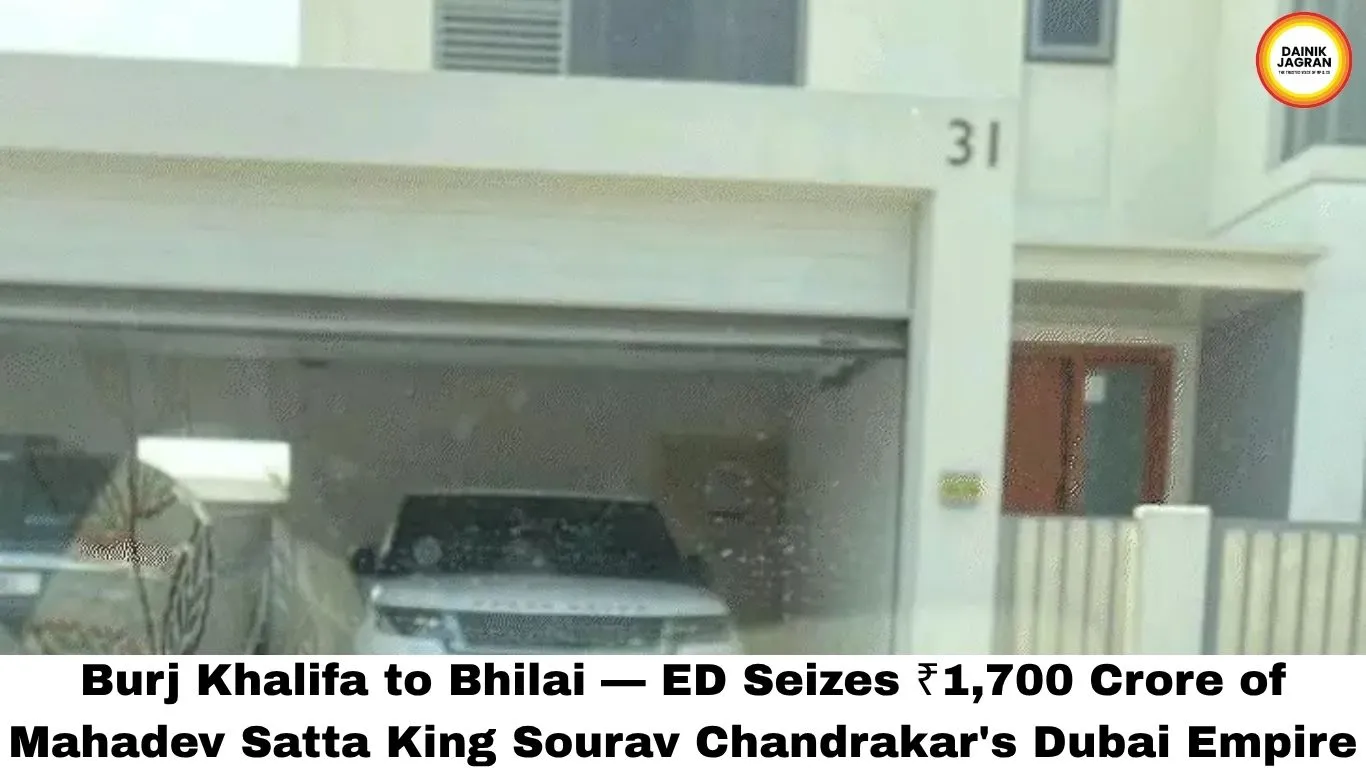
Burj Khalifa to Bhilai — ED Seizes ₹1,700 Crore of Mahadev Satta King Sourav Chandrakar's Dubai Empire

Digital Desk

Burj Khalifa to Bhilai — ED Seizes ₹1,700 Crore of Mahadev Satta King Sourav Chandrakar's Dubai Empire

ED attaches ₹1,700 crore in Dubai villas & Burj Khalifa flats linked to Mahadev app's Sourav Chandrakar. Total seizures now touch ₹4,336 crore.

From a Small Town in Chhattisgarh to the World's Tallest Building

Sourav Chandrakar grew up in Bhilai — a steel town in Chhattisgarh, far from the gleaming towers of Dubai. Today, his name is attached to an apartment in the Burj Khalifa, luxury villas in Dubai Hills Estate, high-end residences in Business Bay and a real estate portfolio in the UAE that the Enforcement Directorate has now valued at ₹1,700 crore.

All of it, the ED alleges, was bought with money stolen from ordinary Indians who placed bets on the Mahadev Online Book platform — and lost.

On March 24, 2026, the ED's Raipur zonal office issued a Provisional Attachment Order under the Prevention of Money Laundering Act attaching 18 immovable properties in Dubai and 2 in New Delhi. It is the single largest attachment in the Mahadev case to date — and it brings the total value of assets seized, frozen or attached in this investigation to a staggering ₹4,336 crore.


What Was Seized — and Where

The properties attached under the March 24 order read like a luxury real estate brochure for Dubai's most exclusive addresses:

Dubai Hills Estate — Hills View cluster: Villa No. 36 — identified as Chandrakar's primary residence, held through Perfect Plan Investment LLC in which he allegedly holds a 95 percent stake. Two additional large plots — numbers 33 and 35 — totalling approximately 72,000 sq ft, where construction of new luxury residences is currently underway using alleged proceeds of illegal betting.

Dubai Hills Estate — Fairway Residency: Villa No. 33, allegedly occupied by co-promoter Ravi Uppal. Villa No. 50 linked to associate Atul Agarwal. Villa No. 13 linked to Shubham Soni. Villa No. 71, registered in the name of Galaxy Ventures Real Estate LLC — claimed to be owned by Madhu Chhaparia, wife of associate Vikash Chhaparia, but allegedly under Chandrakar's beneficial control.

Dubai Hills Estate — Sidra Villas: Villa No. 31, reportedly occupied by associate Vishal Ramani, plus several additional units across Sidra 1, 2 and 3.

Business Bay: Commercial property registered in the name of M/s Souvik Investment LLC — a firm the ED alleges was used to layer and facilitate financial operations from betting proceeds.

SLS Hotel and Residences and Burj Khalifa: High-end apartments at both addresses — the Burj Khalifa flat being perhaps the most symbolically loaded asset in the entire case. The world's tallest building, bought with money taken from the pockets of bettors across India.

New Delhi: Two prime properties also attached under the same order.

The ED estimates Chandrakar controls 35 to 40 villas and apartments across Dubai in total — most registered in the names of associates or offshore shell companies to hide his direct ownership.


How a Betting App Built a ₹5,000 Crore Empire

The Mahadev Online Book was not just an app. It was a franchise empire — and it was engineered with the cold efficiency of a corporate business model.

The platform operated through a network of domain names including Tiger Exchange, Gold365 and Laser247, offering illegal betting on cricket, football, tennis, badminton, card games including teen patti and poker, and even Indian elections. But what made it scale so dramatically was its franchise structure.

Associates across India ran individual "panels" or "branches" — essentially local franchises that acquired customers, managed deposits and withdrawals, and channelled profits upward. The cut was simple and brutal: Chandrakar and Ravi Uppal kept 70 to 75 percent of all profits generated by every panel. Panel operators kept the rest. At the peak of operations, the syndicate had built a customer base of thousands and was illegally accumulating over ₹5,000 crore.

Getting that money out of India without detection required a multi-layered financial architecture. Proceeds were first routed through thousands of mule bank accounts — opened using the KYC documents of unsuspecting individuals who had no idea their identity was being used. The money was then transferred internationally through hawala channels and cryptocurrency transactions, arriving in Dubai scrubbed clean and ready for investment in prime real estate.

What started as a betting app in Chhattisgarh became one of India's most sophisticated cross-border money laundering operations.


The Political Shadow That Won't Go Away

The Mahadev case has never been just about gambling and money laundering. From the beginning, the ED has stated publicly that the case involves high-ranking politicians and bureaucrats from Chhattisgarh — and that political protection was the operating environment that allowed the syndicate to function at such scale for so long.

That dimension of the investigation has been the most politically sensitive and the slowest-moving. While asset attachments have been swift and sweeping, the prosecution of political beneficiaries has been far more measured. Five prosecution complaints have been filed, arraigning 74 accused before the Special PMLA Court in Raipur. But names of politicians and senior officials remain subjects of ongoing investigation rather than prosecution — at least publicly.

The Fugitive Economic Offenders Act applications filed against Chandrakar, Uppal, Anil Agrawal and Shubham Soni are significant. Being declared a Fugitive Economic Offender allows the state to confiscate all assets — not just those directly linked to the crime — and represents a significant escalation of legal pressure. But it requires the accused to be formally declared fugitives by a court, and the process is neither quick nor simple.


Where Are They Now?

Sourav Chandrakar's last known location was the UAE — which is also where most of his now-attached assets are located. India is actively pursuing his extradition, but the UAE extradition process is complex and historically slow for Indian fugitives.

Ravi Uppal's situation is even more complicated. He has reportedly fled from the UAE to Vanuatu — a Pacific island nation with no extradition treaty with India. His physical distance from Indian jurisdiction is currently his most effective legal shield.


₹4,336 Crore — and Still Counting

The March 24 attachment brings the cumulative seizure total in the Mahadev case to ₹4,336 crore — a figure that grows with almost every new round of ED action. Over 175 premises have been searched. Thirteen people have been arrested. Seventy-four accused have been arraigned before the PMLA court in Raipur.

Yet the two men at the top of the pyramid — Chandrakar and Uppal — remain outside India's reach, living in relative comfort, their extraditions grinding through diplomatic and legal processes with no confirmed timeline.

That gap — between the scale of the asset seizures and the continued freedom of the masterminds — is the central unresolved tension of this entire case.


What This Case Reveals About India's Online Betting Crisis

The Mahadev case is the most high-profile example of a much larger problem. India has no legal framework for online betting and gambling at the national level. The absence of regulation has not stopped the industry from existing — it has simply pushed it underground, where it operates without consumer protections, without tax accountability, and with enormous profits available to those willing to break the law.

The result is a system where ordinary bettors are cheated and manipulated, where KYC documents of innocent people are stolen to launder money, where hawala operators and cryptocurrency channels are enriched, and where Dubai real estate fills up with Indian black money while the Indian exchequer gets nothing.

The Mahadev case makes the argument for a regulated, taxed, legal online gaming framework in India more compellingly than any policy paper could. When you regulate an industry, you control it. When you prohibit it without enforcement, you simply hand it to criminals.


The Bottom Line

A man from Bhilai now owns — or owned, until March 24 — a flat in the Burj Khalifa, villas across Dubai Hills and a real estate empire worth ₹1,700 crore, all built on the losses of Indian bettors and the stolen identities of innocent people whose KYC documents became instruments of money laundering.

The ED has moved decisively to seize those assets. The Provisional Attachment Order is a statement of intent — that Indian law enforcement will follow the money wherever it goes, including to the 163rd floor of the world's tallest building.

But an attachment is not a conviction. The properties are frozen — not yet confiscated. The masterminds are free — not yet extradited. And the 74 accused before the Raipur court will take years to prosecute to conclusion.

India has found the money. Now it needs to find the men.

english.dainikjagranmpcg.com
26 Mar 2026 By Jiya.S

Burj Khalifa to Bhilai — ED Seizes ₹1,700 Crore of Mahadev Satta King Sourav Chandrakar's Dubai Empire

Digital Desk

From a Small Town in Chhattisgarh to the World's Tallest Building

Sourav Chandrakar grew up in Bhilai — a steel town in Chhattisgarh, far from the gleaming towers of Dubai. Today, his name is attached to an apartment in the Burj Khalifa, luxury villas in Dubai Hills Estate, high-end residences in Business Bay and a real estate portfolio in the UAE that the Enforcement Directorate has now valued at ₹1,700 crore.

All of it, the ED alleges, was bought with money stolen from ordinary Indians who placed bets on the Mahadev Online Book platform — and lost.

On March 24, 2026, the ED's Raipur zonal office issued a Provisional Attachment Order under the Prevention of Money Laundering Act attaching 18 immovable properties in Dubai and 2 in New Delhi. It is the single largest attachment in the Mahadev case to date — and it brings the total value of assets seized, frozen or attached in this investigation to a staggering ₹4,336 crore.


What Was Seized — and Where

The properties attached under the March 24 order read like a luxury real estate brochure for Dubai's most exclusive addresses:

Dubai Hills Estate — Hills View cluster: Villa No. 36 — identified as Chandrakar's primary residence, held through Perfect Plan Investment LLC in which he allegedly holds a 95 percent stake. Two additional large plots — numbers 33 and 35 — totalling approximately 72,000 sq ft, where construction of new luxury residences is currently underway using alleged proceeds of illegal betting.

Dubai Hills Estate — Fairway Residency: Villa No. 33, allegedly occupied by co-promoter Ravi Uppal. Villa No. 50 linked to associate Atul Agarwal. Villa No. 13 linked to Shubham Soni. Villa No. 71, registered in the name of Galaxy Ventures Real Estate LLC — claimed to be owned by Madhu Chhaparia, wife of associate Vikash Chhaparia, but allegedly under Chandrakar's beneficial control.

Dubai Hills Estate — Sidra Villas: Villa No. 31, reportedly occupied by associate Vishal Ramani, plus several additional units across Sidra 1, 2 and 3.

Business Bay: Commercial property registered in the name of M/s Souvik Investment LLC — a firm the ED alleges was used to layer and facilitate financial operations from betting proceeds.

SLS Hotel and Residences and Burj Khalifa: High-end apartments at both addresses — the Burj Khalifa flat being perhaps the most symbolically loaded asset in the entire case. The world's tallest building, bought with money taken from the pockets of bettors across India.

New Delhi: Two prime properties also attached under the same order.

The ED estimates Chandrakar controls 35 to 40 villas and apartments across Dubai in total — most registered in the names of associates or offshore shell companies to hide his direct ownership.


How a Betting App Built a ₹5,000 Crore Empire

The Mahadev Online Book was not just an app. It was a franchise empire — and it was engineered with the cold efficiency of a corporate business model.

The platform operated through a network of domain names including Tiger Exchange, Gold365 and Laser247, offering illegal betting on cricket, football, tennis, badminton, card games including teen patti and poker, and even Indian elections. But what made it scale so dramatically was its franchise structure.

Associates across India ran individual "panels" or "branches" — essentially local franchises that acquired customers, managed deposits and withdrawals, and channelled profits upward. The cut was simple and brutal: Chandrakar and Ravi Uppal kept 70 to 75 percent of all profits generated by every panel. Panel operators kept the rest. At the peak of operations, the syndicate had built a customer base of thousands and was illegally accumulating over ₹5,000 crore.

Getting that money out of India without detection required a multi-layered financial architecture. Proceeds were first routed through thousands of mule bank accounts — opened using the KYC documents of unsuspecting individuals who had no idea their identity was being used. The money was then transferred internationally through hawala channels and cryptocurrency transactions, arriving in Dubai scrubbed clean and ready for investment in prime real estate.

What started as a betting app in Chhattisgarh became one of India's most sophisticated cross-border money laundering operations.


The Political Shadow That Won't Go Away

The Mahadev case has never been just about gambling and money laundering. From the beginning, the ED has stated publicly that the case involves high-ranking politicians and bureaucrats from Chhattisgarh — and that political protection was the operating environment that allowed the syndicate to function at such scale for so long.

That dimension of the investigation has been the most politically sensitive and the slowest-moving. While asset attachments have been swift and sweeping, the prosecution of political beneficiaries has been far more measured. Five prosecution complaints have been filed, arraigning 74 accused before the Special PMLA Court in Raipur. But names of politicians and senior officials remain subjects of ongoing investigation rather than prosecution — at least publicly.

The Fugitive Economic Offenders Act applications filed against Chandrakar, Uppal, Anil Agrawal and Shubham Soni are significant. Being declared a Fugitive Economic Offender allows the state to confiscate all assets — not just those directly linked to the crime — and represents a significant escalation of legal pressure. But it requires the accused to be formally declared fugitives by a court, and the process is neither quick nor simple.


Where Are They Now?

Sourav Chandrakar's last known location was the UAE — which is also where most of his now-attached assets are located. India is actively pursuing his extradition, but the UAE extradition process is complex and historically slow for Indian fugitives.

Ravi Uppal's situation is even more complicated. He has reportedly fled from the UAE to Vanuatu — a Pacific island nation with no extradition treaty with India. His physical distance from Indian jurisdiction is currently his most effective legal shield.


₹4,336 Crore — and Still Counting

The March 24 attachment brings the cumulative seizure total in the Mahadev case to ₹4,336 crore — a figure that grows with almost every new round of ED action. Over 175 premises have been searched. Thirteen people have been arrested. Seventy-four accused have been arraigned before the PMLA court in Raipur.

Yet the two men at the top of the pyramid — Chandrakar and Uppal — remain outside India's reach, living in relative comfort, their extraditions grinding through diplomatic and legal processes with no confirmed timeline.

That gap — between the scale of the asset seizures and the continued freedom of the masterminds — is the central unresolved tension of this entire case.


What This Case Reveals About India's Online Betting Crisis

The Mahadev case is the most high-profile example of a much larger problem. India has no legal framework for online betting and gambling at the national level. The absence of regulation has not stopped the industry from existing — it has simply pushed it underground, where it operates without consumer protections, without tax accountability, and with enormous profits available to those willing to break the law.

The result is a system where ordinary bettors are cheated and manipulated, where KYC documents of innocent people are stolen to launder money, where hawala operators and cryptocurrency channels are enriched, and where Dubai real estate fills up with Indian black money while the Indian exchequer gets nothing.

The Mahadev case makes the argument for a regulated, taxed, legal online gaming framework in India more compellingly than any policy paper could. When you regulate an industry, you control it. When you prohibit it without enforcement, you simply hand it to criminals.


The Bottom Line

A man from Bhilai now owns — or owned, until March 24 — a flat in the Burj Khalifa, villas across Dubai Hills and a real estate empire worth ₹1,700 crore, all built on the losses of Indian bettors and the stolen identities of innocent people whose KYC documents became instruments of money laundering.

The ED has moved decisively to seize those assets. The Provisional Attachment Order is a statement of intent — that Indian law enforcement will follow the money wherever it goes, including to the 163rd floor of the world's tallest building.

But an attachment is not a conviction. The properties are frozen — not yet confiscated. The masterminds are free — not yet extradited. And the 74 accused before the Raipur court will take years to prosecute to conclusion.

India has found the money. Now it needs to find the men.

https://english.dainikjagranmpcg.com/states/chhattisgarh/burj-khalifa-to-bhilai-%E2%80%94-ed-seizes-%E2%82%B91700-crore-of/article-16001

Related Posts

Advertisement

Latest News


