


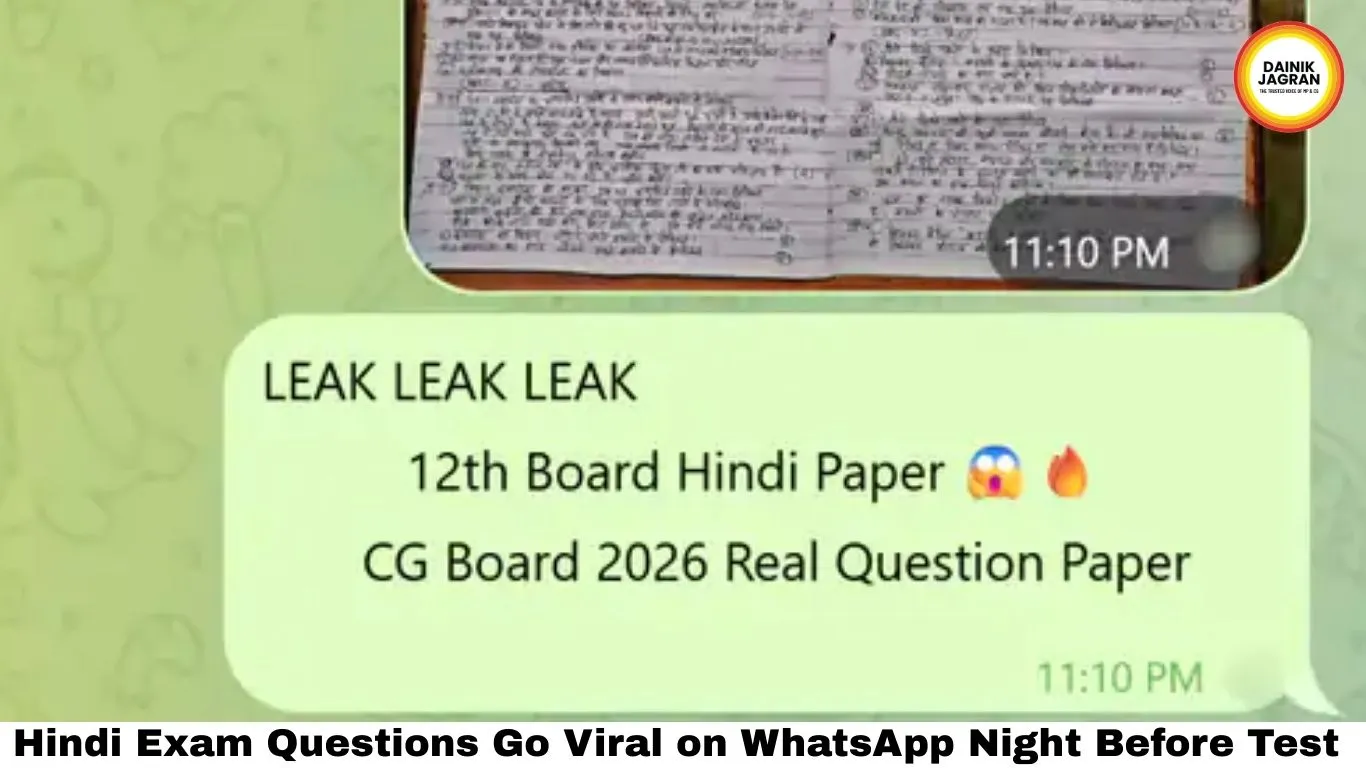
CG Board 12th Paper Leak 2026: Hindi Exam Questions Go Viral on WhatsApp Night Before Test — FIR Filed, NSUI Protests, Students in Limbo as Education Minister Calls It a Rumour
Digital Desk
The Night Before the Exam — and the Questions Were Already Out
It was the evening of March 13, 2026. Across Chhattisgarh, lakhs of Class 12 students were settling into their final hours of revision before the Hindi board examination scheduled for the next morning. Then the WhatsApp messages began to arrive — and with them, a spiral of anxiety, outrage, and chaos that the state's education system is still struggling to contain.
Questions allegedly from the Class 12 Hindi paper had begun circulating rapidly across student groups, parent networks, and teaching communities. By the time most students woke up on March 14, thousands had already seen what was being claimed as the actual examination paper. The CG Board 12th paper leak controversy of 2026 had already taken on a life of its own — before a single answer sheet had been turned over.
What Happened: A Viral Chain That Could Not Be Unrung
The Chhattisgarh Board Class 12 examinations had been running since February 20, 2026, with the final date set for March 18 — making this paper leak eruption land at the most critical and emotionally charged stretch of the entire examination calendar. Students sitting for their final board papers after months of preparation deserved, at a minimum, confidence that the system was secure. That confidence evaporated in a single night.
The Chhattisgarh Madhyamik Shiksha Mandal — the state's board of secondary education — moved swiftly on the institutional front. Acknowledging the seriousness of the situation, the board filed an FIR with both local police and the cyber cell, initiating a formal investigation into the source of the leak and the chain of circulation on WhatsApp and other platforms. The board publicly assured students and parents that the investigation would be fair and thorough.
The National Students Union of India wasted no time taking the fight to the streets. NSUI activists mounted a loud and forceful protest outside the Madhyamik Shiksha Mandal's office in Raipur, demanding a fully independent investigation, immediate accountability for those responsible, and — most critically — clarity on whether students who appeared for the March 14 Hindi examination would be disadvantaged or required to reappear.
The Minister's Denial — and Why It Raises More Questions Than It Answers
Into this charged atmosphere stepped the state's Education Minister, who issued a firm and categorical statement: the viral content was not a genuine paper leak but a deliberate rumour campaign, designed to destabilise the examination process and cause unnecessary panic among students.
The minister's position deserves to be heard — but it also demands scrutiny. If the viral content was entirely fabricated, the cyber cell investigation will prove exactly that, and those responsible for spreading misinformation should face the consequences their actions warrant. But here is where the credibility problem begins: the same state board that is publicly calling this a rumour had already filed an FIR treating it as a genuine leak serious enough for police and cyber investigation.
A government cannot simultaneously file a criminal complaint about a paper leak and dismiss the leak as a baseless rumour. These two positions are structurally incompatible. Either the content that circulated on the night of March 13 was real enough to warrant a police case — or it was not. The Education Minister owes students, parents, and teachers a clearer, more honest answer than the one currently on offer.
The Students Caught in the Middle
At the centre of this entire controversy — often forgotten in the political noise — are hundreds of thousands of young people for whom these examinations represent years of work and, in many cases, the gateway to their entire future.
For students who studied honestly and appeared for the Hindi paper on March 14, there is a profound unfairness in the current situation. If the paper was genuinely leaked, they competed on an unlevel field through no fault of their own. If the paper was not leaked and the viral content was fabricated, they still wrote their examination under a cloud of anxiety and distraction that no student should have to carry into an exam hall.
Either way, they are owed a definitive answer — and quickly. The investigation by the cyber cell needs to produce a clear finding on whether the viral questions matched the actual paper, and that finding needs to be made public without delay. The board's credibility in the eyes of an entire generation of Chhattisgarh students depends on this transparency.
Opinion: WhatsApp Leaks Are a Systemic Failure, Not Just a Criminal One
The CG Board 12th paper leak controversy is not a Chhattisgarh problem. It is an India problem that Chhattisgarh is experiencing this week.
From Rajasthan to Bihar, from Uttar Pradesh to Madhya Pradesh, question papers going viral on WhatsApp the night before board examinations have become a near-annual feature of India's examination season. Each time, the pattern is identical: viral content, panic, an FIR, protests, a denial, a probe, and then — most dangerously — silence as the academic calendar moves on and the structural vulnerabilities that allowed the leak remain entirely intact.
What needs to change is not simply the punishment for leakers — though accountability matters — but the entire architecture of how question papers are printed, stored, transported, and distributed across examination centres. End-to-end digital encryption of question delivery, randomised paper sets across examination centres, real-time monitoring of paper distribution chains, and independent oversight bodies with genuine power are not expensive or impossible demands. They are the basic infrastructure of a trustworthy examination system.
India cannot continue producing 12th standard graduates whose certificates carry a permanent asterisk in public memory — the silent, uncomfortable question of whether their examination was compromised. For a country that prides itself on the quality of its educated workforce, the integrity of the board examination is not an administrative detail. It is the foundation of everything that comes after.
The students of Chhattisgarh's Class 12 batch of 2026 did not create this crisis. The system they were handed did. They deserve better — and more importantly, every student who comes after them deserves a system that has finally been fixed.
.jpg)




