


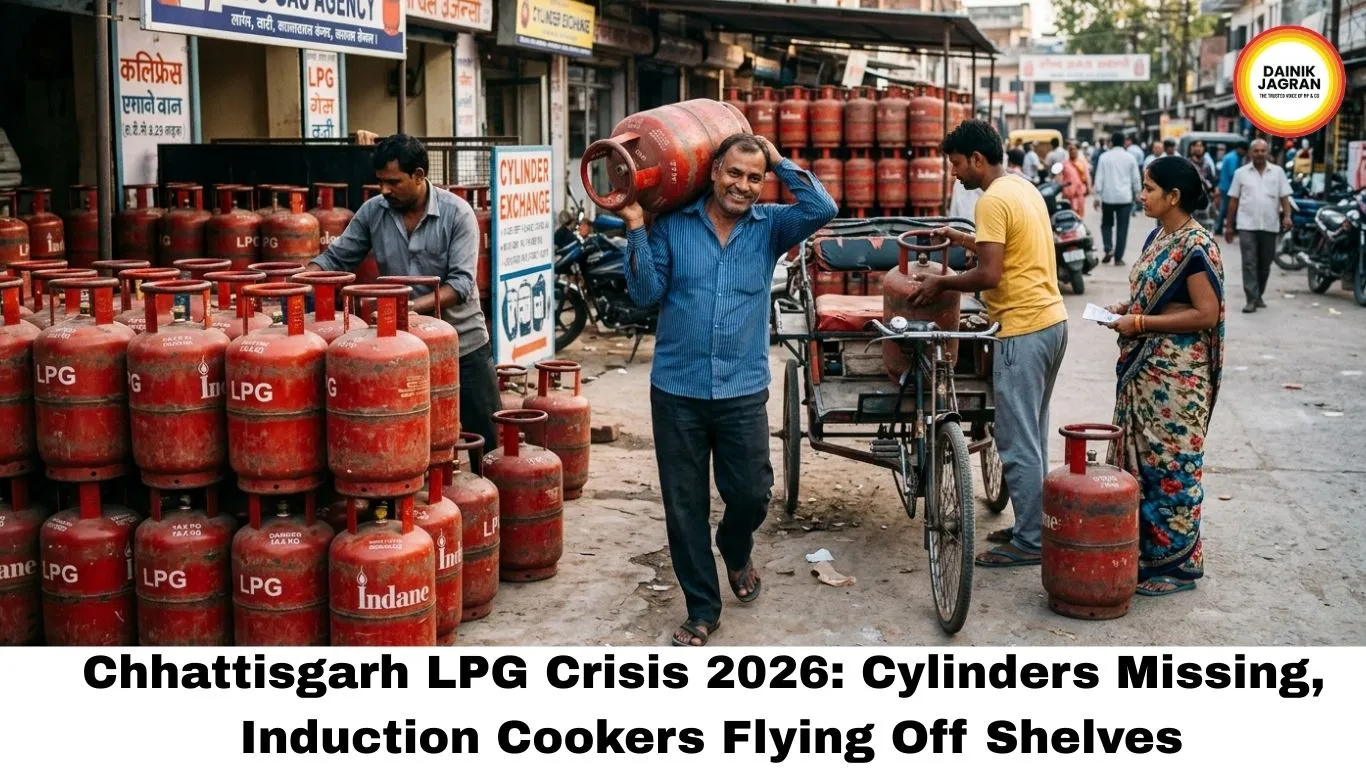
Chhattisgarh LPG Crisis 2026: Cylinders Missing, Induction Cookers Flying Off Shelves — But Is the Real Shortage Being Manufactured?
Digital Desk
Empty Cylinders, Crowded Shops
Across Chhattisgarh, a scene is playing out in every kitchen that few families could have imagined just a fortnight ago. The familiar blue flame of the LPG stove — so deeply woven into the daily rhythm of Indian home life — is burning lower, burning shorter, or not burning at all. And in its place, a new appliance is appearing on kitchen counters: the induction cooktop.
The LPG shortage arising out of the West Asia crisis has fuelled induction cooktop sales dramatically, with several models going increasingly out of stock from retail stores and e-commerce sites across India — and Chhattisgarh is no exception.
But as residents of Raipur, Bilaspur and Durg queue outside gas agencies and electronics stores alike, a sharp and important question is emerging: is this a genuine fuel crisis, or is panic itself the biggest problem?
What Is Actually Happening on the Ground
The immediate trigger is well established. India imports a large share of its crude oil and LPG requirements from West Asia. The ongoing hostilities involving Iran and US allies have led to supply disruptions, particularly through key shipping routes such as the Strait of Hormuz. Amid strained supplies, the Centre is prioritising LPG and PNG supply to households and critical sectors.
The consequence for Chhattisgarh mirrors the national picture. Commercial LPG cylinder distribution has been effectively halted — hitting restaurants, dhabas, caterers, and small food businesses hardest. Domestic cylinder refill timelines have stretched to 20–25 days, leaving families who ran out of gas this week in a genuine bind. And in that anxiety gap, the rush for alternatives has begun.
Restaurants, canteens and hotels are struggling to operate, with many cutting menus or shutting down temporarily due to the lack of commercial cylinders. Households are rushing to find alternatives, and induction cooktop sales have shot up — leaving them out of stock in several major markets.
The Chhattisgarh Mini Steel Plant Association has also flagged that coal and LPG prices may be adversely affected — signalling that the energy crisis is now bleeding beyond kitchens and into industrial production in the state.
The Induction Cooker Frenzy: Real Demand or Manufactured Panic?
Here is where the story gets more complicated — and more important.
On e-commerce platforms, induction cooktop sales have tripled on Flipkart in the last four to five days, while Amazon has seen an even bigger surge, with sales jumping nearly 30 times as households and hotels look for alternatives to LPG for daily cooking needs.
Some stores have reported demand rising more than 25 times compared to normal sales levels. In many areas, inventories were exhausted within hours of new stock arriving, as consumers rushed to place orders through instant delivery platforms.
On the surface, this looks like a genuine supply crisis. But industry experts are urging caution before the narrative spirals further.
Prakash Dadlani, an industry expert with over 30 years in the manufacturing and import/export of electronic appliances, wrote: "There is no shortage of induction cookers. Crores of cookers are already made in India." He explained that while key components like coils and cooktops are imported from China, the majority of other parts — including plastic, PCBs and wires — are sourced domestically. He clarified that the market is well-stocked, but the perception of a shortage has emerged due to a combination of panic buying and slow sales from manufacturers.
Dadlani elaborated that manufacturers are holding onto stock, distributors are increasing their storage, and sellers are inflating prices by demanding cash — a classic panic-amplification cycle where fear, not scarcity, is the primary driver.
In short: induction cookers are available. But fear of shortage is causing a rush that is creating the very shortage people fear. Chhattisgarh's consumers — and those advising them — must understand this difference clearly.
The Practical Reality: Switching to Induction Is Not Simple
For families considering the switch, there is an important technical reality that is often missed in the panic buying rush.
Unlike conventional gas burners, induction cooktops run on electricity and heat food using electromagnetic energy. But consumers switching to them quickly discover an important detail: the appliances only work with specific types of cookware. India TV News Traditional aluminium vessels, clay pots, and most standard Indian cooking utensils are not induction-compatible. Families buying an induction cooker may find they also need to replace their entire set of cooking vessels — an additional expense that can easily double the total cost of the switch.
For most households, domestic LPG supply remains stable. The current shortage is largely affecting commercial cylinders used by restaurants. There is no need to panic-buy appliances. However, an induction cooker can still be useful as a backup cooking option, especially in homes that rely entirely on a single LPG cylinder — and it is handy during cylinder refills or late-night cooking in small kitchens.
This is practical, grounded advice — and it is what Chhattisgarh's residents most need to hear right now.
What Retailers Are Reporting Across the State
The retail picture in Chhattisgarh echoes the national trend, but with local flavour.
Retailers across affected regions report nearly a threefold increase in induction cooker sales due to the LPG shortage. There has also been a rise in sales of heating coils and other products, as people try to cook part of their meals on gas and the rest on induction.
Meanwhile, for commercial establishments unable to source electric alternatives quickly enough, a more traditional solution is gaining traction. Many commercial establishments are placing orders for tandoors, while several crockery stores have reported running out of induction plates due to rising demand. Reports have also surfaced of domestic cylinders being sold for more than ₹1,700 and commercial cylinders allegedly fetching up to ₹2,500 on the black market.
Black market pricing is the most damaging symptom of this crisis. It hits the poorest consumers hardest — those who cannot afford to buy an induction cooker, cannot wait 25 days for a refill, and have no alternative but to pay inflated prices for the fuel they need to cook today's meals.
The Government Must Do Four Things Right Now
The Vishnu Deo Sai government in Chhattisgarh and the central government together must act on four fronts without delay:
- Clamp down on black market LPG immediately: The Essential Commodities Act must be enforced with real teeth — not press releases. District collectors must deploy field teams at every distribution point.
- Issue a clear public advisory on induction cookers: Residents need to know that the appliance shortage is largely perception-driven, that basic models are available at ₹2,000–₹5,000, and that they need compatible cookware to use them effectively.
- Fast-track PNG network expansion in Chhattisgarh's urban areas: Raipur, Bilaspur and Durg must be prioritised for piped natural gas networks that are immune to import disruption.
- Protect small food vendors: An emergency support package — either subsidised alternative fuel access or a temporary daily allowance — must be extended to the thousands of small dhabas, tea stalls and street vendors whose livelihoods have been directly destroyed by the commercial LPG cutoff.
Stay Calm, Stay Informed, Stay Prepared
The Chhattisgarh LPG crisis of 2026 is real — but it is not as catastrophic as the emptied shelves and long queues suggest. Union Minister Suresh Gopi has confirmed that India is actively working to stabilise LPG supply and secure additional imports amid Hormuz Strait disruptions, with priority given to essential services.
The Strait of Hormuz will not remain closed forever. India's domestic production is being ramped up. Alternative supply chains are being activated. This is a crisis with a foreseeable end — provided panic does not make it worse.
For the people of Chhattisgarh, the message is simple: do not rush to buy what you do not urgently need, do not pay black market prices if you can avoid it, and do report any hoarding or price gouging to your district administration's control room immediately.
The flame in your kitchen will return. Make sure that when it does, you have not already been burned by those who profit from your fear.
A cylinder shortage is a policy problem. A panic shortage is a people problem. Chhattisgarh must solve both — starting today.


.jpg)




