


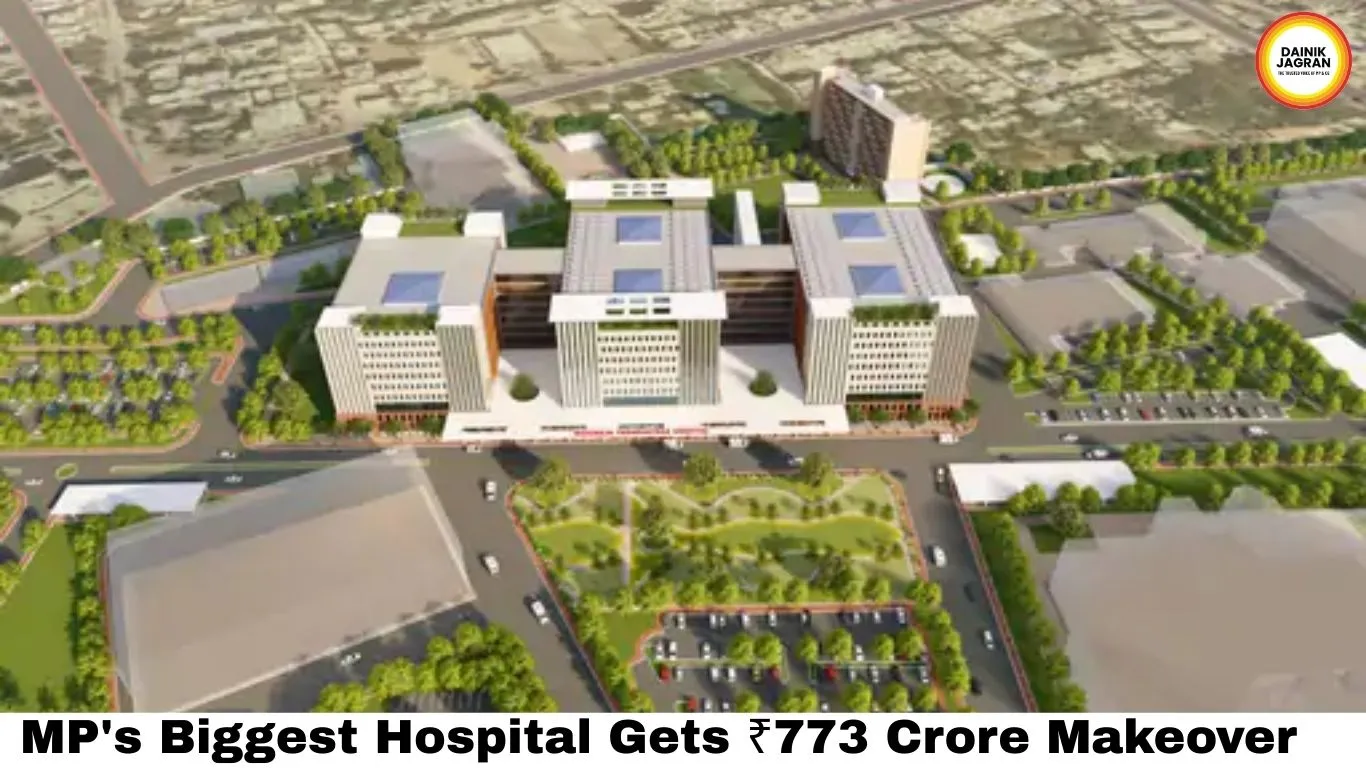
New MY Hospital Indore 2026: MP's Biggest Hospital Gets ₹773 Crore Makeover — 1,700 Beds, Helipad & 36-Month Deadline
Digital Desk
A 70-Year-Old Giant Needs a New Body
It was once Asia's largest government hospital when it opened its doors in 1955. Today, Maharaja Yeshwantrao Hospital — universally known as MY Hospital — is a 70-year-old structure carrying the healthcare weight of millions of people from Indore, the entire Malwa region, Ujjain, and beyond. The walls seep water. The infrastructure groans under daily footfalls of over 5,000 outpatients. And the 1,152 beds — once considered vast — are nowhere near enough for one of central India's most critical public health facilities.
The Madhya Pradesh government has finally said: enough. A brand new MY Hospital is being built — and the new MY Hospital Indore 2026 project is the most ambitious public healthcare construction in the state's history.
The Numbers That Define This Project
The revised blueprint approved by the state government tells a story of scale. What began as a 1,450-bed proposal has been expanded to a 1,700-bed facility, built across nearly eight acres of land near the existing MY Hospital campus. The estimated construction cost stands at ₹773 crore — expected to rise further with the capacity expansion — and the entire project must be completed within 36 months.
The Madhya Pradesh Building Development Corporation (MPBDC) will execute the project, with Delhi-based DDF Consultants handling the architectural design. Health Minister Rajendra Shukla has called this investment a milestone for medical services not just in Indore, but across the entire Malwa belt. Minister Tulsi Silawat described the new facility as a healthcare landmark that will serve the region for the next 50 to 60 years.
What the New Hospital Will Look Like: A to Z
The 11-storey structure will be organised into three distinct functional blocks. The Administrative Block will house all offices and management functions. The Patient Care Block will manage OPD and IPD services — the daily lifeline for thousands of patients. The Support Block will be dedicated to trauma and emergency units, designed to handle high-pressure critical care situations around the clock.
The most striking feature is a rooftop helipad on the 11th floor — enabling rapid airlifting of critical patients from districts that currently have no access to tertiary care. Two multi-level parking facilities will be built to end the perpetual chaos of vehicles spilling across hospital roads. A 550-bed nursing hostel and staff residential quarters will also be constructed within the campus to attract and retain quality healthcare professionals.
The design philosophy is clear: reduce congestion, improve patient flow, raise hygiene standards, and future-proof Indore's public health infrastructure for generations to come.
The Obstacles Standing in the Way
On paper, the project is spectacular. On the ground, it faces significant hurdles. Clearing the construction zone alone is a massive task. Over 10 private encroachments have been identified within the proposed site — including unauthorised shops, makeshift canteens, private medical stores, and temporary settlements behind the Super Specialty Hospital and near the MY TB Centre.
Government-owned buildings also fall within the demolition zone — including the old Cancer Hospital, old hostel quarters, and sections of the Chacha Nehru Hospital campus. Small eateries and tea stalls that generations of patients' families have depended on near the boundary walls will be relocated in coordination with civic authorities. Officials say preparations to vacate these premises are already underway.
There have also been administrative missteps. Authorities responsible for the project reportedly did not consult officials from MGM Medical College or MY Hospital itself before preparing the initial proposal — a lapse that raised concerns about ground-level planning and eventual operational integration.
Why the Old Hospital Will Not Be Demolished
One of the most important aspects of this project is what will not happen: the existing MY Hospital building will continue to function throughout construction and beyond. The old structure, despite its age and deteriorating condition, currently serves 4,000 patients every single day. Shutting it down during a three-year construction window would be a public health catastrophe.
The new facility will be built alongside the existing one, eventually forming a seamlessly connected medical zone along with the Super Specialty Hospital, Chacha Nehru Bal Chikitsalay, and the Cancer Hospital — creating a comprehensive, integrated healthcare campus that will be without parallel in central India.
Indore Deserves This — But Accountability Must Match Ambition
MY Hospital is not just a building. It is the only real option for millions of poor and middle-class families who cannot afford Indore's private hospitals. When its walls leak, when its corridors are overcrowded, when its equipment is outdated — real people suffer real consequences.
The ₹773 crore project is long overdue and deeply welcome. But large government hospital projects in India have a troubled history of cost overruns, delayed timelines, and quality shortcuts. The 36-month deadline must be treated as a firm commitment, not an optimistic estimate. The MPBDC, DDF Consultants, and the state government must ensure transparent, regular progress updates accessible to the public and media.
Indore topped the Swachh Survekshan rankings for years on the promise of accountability and execution. It is time to bring that same energy to the healthcare infrastructure that its poorest citizens depend on most.
.jpg)




