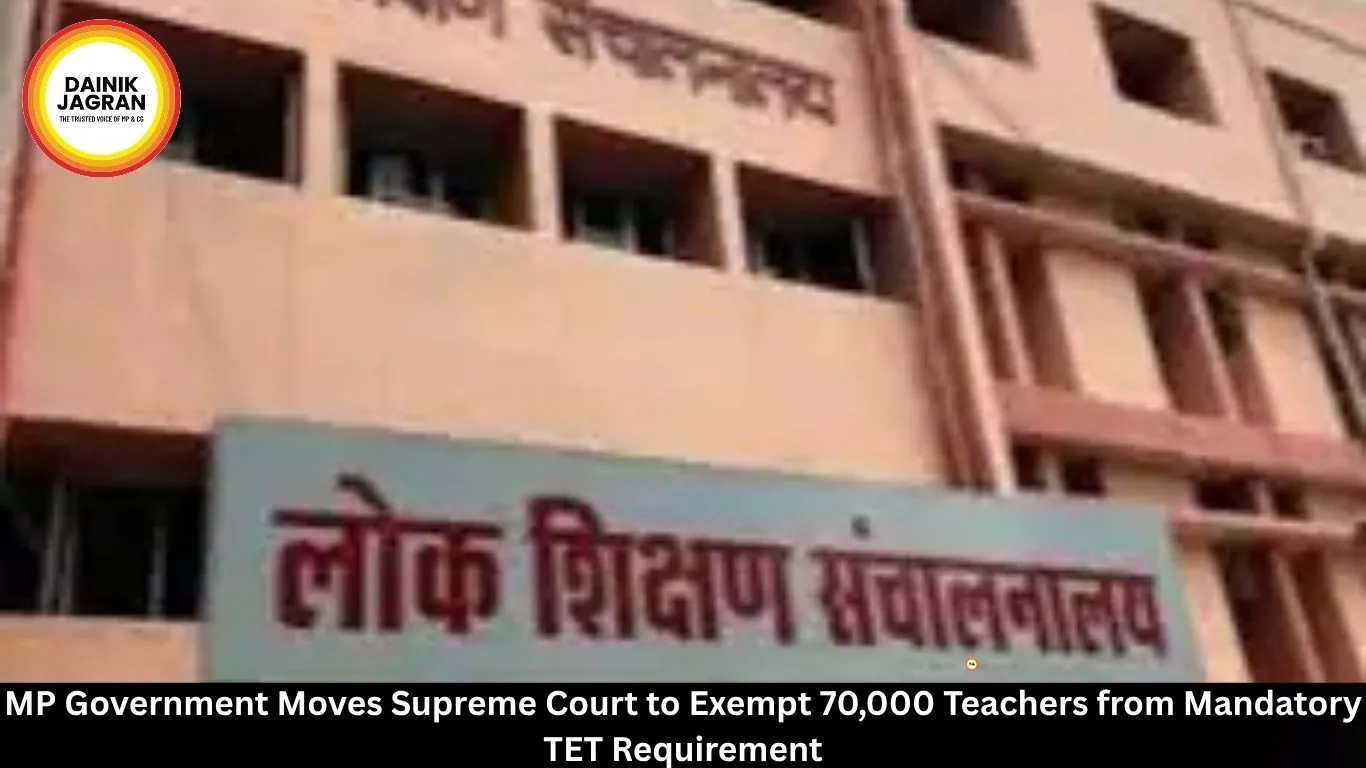
MP Government Appeals to SC to Exempt 70k Teachers from TET
Digital Desk
The MP School Education Department is filing a fresh Supreme Court petition to exempt 70,000 teachers recruited via Vyapam between 2005-2009 from the mandatory TET.
The Madhya Pradesh School Education Department is preparing to approach the Supreme Court of India once again in a desperate bid to rescue nearly 70,000 state teachers from the stringent preview of the mandatory Teacher Eligibility Test (TET). The state’s primary legal contention hinges on the fact that these educators, recruited between 2005 and 2009, had already cleared rigorous state-administered competitive selection exams to secure their government jobs, making a mid-career eligibility re-test fundamentally unfair.
The administrative logjam impacts roughly 150,000 teachers appointed before the Right to Education (RTE) Act of 2009 was officially enacted. Following a firm directive from the Supreme Court in September 2025, the Directorate of Public Instruction (DPI) issued orders this past April, scheduling the mandatory TET for July and August for all veterans appointed between 1998 and 2009.
The Scope of the Supreme Court's Mandate
The apex court’s ruling establishes a definitive threshold for service continuity based on remaining employment tenure. Teachers with less than five years left before their official retirement are completely exempted from the re-certification process. However, those with more than five years of remaining service must pass the TET or face compulsory retirement from state services.
While the court initially set August 31, 2027, as the absolute deadline for clearing the evaluation, it later extended the grace period to August 31, 2028, due to widespread administrative and systemic challenges. Additionally, the court provided partial relief by allowing teachers who fail the initial attempt to reappear in subsequent cycles up until the 2028 cutoff.
The 2005–2009 Recruitment Defense
The Madhya Pradesh government is now building a legal firewall specifically around the 70,000 teachers recruited between 2005 and 2009. This particular cadre was inducted via competitive exams conducted by Vyapam (the MP Professional Examination Board).
-
The Vyapam Merits: The state plans to argue that these teachers cannot be categorized alongside irregular or backdoor appointments, as they survived a highly competitive, state-supervised academic filter.
-
The Legal Hitch: Although these selections were merit-based, the examinations did not technically align with the specific guidelines subsequently established by the National Council for Teacher Education (NCTE) for the standardized TET.
According to senior bureaucratic sources, the School Education Department has concluded detailed consultations with the State Law Department and senior Supreme Court advocates in New Delhi. The state is expected to file its fresh special petition within the week. While top officials privately concede that the probability of the apex court diluting its stance is low, the government is pursuing the legal remedy to demonstrate political solidarity with the state’s massive teaching unions.
"The parliament’s underlying objective behind the RTE Act was to guarantee quality education to future generations. Consequently, active teachers must acquire the absolute baseline qualifications within the stipulated timeframe. The court cannot invalidate this mandate solely based on apprehensions of job loss, as allowing uncertified educators to continue indefinitely compromises the academic future of children." — Supreme Court (Observations from previous review dismissals)
A History of Stern Judicial Refusals
The Supreme Court has maintained an uncompromising posture on educational quality, having already summarily dismissed over 65 review petitions concerning the mandatory TET rule. These petitions were filed collectively by various state governments, teachers' associations, and individual litigators seeking a reversal of the landmark 2025 judgment.
Teacher unions have repeatedly argued that forcing mid-career employees to pass a baseline entrance exam constitutes an arbitrary alteration of their original service conditions. However, the apex court has consistently prioritized institutional standards over labor protections in this context. Thousands of teaching families across Madhya Pradesh are now anxiously awaiting the top court's reaction to this new petition, which could decide the fate of nearly half of the state's veteran teaching workforce.

--------
🚨 Beat the News Rush – Join Now!
Get breaking alerts, hot exclusives, and game-changing stories instantly on your phone. No delays, no fluff – just the edge you need. ⚡
Tap to join:
🟢 WhatsApp Channel: Dainik Jagran MP CG
Crave more?
🅕 Facebook: Dainik Jagran MP CG English
🅧 Twitter (X): Dainik Jagran MP CG
🅘 Instagram: Dainik Jagran MP CG
Share the fire – keep your crew ahead! 🗞️🔥
MP Government Appeals to SC to Exempt 70k Teachers from TET
Digital Desk
The Madhya Pradesh School Education Department is preparing to approach the Supreme Court of India once again in a desperate bid to rescue nearly 70,000 state teachers from the stringent preview of the mandatory Teacher Eligibility Test (TET). The state’s primary legal contention hinges on the fact that these educators, recruited between 2005 and 2009, had already cleared rigorous state-administered competitive selection exams to secure their government jobs, making a mid-career eligibility re-test fundamentally unfair.
The administrative logjam impacts roughly 150,000 teachers appointed before the Right to Education (RTE) Act of 2009 was officially enacted. Following a firm directive from the Supreme Court in September 2025, the Directorate of Public Instruction (DPI) issued orders this past April, scheduling the mandatory TET for July and August for all veterans appointed between 1998 and 2009.
The Scope of the Supreme Court's Mandate
The apex court’s ruling establishes a definitive threshold for service continuity based on remaining employment tenure. Teachers with less than five years left before their official retirement are completely exempted from the re-certification process. However, those with more than five years of remaining service must pass the TET or face compulsory retirement from state services.
While the court initially set August 31, 2027, as the absolute deadline for clearing the evaluation, it later extended the grace period to August 31, 2028, due to widespread administrative and systemic challenges. Additionally, the court provided partial relief by allowing teachers who fail the initial attempt to reappear in subsequent cycles up until the 2028 cutoff.
The 2005–2009 Recruitment Defense
The Madhya Pradesh government is now building a legal firewall specifically around the 70,000 teachers recruited between 2005 and 2009. This particular cadre was inducted via competitive exams conducted by Vyapam (the MP Professional Examination Board).
-
The Vyapam Merits: The state plans to argue that these teachers cannot be categorized alongside irregular or backdoor appointments, as they survived a highly competitive, state-supervised academic filter.
-
The Legal Hitch: Although these selections were merit-based, the examinations did not technically align with the specific guidelines subsequently established by the National Council for Teacher Education (NCTE) for the standardized TET.
According to senior bureaucratic sources, the School Education Department has concluded detailed consultations with the State Law Department and senior Supreme Court advocates in New Delhi. The state is expected to file its fresh special petition within the week. While top officials privately concede that the probability of the apex court diluting its stance is low, the government is pursuing the legal remedy to demonstrate political solidarity with the state’s massive teaching unions.
"The parliament’s underlying objective behind the RTE Act was to guarantee quality education to future generations. Consequently, active teachers must acquire the absolute baseline qualifications within the stipulated timeframe. The court cannot invalidate this mandate solely based on apprehensions of job loss, as allowing uncertified educators to continue indefinitely compromises the academic future of children." — Supreme Court (Observations from previous review dismissals)
A History of Stern Judicial Refusals
The Supreme Court has maintained an uncompromising posture on educational quality, having already summarily dismissed over 65 review petitions concerning the mandatory TET rule. These petitions were filed collectively by various state governments, teachers' associations, and individual litigators seeking a reversal of the landmark 2025 judgment.
Teacher unions have repeatedly argued that forcing mid-career employees to pass a baseline entrance exam constitutes an arbitrary alteration of their original service conditions. However, the apex court has consistently prioritized institutional standards over labor protections in this context. Thousands of teaching families across Madhya Pradesh are now anxiously awaiting the top court's reaction to this new petition, which could decide the fate of nearly half of the state's veteran teaching workforce.