


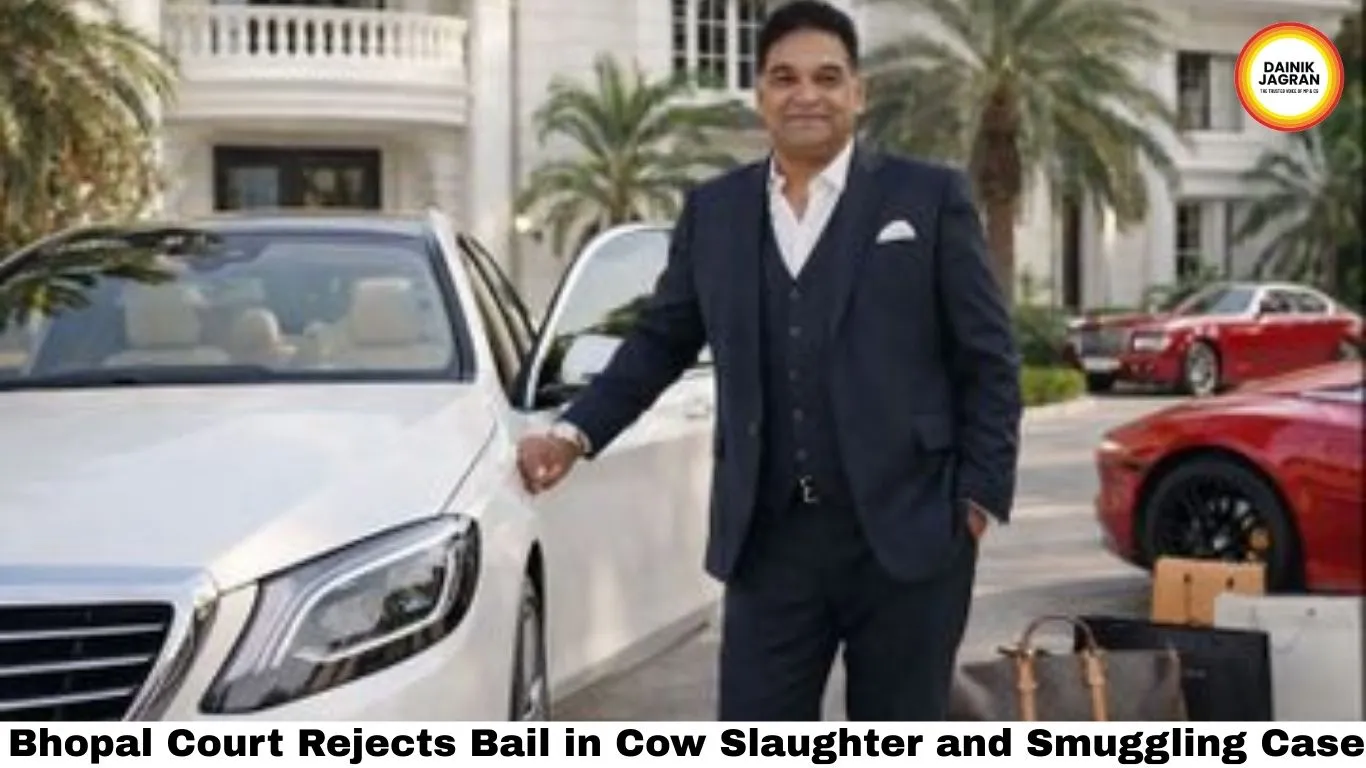
Bhopal Court Rejects Bail in Cow Slaughter and Smuggling Case — Aslam 'Chamda' Stays Behind Bars as Hindu Organisations Object
Digital Desk
A Court Says No — And a City Exhales
In a significant legal development that has kept Bhopal's political and social circles on edge, a local court has rejected the bail application of the accused in the now-infamous Bhopal cow slaughter and beef smuggling case. The man at the centre of the storm — Aslam Qureshi, widely known as Aslam 'Chamda' — remains in judicial custody as investigators continue to peel back the layers of what is turning out to be one of the most politically charged criminal cases in Madhya Pradesh in recent years.
In the high-profile Bhopal 26.5-tonne beef recovery case, the Hindu Utsav Samiti has filed an objection in court against the bail application of the accused Aslam Chamda, actively opposing his release from jail. The court's decision to reject bail, in the face of organised civil society opposition, sends a clear message: this case will not be quietly buried.
Who Is Aslam 'Chamda' and How Did He Build His Empire?
The story of Aslam Qureshi is a textbook case of how alleged criminality, political patronage, and institutional failure can combine over decades to create untouchable power.
Aslam began his business journey around 1988, purchasing buffalo hides from villages across Sehore, Vidisha, Raisen and Ashta — earning him the nickname 'Chamda', meaning animal hide. From those humble beginnings, his alleged operations grew far beyond the hide trade.
Over the years, he allegedly built a massive business empire — reportedly with influence over local administration and politicians. Sources claim Aslam owns over 30 properties across Bhopal and other cities, including luxury villas and bungalows. His lavish lifestyle is under police scrutiny, with reports that he frequently travelled to Mumbai, Dubai and other destinations.
He is accused of operating and controlling the slaughterhouse for nearly 20 years, reportedly aided by patronage from regional leaders and officials, which helped him repeatedly secure government contracts.
This is not a small-time offender. This is an alleged criminal ecosystem — built brick by brick over two decades.
The 26.5-Tonne Scandal: What Was Found
The scale of the seizure that triggered Aslam's arrest shocked even seasoned law enforcement officials. A total of 1,325 cartons containing boneless frozen buffalo meat were being transported to the cold storage facility of a Mumbai-based beef export company allegedly sourced from illegal slaughterhouse operations at the BMC facility in Jinsi, Bhopal.
During Aslam's remand, police seized slaughterhouse-related records from 2014-15 onwards and questioned municipal employees, including assistant engineer Saurabh Sood. Officials say further summons to municipal officers are likely as the investigation expands.
The investigation has also opened a disturbing sub-chapter. The NHRC rejected a police report in October 2025, pointing out serious investigative lapses — noting that while police termed allegations baseless, Aslam himself admitted to employing labourers from border states such as West Bengal, Assam and Bihar and housing them on his private property. Police had also failed to verify the authenticity of labourers' identity documents.
The Political Dimension: Who Turned a Blind Eye?
Bhopal MP Alok Sharma alleged that opening the slaughterhouse could not have been possible without the collusion of local police and municipal corporation employees — noting that when he was Bhopal's mayor, he did not allow a single slaughterhouse to open. He stated that several officials were involved and their role must be investigated. DNA India
Even after the Bhopal Municipal Corporation sealed the slaughterhouse, Qureshi's influence is said to persist. The land opposite the slaughterhouse, allotted for a Metro rail project, remains under his aides' control.
This is the detail that should disturb every Bhopal resident the most. A man in judicial custody, accused of decades of illegal operations, allegedly still holds influence over prime government land. It raises a question that the court proceedings alone cannot answer: how deep does this network go, and how many officials enabled it?
What the Law Says — And How Courts Are Responding
India's judicial system has taken an increasingly firm stance on cow slaughter and smuggling cases. The Punjab and Haryana High Court recently held that anticipatory bail is a discretionary relief intended to protect innocent individuals — not to provide sanctuary to those who repeatedly violate the law with impunity. The court noted that Article 51A(g) of the Constitution encourages compassion toward all living creatures, but cow slaughter committed repeatedly and deliberately strikes at the core of constitutional morality and social order.
Courts have further noted that in a pluralistic society, certain acts that offend the deeply held beliefs of a significant population group can have severe repercussions on public peace — making bail decisions not merely legal, but social in their consequence.
In the Bhopal case, the court's rejection of bail aligns with this national judicial trend — recognising that the gravity of the alleged offence, the scale of the operation, and the accused's alleged influence all weigh heavily against release.
What Must Happen Next
The bail rejection is a legal milestone — but the real accountability is still pending. Here is what investigators, administrators, and the government must now deliver:
- A full audit of all BMC slaughterhouse contracts issued since 2014-15, with public disclosure of who approved them and on what basis.
- Prosecution of officials who allegedly enabled two decades of illegal operations — junior employees cannot be the only ones held accountable.
- Independent verification of land records adjacent to the sealed slaughterhouse, to ensure no further unauthorised control is exercised.
- Fast-tracked chargesheeting so that the case does not languish in procedural delays for years.
Conclusion: Justice Must Go Beyond the Bail Hearing
The Bhopal court's rejection of Aslam Chamda's bail is an important signal — but it is only the beginning. Thousands of such cases across India end with the accused eventually securing bail, charges being diluted, and powerful networks quietly reassembling themselves.
For the people of Bhopal, the 26.5-tonne beef case is not just about one man or one slaughterhouse. It is about whether a city and a state can genuinely dismantle the web of corruption and political patronage that allegedly allowed illegal operations to flourish for two decades, right inside a municipal facility.
The court has held the line. Now the investigation, the prosecution, and the government must do the same.
An empire built on illegal slaughter cannot be dismantled with one bail rejection. But it has to start somewhere.




.jpg)




