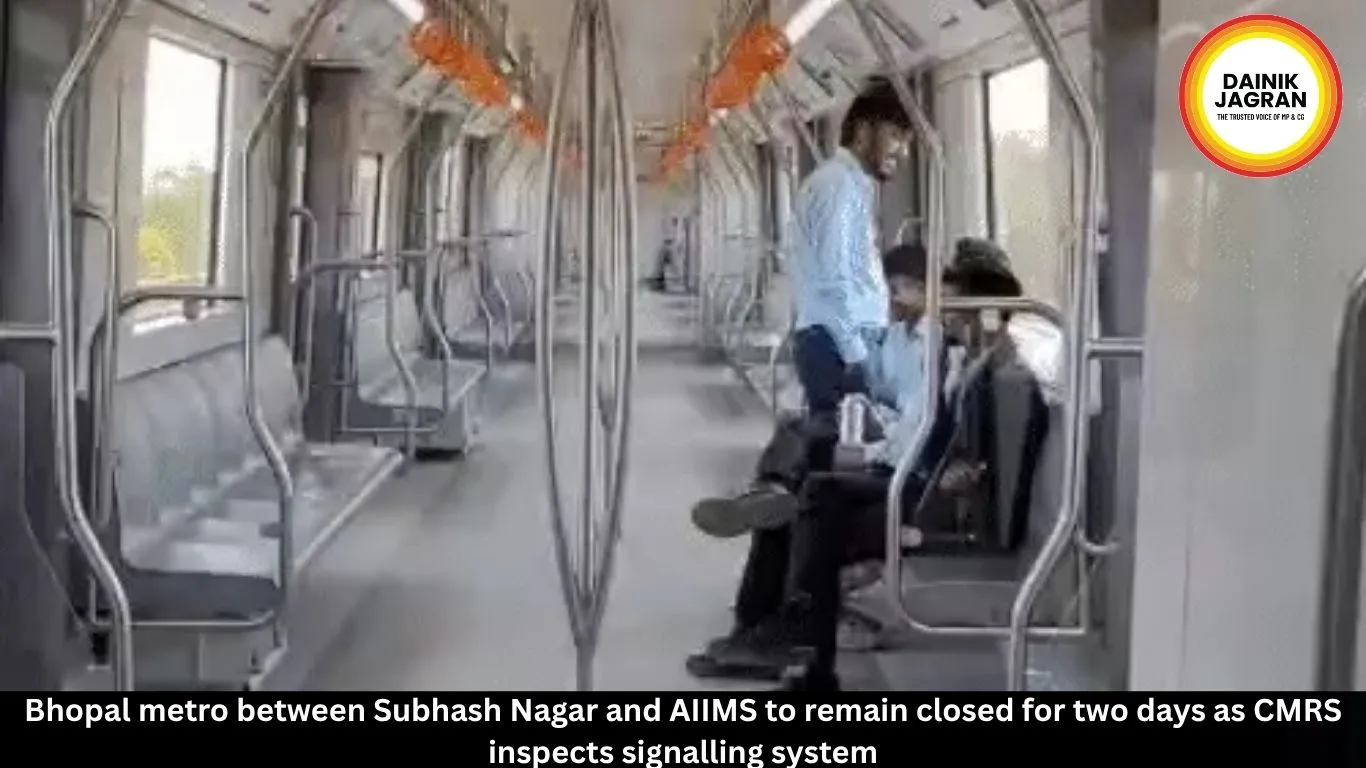
Bhopal metro between Subhash Nagar and AIIMS to remain closed for two days as CMRS inspects signalling system
Digital Desk
Metro services on the Subhash Nagar–AIIMS stretch will be suspended for two days, Wednesday and Thursday, while the Commissioner of Metro Rail Safety (CMRS) inspects and tests a newly installed signalling system, officials said. The CMRS team arrived in the city on Tuesday and will issue a clearance before trains resume under the updated schedule.
The halt affects the roughly 7‑kilometre priority corridor where signalling work has now been completed as the first phase of an about ₹800 crore contract to upgrade systems across the combined 30 km Orange‑Yellow routes in Bhopal and Indore. Metro authorities said the inspection and trial will determine whether the system is fully functional; once the CMRS gives an “OK” report, the improved signalling will be activated and a fresh timetable announced.
At present only 12 km of the network is operational and, because there is no full signalling in place, services run on a single track. That constraint has kept train frequency at one service every 75 minutes, meaning long waits for commuters. Officials expect the new signalling to allow two‑track operation between Subhash Nagar and AIIMS, reducing headways and significantly increasing train frequency.
“We are expecting trials to be completed and normal services to resume from June 26 with a revised timetable,” a metro official said, declining to give further details before the CMRS sign‑off. Commuters will be informed about the new timings after certification.
Why the shutdown matters
Technical experts describe signalling as the backbone of any metro network. Beyond simple signals, modern systems manage train speed, maintain safe gaps between trains, enable automated operations, and handle emergency controls. Without it, multi‑track running — and the higher frequency riders expect — is not possible. In Bhopal’s case, lack of signalling has forced trains to use the down track for both directions: the same train that travels out returns on the same track, leaving the up track unused.
Passengers and civic groups have often criticised the slow pace of services. “Bhopal metro runs even slower than a bicycle at times,” said one commuter on social media, reflecting widespread frustration over sparse services that largely operate only between noon and late afternoon. Officials say the new system, modelled on technology used by the Delhi Metro, will allow safer and more frequent operations and help extend service hours to better match office and peak travel times.
What to expect next
-
CMRS inspection and testing over the two days will check interoperability, fail‑safe responses, and emergency procedures.
-
After formal clearance, the metro operator will publish a new schedule; officials say the timetable change will be rolled out in July when the signalling is fully operational.
-
Authorities anticipate shorter headways and more trips per day, easing crowding and reducing wait times during peak hours.
Background and scale
The signalling upgrade on the Subhash Nagar–AIIMS section is the first deliverable under a larger ₹800 crore tender for the combined Orange‑Yellow corridors across Bhopal and Indore. Once implemented across the network, the system is expected to enable continuous two‑track operation and automated features similar to those used in established metros in India.
For now, commuters relying on the Subhash Nagar–AIIMS stretch should plan alternate transport for Wednesday and Thursday. Metro officials said station staff and customer service teams will assist passengers during the suspension and that updates will be shared through official channels and social media after the CMRS completes its review.
Further technical details, the exact revised schedule and any phased recommencement plan will be confirmed after the CMRS issues its report. Authorities urged commuters to watch official metro handles for the latest information.

--------
🚨 Beat the News Rush – Join Now!
Get breaking alerts, hot exclusives, and game-changing stories instantly on your phone. No delays, no fluff – just the edge you need. ⚡
Tap to join:
🟢 WhatsApp Channel: Dainik Jagran MP CG
Crave more?
🅕 Facebook: Dainik Jagran MP CG English
🅧 Twitter (X): Dainik Jagran MP CG
🅘 Instagram: Dainik Jagran MP CG
Share the fire – keep your crew ahead! 🗞️🔥
Bhopal metro between Subhash Nagar and AIIMS to remain closed for two days as CMRS inspects signalling system
Digital Desk
The halt affects the roughly 7‑kilometre priority corridor where signalling work has now been completed as the first phase of an about ₹800 crore contract to upgrade systems across the combined 30 km Orange‑Yellow routes in Bhopal and Indore. Metro authorities said the inspection and trial will determine whether the system is fully functional; once the CMRS gives an “OK” report, the improved signalling will be activated and a fresh timetable announced.
At present only 12 km of the network is operational and, because there is no full signalling in place, services run on a single track. That constraint has kept train frequency at one service every 75 minutes, meaning long waits for commuters. Officials expect the new signalling to allow two‑track operation between Subhash Nagar and AIIMS, reducing headways and significantly increasing train frequency.
“We are expecting trials to be completed and normal services to resume from June 26 with a revised timetable,” a metro official said, declining to give further details before the CMRS sign‑off. Commuters will be informed about the new timings after certification.
Why the shutdown matters
Technical experts describe signalling as the backbone of any metro network. Beyond simple signals, modern systems manage train speed, maintain safe gaps between trains, enable automated operations, and handle emergency controls. Without it, multi‑track running — and the higher frequency riders expect — is not possible. In Bhopal’s case, lack of signalling has forced trains to use the down track for both directions: the same train that travels out returns on the same track, leaving the up track unused.
Passengers and civic groups have often criticised the slow pace of services. “Bhopal metro runs even slower than a bicycle at times,” said one commuter on social media, reflecting widespread frustration over sparse services that largely operate only between noon and late afternoon. Officials say the new system, modelled on technology used by the Delhi Metro, will allow safer and more frequent operations and help extend service hours to better match office and peak travel times.
What to expect next
-
CMRS inspection and testing over the two days will check interoperability, fail‑safe responses, and emergency procedures.
-
After formal clearance, the metro operator will publish a new schedule; officials say the timetable change will be rolled out in July when the signalling is fully operational.
-
Authorities anticipate shorter headways and more trips per day, easing crowding and reducing wait times during peak hours.
Background and scale
The signalling upgrade on the Subhash Nagar–AIIMS section is the first deliverable under a larger ₹800 crore tender for the combined Orange‑Yellow corridors across Bhopal and Indore. Once implemented across the network, the system is expected to enable continuous two‑track operation and automated features similar to those used in established metros in India.
For now, commuters relying on the Subhash Nagar–AIIMS stretch should plan alternate transport for Wednesday and Thursday. Metro officials said station staff and customer service teams will assist passengers during the suspension and that updates will be shared through official channels and social media after the CMRS completes its review.
Further technical details, the exact revised schedule and any phased recommencement plan will be confirmed after the CMRS issues its report. Authorities urged commuters to watch official metro handles for the latest information.