


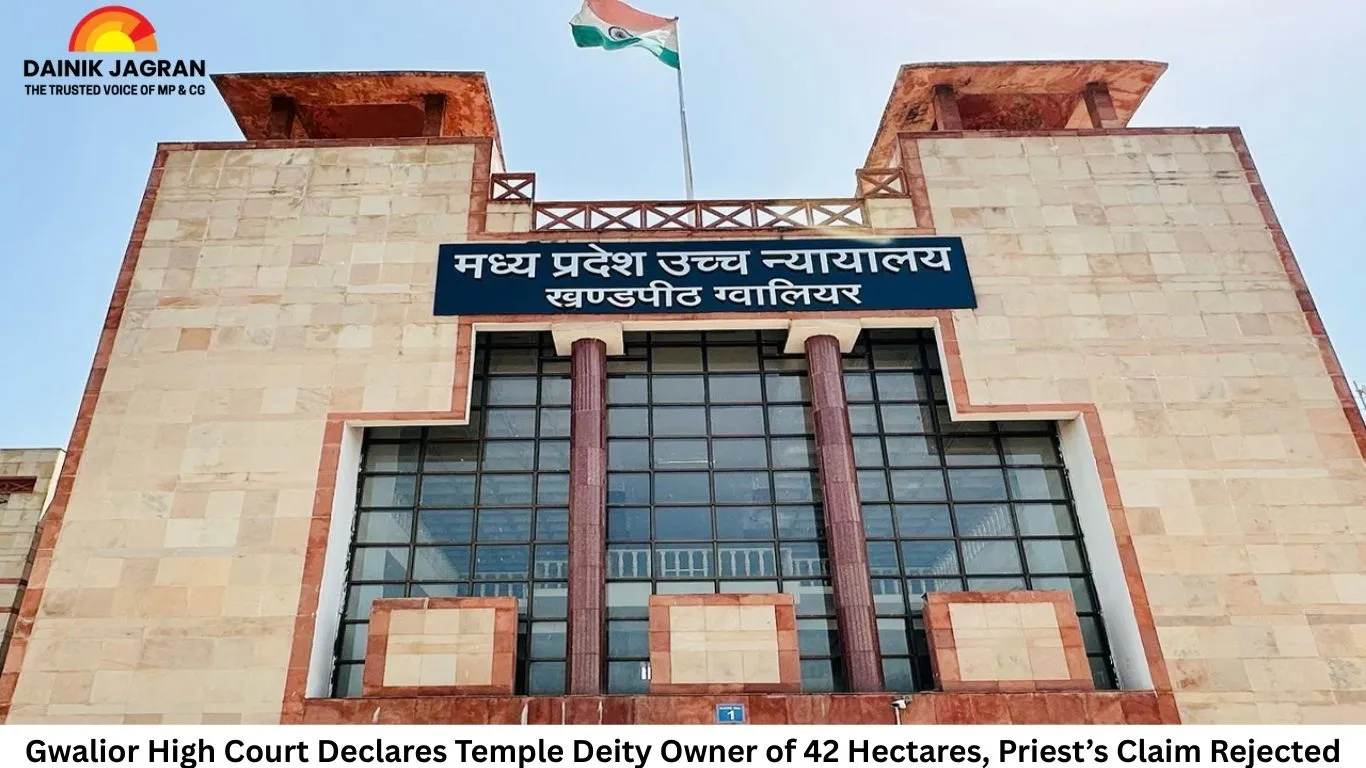
Gwalior High Court Declares Temple Deity Owner of 42 Hectares, Priest’s Claim Rejected
Digital Desk
The decision came in a second appeal pending since 2006. Justice G.S. Ahluwalia ruled that under established legal principles, a deity is recognized as a juristic entity capable of owning property, while a priest serves only as caretaker. Consequently, management authority, including priest appointments, will remain with the state.
The dispute concerned farmland linked to the historic Shri Ganeshji Temple, spread across three villages and recorded in revenue documents under the religious endowment department. State counsel argued that official land records consistently showed government control and that the priest’s role was limited to ritual duties. Any personal ownership claim over temple property, the state maintained, contradicts both law and religious trust principles.
The priest, Bhalchand Rao, had contended that the temple and its land were inherited by his family about two centuries ago, asserting it was a private shrine. Lower courts earlier accepted this argument. However, the High Court found that he failed to produce documentary proof of succession or title. A license he submitted related only to installation of an idol and did not establish ownership rights.
Citing precedents of the Supreme Court of India, the bench reiterated that temple assets are vested in the deity, and priests or managers cannot treat them as personal property. The judgment emphasized that recognizing private ownership without proof would be contrary to the deity’s legal interests and public trust doctrine.
Legal experts say the ruling reinforces long-standing jurisprudence on religious endowments and could influence similar disputes across Madhya Pradesh, where questions of hereditary priesthood and property control frequently arise. With the court clarifying administrative authority, state officials are expected to assume full oversight of the temple’s land and related assets.
.jpg)




