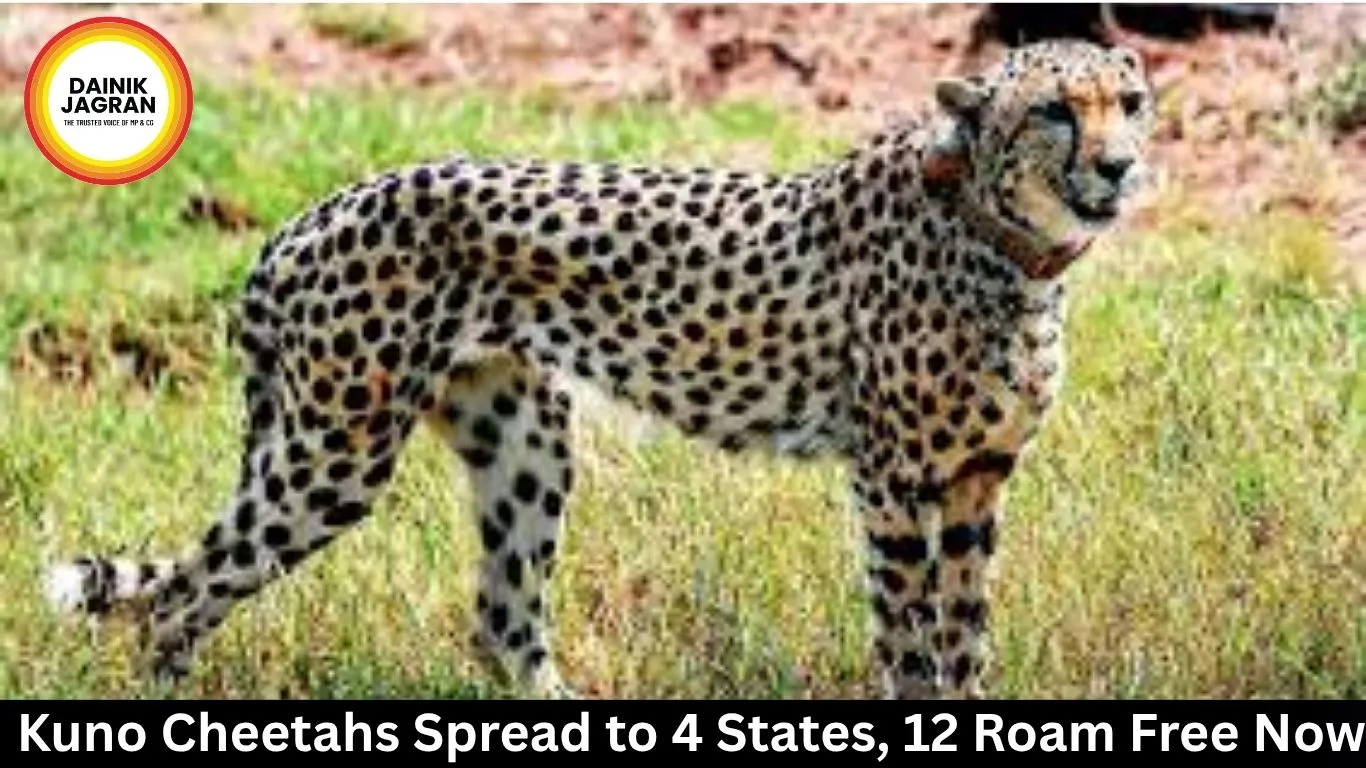
Kuno Cheetahs Spread to 4 States, 12 Roam Free Now
Digital Desk
Twelve Kuno cheetahs now roam freely across MP and Rajasthan as India's cheetah landscape expands to 17,000 sq km spanning 25 districts and 3 sanctuaries.
Kuno Cheetahs Spread to 4 States, 12 Now Roam Free in Open Landscape
Six cheetahs have moved beyond Kuno National Park boundaries into Gwalior, Morena, Shivpuri and Rajasthan's Baran district, raising both conservation hopes and human-wildlife conflict concerns.
Cheetahs Cross Park Limits
Twelve cheetahs from Kuno National Park are now living and moving freely in open terrain — half within the park's boundaries and the remaining six well beyond them. Location tracking data has confirmed their presence in forested stretches of Gwalior, Morena and Shivpuri in Madhya Pradesh, with movement also recorded in the direction of Baran in Rajasthan.
Park management maintains there is no immediate threat. Officials say the movement aligns with the designated natural range carved out for the animals and is being closely monitored.
Villagers Face a New Reality
On the ground, however, residents near Sabalgarh are experiencing a different situation. A video circulating widely on social media showed a villager driving away a cheetah to protect his buffalo — an incident that park authorities have acknowledged as an isolated case, but wildlife observers say points to rising friction between big cats and local communities.
As per reports, such encounters have been increasing in areas adjoining the national park, particularly near settlements where livestock grazing overlaps with cheetah movement zones.
17,000 Sq Km Corridor Approved
To support the long-term expansion of India's cheetah population, the government has formally developed a 17,000 square kilometre "cheetah landscape." This designated zone spans 25 districts across two states — 12 in Madhya Pradesh and 13 in Rajasthan — covering Sheopur, Shivpuri, Morena, Gwalior, Guna, Ashoknagar and several other districts.
Three Sanctuaries to Connect
Wildlife experts indicate the corridor is designed to link Kuno National Park, Gandhi Sagar sanctuary and Mukundara Hills reserve. According to officials, once fully operational, this will allow cheetahs to travel between states without disruption, boosting natural dispersal and genetic diversity within the reintroduced population.
Management Defends Its Approach
Park authorities have pushed back against alarm, insisting that free-ranging movement is a sign of successful acclimatisation rather than a cause for concern. Sources indicated the animals are being moved into areas pre-identified as suitable for natural habitation, and that field teams are tracking their movements in real time.
Officials added that the Sabalgarh video, while widely shared, did not indicate any attack on the villager or the livestock, and that the cheetah retreated without incident.
A Conservation Milestone Under Scrutiny
India's cheetah reintroduction programme, launched in September 2022 with animals brought from Namibia and later South Africa, has seen mixed results. Several cheetahs died in the initial phase from infections and territorial stress. The current milestone of 12 animals roaming freely is being projected by authorities as a turning point, though conservationists stress that community readiness in fringe areas remains a critical gap.
What Lies Ahead
As the cheetah landscape takes shape, the immediate challenge for Kuno management is handling the interface between expanding cheetah territory and human settlements. Sources indicated that compensation frameworks for livestock loss and community awareness initiatives are being reviewed as part of the broader conservation plan. The next phase will test whether India's most watched wildlife story can translate into lasting coexistence on the ground.

--------
๐จ Beat the News Rush โ Join Now!
Get breaking alerts, hot exclusives, and game-changing stories instantly on your phone. No delays, no fluff โ just the edge you need. โก
Tap to join:ย
๐ข WhatsApp Channel: Dainik Jagran MP CG
Crave more?
๐ Facebook: Dainik Jagran MP CG English
๐ ง Twitter (X): Dainik Jagran MP CG
๐ Instagram: Dainik Jagran MP CG
Share the fire โ keep your crew ahead! ๐๏ธ๐ฅ
Kuno Cheetahs Spread to 4 States, 12 Roam Free Now
Digital Desk
Kuno Cheetahs Spread to 4 States, 12 Now Roam Free in Open Landscape
Six cheetahs have moved beyond Kuno National Park boundaries into Gwalior, Morena, Shivpuri and Rajasthan's Baran district, raising both conservation hopes and human-wildlife conflict concerns.
Cheetahs Cross Park Limits
Twelve cheetahs from Kuno National Park are now living and moving freely in open terrain — half within the park's boundaries and the remaining six well beyond them. Location tracking data has confirmed their presence in forested stretches of Gwalior, Morena and Shivpuri in Madhya Pradesh, with movement also recorded in the direction of Baran in Rajasthan.
Park management maintains there is no immediate threat. Officials say the movement aligns with the designated natural range carved out for the animals and is being closely monitored.
Villagers Face a New Reality
On the ground, however, residents near Sabalgarh are experiencing a different situation. A video circulating widely on social media showed a villager driving away a cheetah to protect his buffalo — an incident that park authorities have acknowledged as an isolated case, but wildlife observers say points to rising friction between big cats and local communities.
As per reports, such encounters have been increasing in areas adjoining the national park, particularly near settlements where livestock grazing overlaps with cheetah movement zones.
17,000 Sq Km Corridor Approved
To support the long-term expansion of India's cheetah population, the government has formally developed a 17,000 square kilometre "cheetah landscape." This designated zone spans 25 districts across two states — 12 in Madhya Pradesh and 13 in Rajasthan — covering Sheopur, Shivpuri, Morena, Gwalior, Guna, Ashoknagar and several other districts.
Three Sanctuaries to Connect
Wildlife experts indicate the corridor is designed to link Kuno National Park, Gandhi Sagar sanctuary and Mukundara Hills reserve. According to officials, once fully operational, this will allow cheetahs to travel between states without disruption, boosting natural dispersal and genetic diversity within the reintroduced population.
Management Defends Its Approach
Park authorities have pushed back against alarm, insisting that free-ranging movement is a sign of successful acclimatisation rather than a cause for concern. Sources indicated the animals are being moved into areas pre-identified as suitable for natural habitation, and that field teams are tracking their movements in real time.
Officials added that the Sabalgarh video, while widely shared, did not indicate any attack on the villager or the livestock, and that the cheetah retreated without incident.
A Conservation Milestone Under Scrutiny
India's cheetah reintroduction programme, launched in September 2022 with animals brought from Namibia and later South Africa, has seen mixed results. Several cheetahs died in the initial phase from infections and territorial stress. The current milestone of 12 animals roaming freely is being projected by authorities as a turning point, though conservationists stress that community readiness in fringe areas remains a critical gap.
What Lies Ahead
As the cheetah landscape takes shape, the immediate challenge for Kuno management is handling the interface between expanding cheetah territory and human settlements. Sources indicated that compensation frameworks for livestock loss and community awareness initiatives are being reviewed as part of the broader conservation plan. The next phase will test whether India's most watched wildlife story can translate into lasting coexistence on the ground.