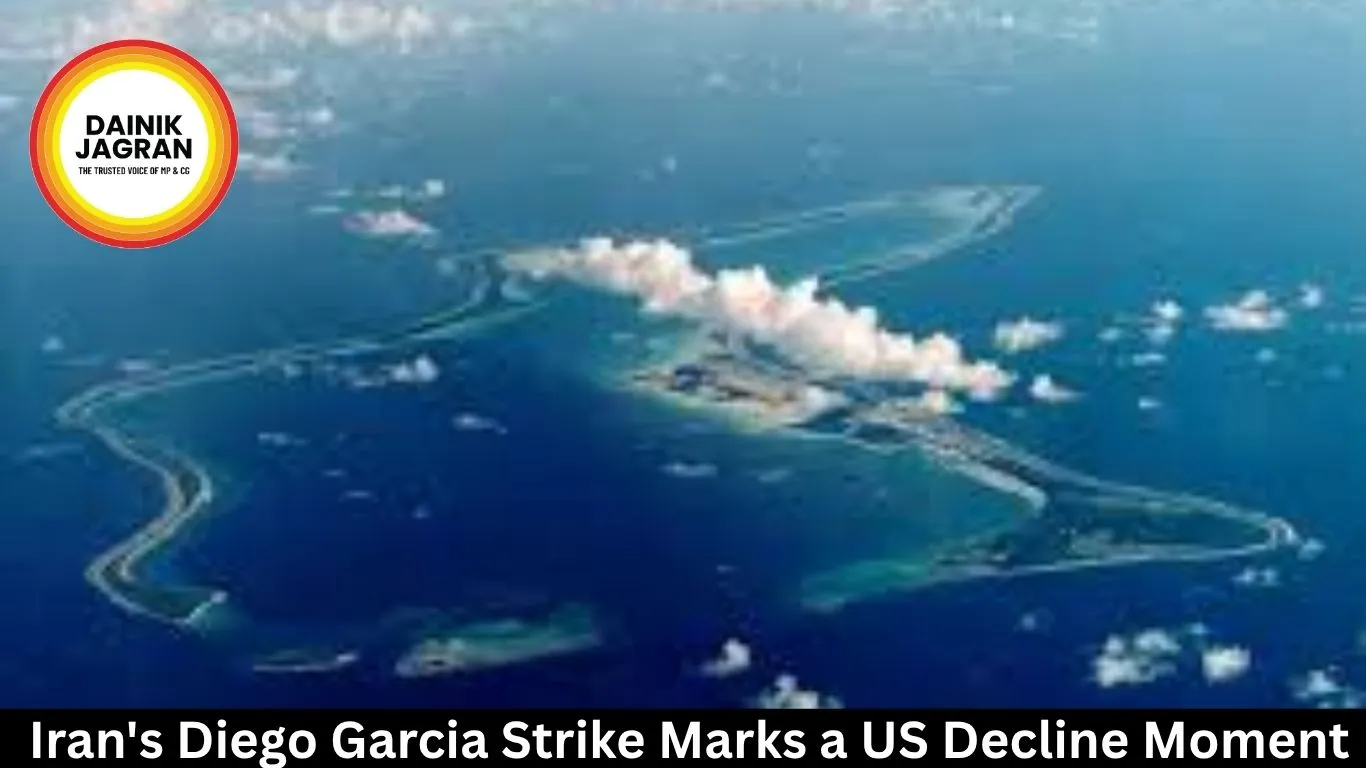
Iran's Diego Garcia Strike Marks a US Decline Moment

Digital Desk

 Iran's Diego Garcia Strike Marks a US Decline Moment

Iran's 4,000-km ballistic missile strike on Diego Garcia exposes the limits of American military power in the Middle East — an opinion analysis of US credibility and global alliances in 2026.


Iran's Strike on Diego Garcia Signals a Strategic Turning Point America Can No Longer Ignore

When a sanctions-battered nation fires ballistic missiles 4,000 kilometres to reach a joint US-UK base, the debate about American decline stops being theoretical.

Iran's ballistic missile strike targeting Diego Garcia — the heavily fortified joint US-UK military installation in the Indian Ocean — has shattered one of Washington's most carefully maintained illusions. For years, American officials publicly accepted Tehran's declared maximum missile range of 2,000 kilometres. What struck toward Diego Garcia this week travelled twice that distance. The range was not a secret weapon. It was a concealed capability, now very deliberately unveiled.

A capability long hidden in plain sight

According to US officials cited by The Wall Street Journal, Iran fired two ballistic missiles toward Diego Garcia, roughly 4,000 kilometres from Iranian territory. One reportedly failed mid-flight; the other was intercepted by an American warship. Neither struck the base, which hosts B-2 stealth bombers. But the outcome, in military terms, is almost secondary to what the launch itself communicates.

Missile programmes are not evaluated solely on hit rates. They are evaluated on reach. Tehran has now demonstrated — publicly, unambiguously, and under combat conditions — that it possesses an intermediate-range ballistic missile capable of threatening US assets across an entire theatre. Every American base, every allied installation, every carrier group operating within a 4,000-kilometre arc of Iran now falls within a redrawn threat envelope. That includes much of Europe.

Two missiles, three possible explanations

Analysts following the strike have raised three distinct interpretations. The first and most straightforward: Iran has fielded a new intermediate-range ballistic missile — a class defined by ranges between 3,000 and 5,500 kilometres — that it had never publicly disclosed. States routinely keep long-range missile programmes quiet because announced capabilities immediately alarm neighbours and invite coalition-building against them.

The second possibility involves known physics rather than unknown hardware. Iran's publicly acknowledged Khurramshahr-4 missile carries a range of approximately 2,000 kilometres with a 1,500-kilogram payload. Reduce that payload to 400 or 600 kilograms — standard ballistic missile engineering — and the same airframe plausibly reaches 4,000 kilometres. Tehran may have simply flown a lighter configuration of an existing system, one it had never previously had cause to demonstrate at full range.

A third interpretation, circulating in some quarters, is that the reported strike is a false-flag narrative crafted in Washington — a means of pressuring reluctant European governments into deeper engagement against Iran by reminding them their capitals now sit within range. Since all reporting traces back to unnamed US officials, this angle cannot be entirely dismissed.

Trump's contradictions put on record

President Donald Trump's response on Truth Social was sweeping and, measured against events, difficult to reconcile. He declared Iranian missile capabilities "completely degraded," launchers destroyed, the defence industrial base neutralised, and the regime's air force and navy rendered ineffective. He stated that the United States had permanently foreclosed Iran's path to nuclear weapons and described the Middle East military campaign as a success ripe for drawdown.

All of this was posted within hours of reports that Iranian ballistic missiles had been launched against a US military installation at transcontinental range. The dissonance was not lost on observers. Governments taking stock of Washington's reliability — allies and adversaries alike — now have a documented instance of official triumphalism issued simultaneously with evidence of strategic setback.

Hormuz and the allies left holding the bill

On the Strait of Hormuz, Trump was unambiguous: those who use it should police it. Since the United States does not import oil through the strait, he argued, the burden of securing it falls on those who do. The countries he named as protected partners — Saudi Arabia, Qatar, the UAE, Bahrain, Kuwait — are the same governments whose energy infrastructure has absorbed Iranian strikes and whose reputations as stable investment destinations have been materially damaged by a conflict they did not choose and could not control.

Qatar, a treaty-bound American security partner, is reported to have lost access to European gas markets for up to five years as a consequence of the war's disruptions. The Gulf states entered this conflict under American assurances. They are now being told to secure their own waterways.

The countries most directly exposed to Hormuz disruption — India, China, Japan, South Korea, and the European Union — include both American allies and strategic competitors. India and China have maintained studied neutrality and kept their tanker traffic moving. Japan, South Korea, and European NATO members have not. They are now the most vulnerable and the least equipped to act.

The realist calculus of declining power

Offensive realism, the analytical tradition associated with the University of Chicago's John Mearsheimer, holds that great powers compete for regional hegemony and that their influence is ultimately measured by outcomes, not declarations. Applied to this episode, the ledger is stark. Iran — a country of roughly 350 billion dollars in GDP operating under comprehensive international sanctions for decades — has fought a regional hegemon to a strategic stalemate. Its regime remains intact. Its nuclear programme is undestroyed. Its missile range has expanded, not contracted. And the United States is withdrawing.

American power is not reducible to military hardware. It derives substantially from network power — the credibility of its alliance commitments, the willingness of other states to follow American leadership because they believe that leadership is reliable. When treaty partners watch a fellow treaty partner absorb losses and receive, in return, advice to manage their own affairs, they update their beliefs about what American guarantees are worth. So do adversaries, who recalibrate how far they can push before genuine costs are imposed.

What happens next

The Gulf states will deepen security arrangements with actors outside Washington's orbit — not because they have abandoned the American relationship but because they have witnessed its limits under pressure. European governments, already unnerved by the transactional turn in US foreign policy, will absorb the news that Iran can now reach European capitals with ballistic missiles and draw their own conclusions. Asian allies dependent on Hormuz energy flows will quietly explore alternatives.

None of this constitutes an immediate collapse of American primacy. Great powers decline over decades, not news cycles. But Iran's missiles over Diego Garcia and Trump's subsequent announcement of military drawdown have, in a single week, provided the clearest evidence yet that the post-1991 era of unchallenged American dominance in the Middle East is closing.

The signal that matters

Tehran understands that both missiles missed. It also understands that the point was never to destroy Diego Garcia. The point was to demonstrate that it could be targeted. Deterrence is built on capability, not intentions — and Iran's intermediate-range ballistic missile capability is no longer a matter of intelligence assessment. It is a matter of observable fact.

The United States declared that fact impossible just days before it happened. That gap between declaration and reality is where reputations are made and lost. For foreign ministries from Riyadh to Tokyo, the question is no longer whether American power is retreating. It is how fast, and what comes next.
 

english.dainikjagranmpcg.com
22 Mar 2026 By Abhishek Joshi

Iran's Diego Garcia Strike Marks a US Decline Moment

Digital Desk

Iran's Strike on Diego Garcia Signals a Strategic Turning Point America Can No Longer Ignore

When a sanctions-battered nation fires ballistic missiles 4,000 kilometres to reach a joint US-UK base, the debate about American decline stops being theoretical.

Iran's ballistic missile strike targeting Diego Garcia — the heavily fortified joint US-UK military installation in the Indian Ocean — has shattered one of Washington's most carefully maintained illusions. For years, American officials publicly accepted Tehran's declared maximum missile range of 2,000 kilometres. What struck toward Diego Garcia this week travelled twice that distance. The range was not a secret weapon. It was a concealed capability, now very deliberately unveiled.

A capability long hidden in plain sight

According to US officials cited by The Wall Street Journal, Iran fired two ballistic missiles toward Diego Garcia, roughly 4,000 kilometres from Iranian territory. One reportedly failed mid-flight; the other was intercepted by an American warship. Neither struck the base, which hosts B-2 stealth bombers. But the outcome, in military terms, is almost secondary to what the launch itself communicates.

Missile programmes are not evaluated solely on hit rates. They are evaluated on reach. Tehran has now demonstrated — publicly, unambiguously, and under combat conditions — that it possesses an intermediate-range ballistic missile capable of threatening US assets across an entire theatre. Every American base, every allied installation, every carrier group operating within a 4,000-kilometre arc of Iran now falls within a redrawn threat envelope. That includes much of Europe.

Two missiles, three possible explanations

Analysts following the strike have raised three distinct interpretations. The first and most straightforward: Iran has fielded a new intermediate-range ballistic missile — a class defined by ranges between 3,000 and 5,500 kilometres — that it had never publicly disclosed. States routinely keep long-range missile programmes quiet because announced capabilities immediately alarm neighbours and invite coalition-building against them.

The second possibility involves known physics rather than unknown hardware. Iran's publicly acknowledged Khurramshahr-4 missile carries a range of approximately 2,000 kilometres with a 1,500-kilogram payload. Reduce that payload to 400 or 600 kilograms — standard ballistic missile engineering — and the same airframe plausibly reaches 4,000 kilometres. Tehran may have simply flown a lighter configuration of an existing system, one it had never previously had cause to demonstrate at full range.

A third interpretation, circulating in some quarters, is that the reported strike is a false-flag narrative crafted in Washington — a means of pressuring reluctant European governments into deeper engagement against Iran by reminding them their capitals now sit within range. Since all reporting traces back to unnamed US officials, this angle cannot be entirely dismissed.

Trump's contradictions put on record

President Donald Trump's response on Truth Social was sweeping and, measured against events, difficult to reconcile. He declared Iranian missile capabilities "completely degraded," launchers destroyed, the defence industrial base neutralised, and the regime's air force and navy rendered ineffective. He stated that the United States had permanently foreclosed Iran's path to nuclear weapons and described the Middle East military campaign as a success ripe for drawdown.

All of this was posted within hours of reports that Iranian ballistic missiles had been launched against a US military installation at transcontinental range. The dissonance was not lost on observers. Governments taking stock of Washington's reliability — allies and adversaries alike — now have a documented instance of official triumphalism issued simultaneously with evidence of strategic setback.

Hormuz and the allies left holding the bill

On the Strait of Hormuz, Trump was unambiguous: those who use it should police it. Since the United States does not import oil through the strait, he argued, the burden of securing it falls on those who do. The countries he named as protected partners — Saudi Arabia, Qatar, the UAE, Bahrain, Kuwait — are the same governments whose energy infrastructure has absorbed Iranian strikes and whose reputations as stable investment destinations have been materially damaged by a conflict they did not choose and could not control.

Qatar, a treaty-bound American security partner, is reported to have lost access to European gas markets for up to five years as a consequence of the war's disruptions. The Gulf states entered this conflict under American assurances. They are now being told to secure their own waterways.

The countries most directly exposed to Hormuz disruption — India, China, Japan, South Korea, and the European Union — include both American allies and strategic competitors. India and China have maintained studied neutrality and kept their tanker traffic moving. Japan, South Korea, and European NATO members have not. They are now the most vulnerable and the least equipped to act.

The realist calculus of declining power

Offensive realism, the analytical tradition associated with the University of Chicago's John Mearsheimer, holds that great powers compete for regional hegemony and that their influence is ultimately measured by outcomes, not declarations. Applied to this episode, the ledger is stark. Iran — a country of roughly 350 billion dollars in GDP operating under comprehensive international sanctions for decades — has fought a regional hegemon to a strategic stalemate. Its regime remains intact. Its nuclear programme is undestroyed. Its missile range has expanded, not contracted. And the United States is withdrawing.

American power is not reducible to military hardware. It derives substantially from network power — the credibility of its alliance commitments, the willingness of other states to follow American leadership because they believe that leadership is reliable. When treaty partners watch a fellow treaty partner absorb losses and receive, in return, advice to manage their own affairs, they update their beliefs about what American guarantees are worth. So do adversaries, who recalibrate how far they can push before genuine costs are imposed.

What happens next

The Gulf states will deepen security arrangements with actors outside Washington's orbit — not because they have abandoned the American relationship but because they have witnessed its limits under pressure. European governments, already unnerved by the transactional turn in US foreign policy, will absorb the news that Iran can now reach European capitals with ballistic missiles and draw their own conclusions. Asian allies dependent on Hormuz energy flows will quietly explore alternatives.

None of this constitutes an immediate collapse of American primacy. Great powers decline over decades, not news cycles. But Iran's missiles over Diego Garcia and Trump's subsequent announcement of military drawdown have, in a single week, provided the clearest evidence yet that the post-1991 era of unchallenged American dominance in the Middle East is closing.

The signal that matters

Tehran understands that both missiles missed. It also understands that the point was never to destroy Diego Garcia. The point was to demonstrate that it could be targeted. Deterrence is built on capability, not intentions — and Iran's intermediate-range ballistic missile capability is no longer a matter of intelligence assessment. It is a matter of observable fact.

The United States declared that fact impossible just days before it happened. That gap between declaration and reality is where reputations are made and lost. For foreign ministries from Riyadh to Tokyo, the question is no longer whether American power is retreating. It is how fast, and what comes next.


https://english.dainikjagranmpcg.com/opinion/-irans-diego-garcia-strike-marks-a-us-decline-moment/article-15775

Advertisement

Latest News