

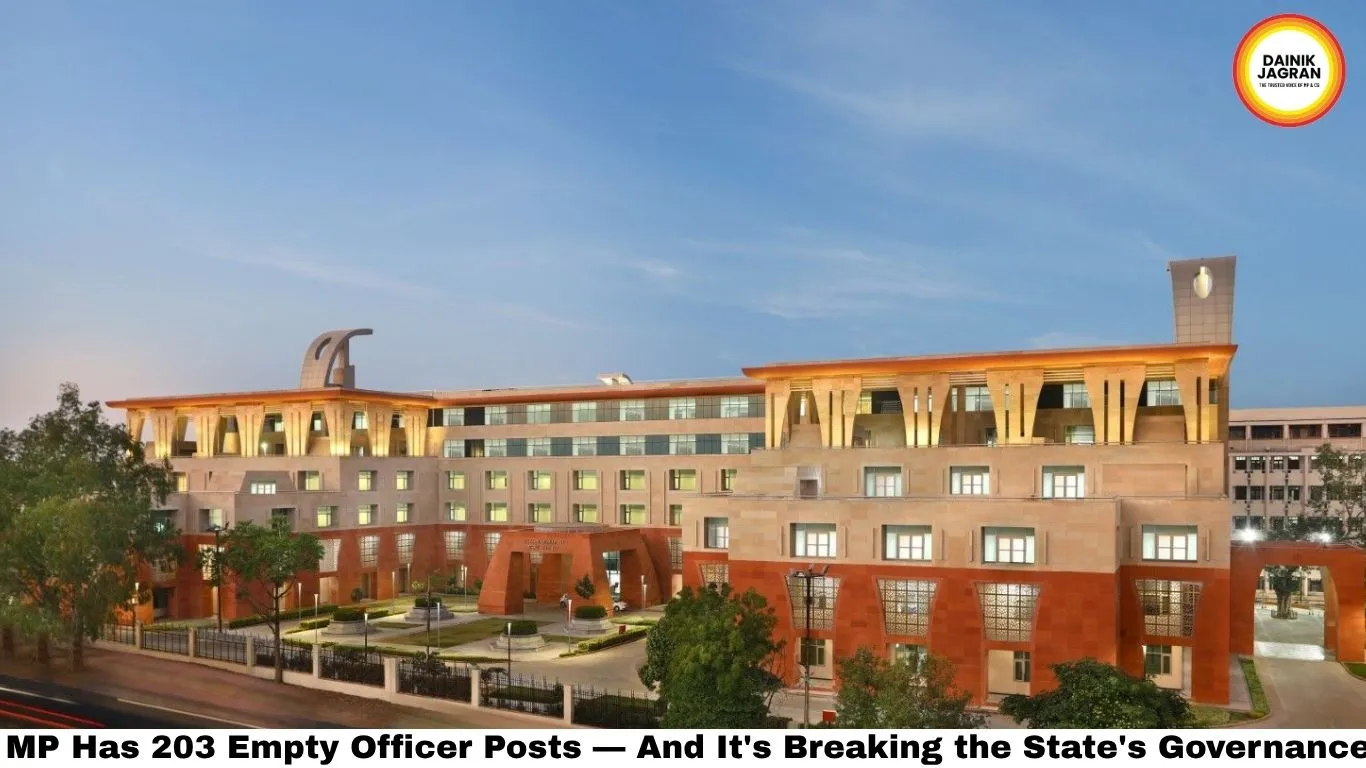
MP Has 203 Empty Officer Posts — And It's Breaking the State's Governance
Digital Desk
MP's IAS, IPS & IFoS crisis: 203 posts vacant, one officer handling 5 roles. How India's bureaucratic shortage is failing citizens on the ground every day.
One Officer. Five Departments. Zero Accountability.
Somewhere in Madhya Pradesh right now, a single IAS officer is holding charge of five different departments simultaneously. He is not doing this because he is exceptional. He is doing it because there is no one else.
This is not an isolated case. It is the daily operational reality of a state running on a skeleton administrative crew — and Parliament data tabled just last month confirms it is getting worse.
According to a written reply by Union Minister of State Dr. Jitendra Singh in the Rajya Sabha on February 12, 2026, Madhya Pradesh has a staggering 203 vacant posts across its three All India Services — IAS, IPS and IFoS. In a state of over 8.5 crore people, governing 52 districts across everything from law and order to forest cover to welfare schemes, that is not a vacancy figure. It is a governance emergency.
The Numbers Parliament Does Not Want You to Miss
The data is stark, verified and officially on record:
| Service | Sanctioned Strength | Officers in Position | Vacant Posts | Vacancy % |
|---|---|---|---|---|
| IAS (MP) | 459 | 391 | 68 | 14.8% |
| IPS (MP) | — | — | 48 | — |
| IFoS (MP) | ~300 | — | 87 | 29% |
| Total (MP) | — | — | 203 | — |
Nationally, the picture is equally grim. Against a sanctioned IAS strength of 6,877, only 5,577 officers are in position — a nationwide vacancy of 1,300, or nearly 19 percent. The IPS has 505 vacant posts. The Indian Forest Service has over 1,000 vacancies — nearly one-third of its entire sanctioned strength. Combined, India is running its entire administrative machinery with 2,834 fewer All India Service officers than it is supposed to have.
For Madhya Pradesh specifically, the IFoS figure is the most alarming. With 87 forest officer posts vacant — a 29 percent vacancy rate — the state's already embattled forest cover, tribal welfare programmes and wildlife corridors are being managed by a workforce operating at barely two-thirds capacity.
And Madhya Pradesh ranks among the worst-affected states nationally, consistently appearing in the top three or four states for directly recruited IPS vacancies, with 43 directly recruited IPS posts lying vacant — the highest of any state in India.
What an Empty Post Actually Means on the Ground
When a policy paper talks about a "vacancy," it sounds administrative and distant. What it means in practice is something far more concrete — and far more damaging.
In district administration: When a Collector's post is vacant or held on additional charge, every file that needs a Collector's signature waits. Land dispute hearings get postponed. Disaster relief coordination slows. Welfare scheme disbursements pile up. Citizens who have waited months for a decision wait months more.
In law and order: An IPS officer holding charge of two districts simultaneously cannot meaningfully supervise either. Police accountability falls. Response times suffer. Crime investigation quality declines. The most vulnerable communities — rural women, tribal populations, the economically marginalised — bear this cost most heavily because they have the least access to alternative forms of redress.
In forest governance: With 87 IFoS posts vacant across MP, illegal mining, encroachment on forest land and poaching are being monitored by a force stretched to its absolute limit. The state's forest cover — already under severe pressure from development and climate stress — is being administered by officers managing two to three times their designed workload.
In welfare delivery: Nearly every major government scheme — MGNREGA, PM Awas Yojana, mid-day meals, health missions — requires officers at the district and block level to function. When those officers are absent, holding additional charge or too stretched to supervise properly, leakages increase, beneficiaries are missed and money meant for the poor quietly disappears into the administrative gap.
Why Is This Happening? The Structural Reasons
The MP officer shortage is not new. It has been building for years, driven by three structural forces that no government — state or central — has seriously addressed.
1. Retirements are outpacing recruitment
India recruits approximately 180 IAS officers per year through UPSC — a figure that has remained static since 2012 despite the country's population, administrative complexity and governance demands growing substantially. Meanwhile, older batches are retiring at accelerating pace as the large recruitment cohorts of the 1980s and 1990s reach superannuation age. The pipeline is not keeping up with the drain.
2. The examination-to-posting cycle is brutally slow
A candidate who clears UPSC today will spend 18 to 24 months in training at LBSNAA before being posted to a state cadre. There is no fast-track mechanism for filling urgent vacancies. When a senior officer retires, the post can sit empty for a year or more before a replacement is formally in position.
3. Cadre imbalances are structurally locked in
India's new Zone-based Cadre Allocation Policy, implemented from 2026, divides states into four groups for posting purposes. Madhya Pradesh falls in Group III. While the insider-outsider ratio of 1:2 is maintained, the allocation system does not directly address states that have been chronically understaffed for years. MP's historical shortage does not automatically get corrected by a new allocation formula — it requires targeted remedial action that has not materialised.
MP's Rank in India's Bureaucratic Crisis
Among all Indian states, Madhya Pradesh holds the uncomfortable distinction of being among the most severely short-staffed for directly recruited IPS officers — ranking first nationally with 43 directly recruited vacancies. For IAS directly recruited vacancies, MP has historically ranked among the top three or four states, alongside Maharashtra, Uttar Pradesh and Tamil Nadu.
This is not a reflection of MP being a less-preferred posting. It reflects a state whose administrative demands — 52 districts, 8.5 crore population, vast forest cover, large tribal population, complex land tenure — require more officers, not fewer. The gap between what the state needs and what it has is widening every year.
The Human Cost Nobody Talks About
Every policy discussion about IAS and IPS vacancies happens in the language of charts, percentages and Parliamentary replies. But the real cost is paid by people who will never appear in those charts.
The farmer in Shivpuri waiting six months for a land dispute resolution that requires a Collector's hearing. The tribal family in Mandla whose forest rights application has been pending for two years because the IFoS officer who handles such cases is managing two districts simultaneously. The woman in Rewa whose police complaint has not been acted upon because the SP is stretched across two jurisdictions. The child in a rural block whose mid-day meal programme has been leaking funds because there is no officer with the bandwidth to supervise it properly.
These are not hypothetical cases. They are the statistical inevitability of a state running 203 officer posts short.
Three Fixes That Are Actually Possible
India does not need to reinvent its civil services to solve this crisis. Three targeted measures could meaningfully close the gap within two to three years:
Increase UPSC annual intake to 250 IAS. The current figure of 180 has not changed in over a decade. India's governance complexity has. A modest increase to 250, sustained over five years, would add over 350 additional officers to the national pool — enough to make a real dent in chronic vacancies in states like MP.
Create a fast-track additional charge ceiling. No officer should hold additional charge of more than two positions simultaneously, and no position should remain on additional charge for more than six months without a formal review. Mandatory reporting to DoPT — and public disclosure — would create accountability that currently does not exist.
Fix MP's IFoS crisis as a national priority. A 29 percent vacancy rate in forest officers is not just an administrative problem. It is an environmental emergency. Given the scale of forest governance challenges in MP — one of India's most forested states — a dedicated IFoS recruitment drive targeted at reducing MP's vacancy to below 10 percent within 24 months is both achievable and urgently necessary.
The Bottom Line
Madhya Pradesh is not ungoverned. It is undergoverned — by officers who are working harder than any system should demand, covering desks that should have someone else sitting at them, and making governance decisions at a pace and quality that is inevitably compromised by the sheer volume of what they are being asked to do alone.
The 203 empty posts in MP's All India Services are not a bureaucratic footnote. They are 203 specific failures of governance — 203 places where a citizen's problem is taking longer to solve, where a scheme is leaking money it should not, where accountability is thinner than it needs to be.
Parliament has the data. The government has acknowledged the problem. What is missing is the urgency that a crisis of this scale demands.
The files are piling up. The desks are empty. And the people who need the government most are waiting the longest.
MP Has 203 Empty Officer Posts — And It's Breaking the State's Governance
Digital Desk
One Officer. Five Departments. Zero Accountability.
Somewhere in Madhya Pradesh right now, a single IAS officer is holding charge of five different departments simultaneously. He is not doing this because he is exceptional. He is doing it because there is no one else.
This is not an isolated case. It is the daily operational reality of a state running on a skeleton administrative crew — and Parliament data tabled just last month confirms it is getting worse.
According to a written reply by Union Minister of State Dr. Jitendra Singh in the Rajya Sabha on February 12, 2026, Madhya Pradesh has a staggering 203 vacant posts across its three All India Services — IAS, IPS and IFoS. In a state of over 8.5 crore people, governing 52 districts across everything from law and order to forest cover to welfare schemes, that is not a vacancy figure. It is a governance emergency.
The Numbers Parliament Does Not Want You to Miss
The data is stark, verified and officially on record:
| Service | Sanctioned Strength | Officers in Position | Vacant Posts | Vacancy % |
|---|---|---|---|---|
| IAS (MP) | 459 | 391 | 68 | 14.8% |
| IPS (MP) | — | — | 48 | — |
| IFoS (MP) | ~300 | — | 87 | 29% |
| Total (MP) | — | — | 203 | — |
Nationally, the picture is equally grim. Against a sanctioned IAS strength of 6,877, only 5,577 officers are in position — a nationwide vacancy of 1,300, or nearly 19 percent. The IPS has 505 vacant posts. The Indian Forest Service has over 1,000 vacancies — nearly one-third of its entire sanctioned strength. Combined, India is running its entire administrative machinery with 2,834 fewer All India Service officers than it is supposed to have.
For Madhya Pradesh specifically, the IFoS figure is the most alarming. With 87 forest officer posts vacant — a 29 percent vacancy rate — the state's already embattled forest cover, tribal welfare programmes and wildlife corridors are being managed by a workforce operating at barely two-thirds capacity.
And Madhya Pradesh ranks among the worst-affected states nationally, consistently appearing in the top three or four states for directly recruited IPS vacancies, with 43 directly recruited IPS posts lying vacant — the highest of any state in India.
What an Empty Post Actually Means on the Ground
When a policy paper talks about a "vacancy," it sounds administrative and distant. What it means in practice is something far more concrete — and far more damaging.
In district administration: When a Collector's post is vacant or held on additional charge, every file that needs a Collector's signature waits. Land dispute hearings get postponed. Disaster relief coordination slows. Welfare scheme disbursements pile up. Citizens who have waited months for a decision wait months more.
In law and order: An IPS officer holding charge of two districts simultaneously cannot meaningfully supervise either. Police accountability falls. Response times suffer. Crime investigation quality declines. The most vulnerable communities — rural women, tribal populations, the economically marginalised — bear this cost most heavily because they have the least access to alternative forms of redress.
In forest governance: With 87 IFoS posts vacant across MP, illegal mining, encroachment on forest land and poaching are being monitored by a force stretched to its absolute limit. The state's forest cover — already under severe pressure from development and climate stress — is being administered by officers managing two to three times their designed workload.
In welfare delivery: Nearly every major government scheme — MGNREGA, PM Awas Yojana, mid-day meals, health missions — requires officers at the district and block level to function. When those officers are absent, holding additional charge or too stretched to supervise properly, leakages increase, beneficiaries are missed and money meant for the poor quietly disappears into the administrative gap.
Why Is This Happening? The Structural Reasons
The MP officer shortage is not new. It has been building for years, driven by three structural forces that no government — state or central — has seriously addressed.
1. Retirements are outpacing recruitment
India recruits approximately 180 IAS officers per year through UPSC — a figure that has remained static since 2012 despite the country's population, administrative complexity and governance demands growing substantially. Meanwhile, older batches are retiring at accelerating pace as the large recruitment cohorts of the 1980s and 1990s reach superannuation age. The pipeline is not keeping up with the drain.
2. The examination-to-posting cycle is brutally slow
A candidate who clears UPSC today will spend 18 to 24 months in training at LBSNAA before being posted to a state cadre. There is no fast-track mechanism for filling urgent vacancies. When a senior officer retires, the post can sit empty for a year or more before a replacement is formally in position.
3. Cadre imbalances are structurally locked in
India's new Zone-based Cadre Allocation Policy, implemented from 2026, divides states into four groups for posting purposes. Madhya Pradesh falls in Group III. While the insider-outsider ratio of 1:2 is maintained, the allocation system does not directly address states that have been chronically understaffed for years. MP's historical shortage does not automatically get corrected by a new allocation formula — it requires targeted remedial action that has not materialised.
MP's Rank in India's Bureaucratic Crisis
Among all Indian states, Madhya Pradesh holds the uncomfortable distinction of being among the most severely short-staffed for directly recruited IPS officers — ranking first nationally with 43 directly recruited vacancies. For IAS directly recruited vacancies, MP has historically ranked among the top three or four states, alongside Maharashtra, Uttar Pradesh and Tamil Nadu.
This is not a reflection of MP being a less-preferred posting. It reflects a state whose administrative demands — 52 districts, 8.5 crore population, vast forest cover, large tribal population, complex land tenure — require more officers, not fewer. The gap between what the state needs and what it has is widening every year.
The Human Cost Nobody Talks About
Every policy discussion about IAS and IPS vacancies happens in the language of charts, percentages and Parliamentary replies. But the real cost is paid by people who will never appear in those charts.
The farmer in Shivpuri waiting six months for a land dispute resolution that requires a Collector's hearing. The tribal family in Mandla whose forest rights application has been pending for two years because the IFoS officer who handles such cases is managing two districts simultaneously. The woman in Rewa whose police complaint has not been acted upon because the SP is stretched across two jurisdictions. The child in a rural block whose mid-day meal programme has been leaking funds because there is no officer with the bandwidth to supervise it properly.
These are not hypothetical cases. They are the statistical inevitability of a state running 203 officer posts short.
Three Fixes That Are Actually Possible
India does not need to reinvent its civil services to solve this crisis. Three targeted measures could meaningfully close the gap within two to three years:
Increase UPSC annual intake to 250 IAS. The current figure of 180 has not changed in over a decade. India's governance complexity has. A modest increase to 250, sustained over five years, would add over 350 additional officers to the national pool — enough to make a real dent in chronic vacancies in states like MP.
Create a fast-track additional charge ceiling. No officer should hold additional charge of more than two positions simultaneously, and no position should remain on additional charge for more than six months without a formal review. Mandatory reporting to DoPT — and public disclosure — would create accountability that currently does not exist.
Fix MP's IFoS crisis as a national priority. A 29 percent vacancy rate in forest officers is not just an administrative problem. It is an environmental emergency. Given the scale of forest governance challenges in MP — one of India's most forested states — a dedicated IFoS recruitment drive targeted at reducing MP's vacancy to below 10 percent within 24 months is both achievable and urgently necessary.
The Bottom Line
Madhya Pradesh is not ungoverned. It is undergoverned — by officers who are working harder than any system should demand, covering desks that should have someone else sitting at them, and making governance decisions at a pace and quality that is inevitably compromised by the sheer volume of what they are being asked to do alone.
The 203 empty posts in MP's All India Services are not a bureaucratic footnote. They are 203 specific failures of governance — 203 places where a citizen's problem is taking longer to solve, where a scheme is leaking money it should not, where accountability is thinner than it needs to be.
Parliament has the data. The government has acknowledged the problem. What is missing is the urgency that a crisis of this scale demands.
The files are piling up. The desks are empty. And the people who need the government most are waiting the longest.


