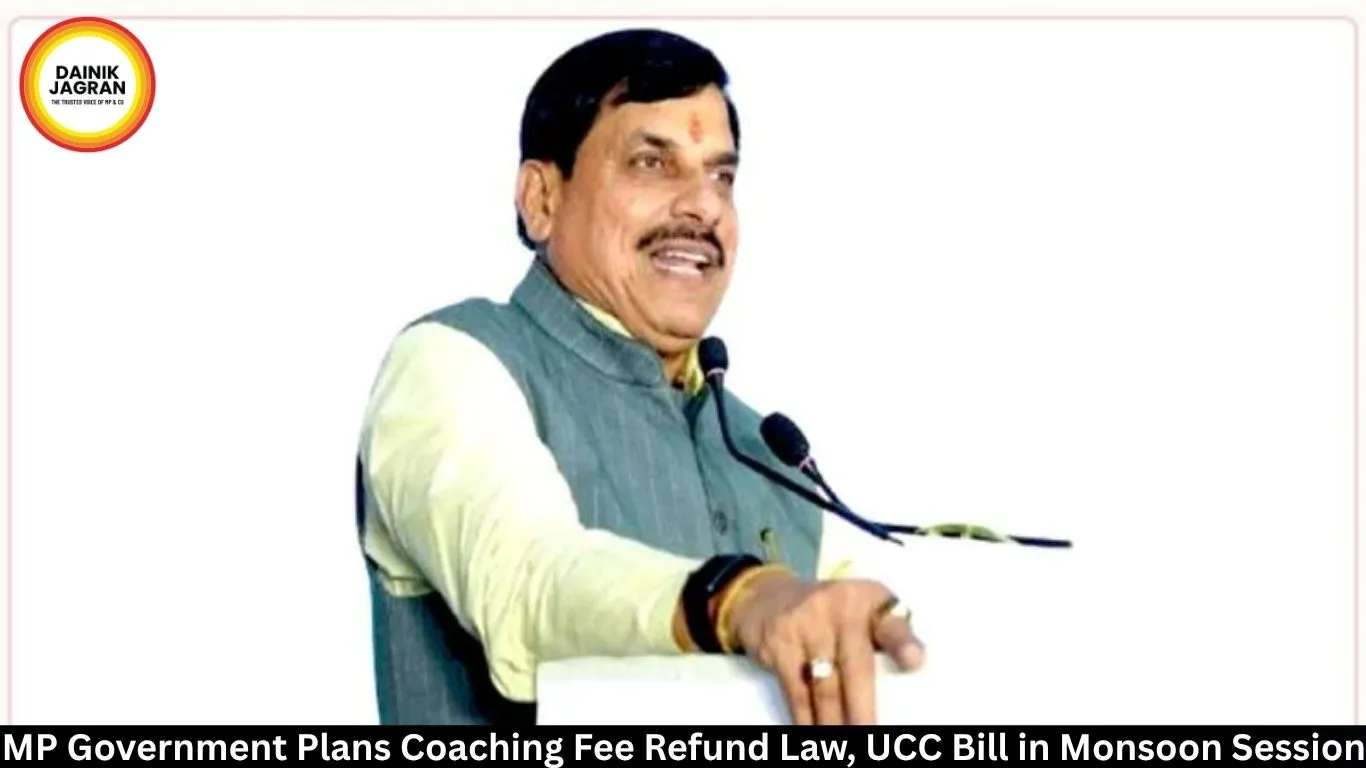
MP Monsoon Session: Coaching Fee Refund Law, UCC and Fire Safety Bills Likely to Be Introduced
Digital Desk
The Madhya Pradesh government is expected to introduce major bills during the Assembly's Monsoon Session, including a coaching fee refund law, Uniform Civil Code, fire safety reforms, labour code and Ease of Doing Business legislation.
The Madhya Pradesh government is set to introduce a series of major reform bills during the upcoming Monsoon Session of the State Assembly, covering areas such as private coaching institutes, industrial approvals, fire safety, labour laws, digital governance and the proposed Uniform Civil Code (UCC).
Among the key proposals is the Private Coaching Institutes (Registration and Regulation) Bill, 2026, which seeks to regulate coaching centres across the state for the first time. The proposed legislation would make it mandatory for institutes to refund the remaining course fee within 10 days if a student withdraws before completing the course.
Coaching Centres to Face New Regulations
The proposed coaching regulation law introduces comprehensive rules governing the registration, admission process, advertisements and functioning of private coaching institutes.
Officials say the legislation is aimed at protecting students' interests by bringing transparency and accountability to the rapidly expanding coaching sector.
One of the most significant provisions requires coaching institutes to refund the unused portion of fees within ten days of a student's withdrawal, addressing a long-standing grievance raised by students and parents.
Single-Window Clearance for Industries
The state government is also preparing to table the Ease of Doing Business Bill, 2026, which proposes a unified approval mechanism for industrial projects.
Under the proposed system, investors will no longer need to obtain separate approvals from multiple government departments. Instead, all permissions will be processed through a single-window platform, reducing procedural delays and simplifying the investment process.
The government expects the reform to improve the state's business environment and accelerate project implementation.
Private University Norms to Be Relaxed
The Private Universities (Establishment and Operation) Amendment Bill, 2026 proposes changes to land requirements and other eligibility conditions in line with the National Education Policy (NEP).
The amendments are intended to simplify regulatory requirements while maintaining standards related to academic quality and infrastructure, encouraging greater private investment in higher education.
Stricter Fire Safety Standards
Another major proposal is the Fire and Emergency Services Bill, 2026, which seeks to strengthen fire safety norms across Madhya Pradesh.
If passed, the law will make fire safety compliance mandatory for buildings exceeding 15 metres in height, as well as large schools, hostels, hospitals, shopping malls and commercial complexes.
The bill also proposes penalties for non-compliance and includes provisions for the introduction of a fire safety tax.
Labour Laws and Digital Governance
The government is expected to introduce the Madhya Pradesh Labour Code, 2026, consolidating various labour laws into a single framework. The objective is to simplify compliance for industries while safeguarding workers' rights under updated provisions.
In addition, amendments to the Madhya Pradesh Civil Security Code are planned to align state procedures with the Bharatiya Nagarik Suraksha Sanhita (BNSS). The changes aim to promote greater digitisation of police investigations and judicial processes.
Uniform Civil Code Bill Likely
The government may also table the Madhya Pradesh Uniform Civil Code (UCC) Bill, 2026 during the session.
According to the proposal, the legislation seeks to establish a common legal framework governing matters such as marriage, divorce, adoption and inheritance across all communities. The proposed law is also expected to include provisions aimed at strengthening the rights of women and children.
The bills are expected to be taken up for discussion during the Monsoon Session, where lawmakers will debate the proposed reforms before any final legislative approval.
--------
🚨 Beat the News Rush – Join Now!
Get breaking alerts, hot exclusives, and game-changing stories instantly on your phone. No delays, no fluff – just the edge you need. ⚡
Tap to join:
🟢 WhatsApp Channel: Dainik Jagran MP CG
Crave more?
🅕 Facebook: Dainik Jagran MP CG English
🅧 Twitter (X): Dainik Jagran MP CG
🅘 Instagram: Dainik Jagran MP CG
Share the fire – keep your crew ahead! 🗞️🔥
MP Monsoon Session: Coaching Fee Refund Law, UCC and Fire Safety Bills Likely to Be Introduced
Digital Desk
The Madhya Pradesh government is set to introduce a series of major reform bills during the upcoming Monsoon Session of the State Assembly, covering areas such as private coaching institutes, industrial approvals, fire safety, labour laws, digital governance and the proposed Uniform Civil Code (UCC).
Among the key proposals is the Private Coaching Institutes (Registration and Regulation) Bill, 2026, which seeks to regulate coaching centres across the state for the first time. The proposed legislation would make it mandatory for institutes to refund the remaining course fee within 10 days if a student withdraws before completing the course.
Coaching Centres to Face New Regulations
The proposed coaching regulation law introduces comprehensive rules governing the registration, admission process, advertisements and functioning of private coaching institutes.
Officials say the legislation is aimed at protecting students' interests by bringing transparency and accountability to the rapidly expanding coaching sector.
One of the most significant provisions requires coaching institutes to refund the unused portion of fees within ten days of a student's withdrawal, addressing a long-standing grievance raised by students and parents.
Single-Window Clearance for Industries
The state government is also preparing to table the Ease of Doing Business Bill, 2026, which proposes a unified approval mechanism for industrial projects.
Under the proposed system, investors will no longer need to obtain separate approvals from multiple government departments. Instead, all permissions will be processed through a single-window platform, reducing procedural delays and simplifying the investment process.
The government expects the reform to improve the state's business environment and accelerate project implementation.
Private University Norms to Be Relaxed
The Private Universities (Establishment and Operation) Amendment Bill, 2026 proposes changes to land requirements and other eligibility conditions in line with the National Education Policy (NEP).
The amendments are intended to simplify regulatory requirements while maintaining standards related to academic quality and infrastructure, encouraging greater private investment in higher education.
Stricter Fire Safety Standards
Another major proposal is the Fire and Emergency Services Bill, 2026, which seeks to strengthen fire safety norms across Madhya Pradesh.
If passed, the law will make fire safety compliance mandatory for buildings exceeding 15 metres in height, as well as large schools, hostels, hospitals, shopping malls and commercial complexes.
The bill also proposes penalties for non-compliance and includes provisions for the introduction of a fire safety tax.
Labour Laws and Digital Governance
The government is expected to introduce the Madhya Pradesh Labour Code, 2026, consolidating various labour laws into a single framework. The objective is to simplify compliance for industries while safeguarding workers' rights under updated provisions.
In addition, amendments to the Madhya Pradesh Civil Security Code are planned to align state procedures with the Bharatiya Nagarik Suraksha Sanhita (BNSS). The changes aim to promote greater digitisation of police investigations and judicial processes.
Uniform Civil Code Bill Likely
The government may also table the Madhya Pradesh Uniform Civil Code (UCC) Bill, 2026 during the session.
According to the proposal, the legislation seeks to establish a common legal framework governing matters such as marriage, divorce, adoption and inheritance across all communities. The proposed law is also expected to include provisions aimed at strengthening the rights of women and children.
The bills are expected to be taken up for discussion during the Monsoon Session, where lawmakers will debate the proposed reforms before any final legislative approval.