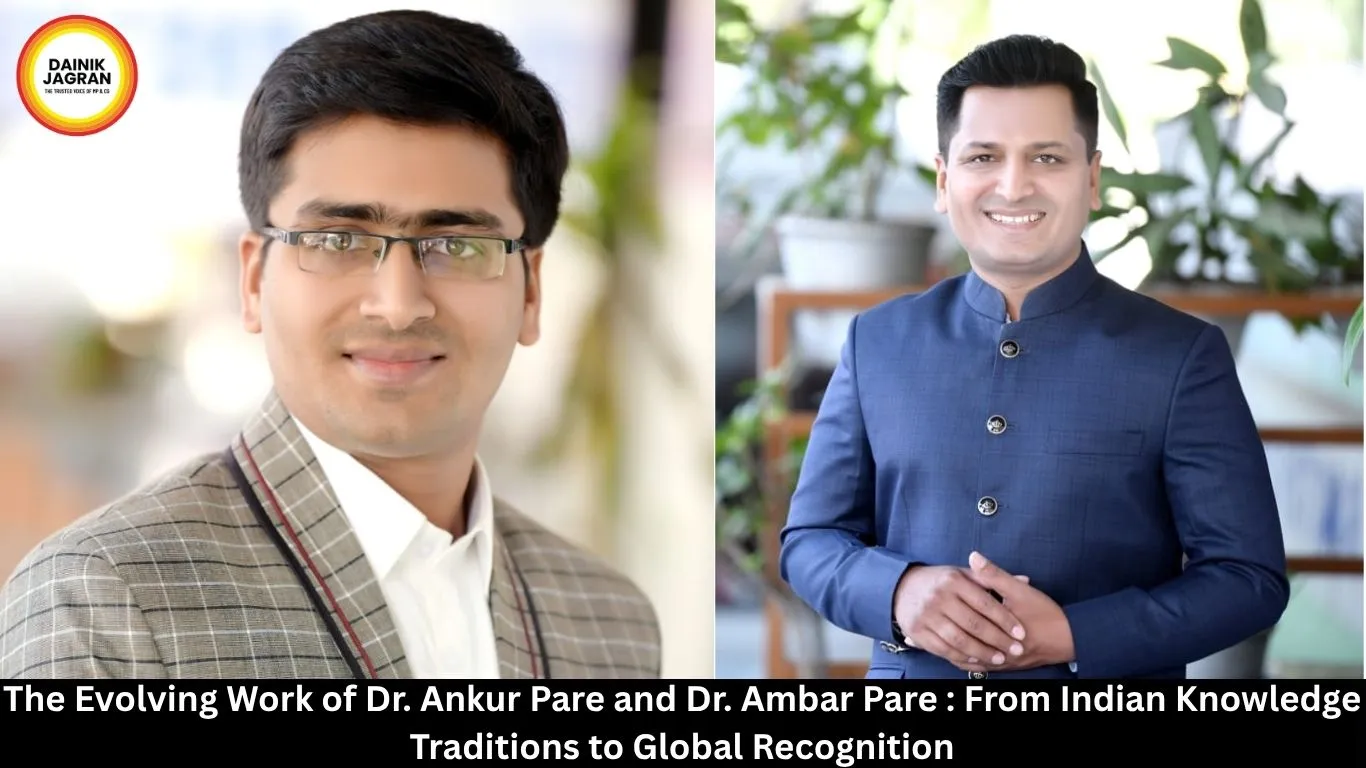
The Evolving Work of Dr. Ankur Pare and Dr. Ambar Pare : From Indian Knowledge Traditions to Global Recognition
Digital desk
With professional interests spanning Indian Knowledge Systems, Ayurveda, Yoga, Naturopathy, writing and entrepreneurship, the two brothers have developed distinct areas of work while remaining connected to a shared intellectual and cultural heritage.
The professional work of Dr. Ankur Pare and Dr. Ambar Pare has developed along different lines, but both remain connected to a larger subject—the place of India's knowledge traditions in contemporary life.
The elder brother, Dr. Ankur Pare, has built his professional interests around writing, social subjects, Indian Knowledge Systems and entrepreneurship, along with his association with the Ayurveda and herbal sector. The younger brother, Dr. Ambar Pare, has developed a health-focused professional path around Ayurveda, Yoga, Naturopathy, traditional Indian health practices and holistic approaches to wellbeing. Their fields are distinct, yet there is a common thread in their work: an interest in understanding India's traditional knowledge and exploring how it can be discussed in the context of present-day society.
From Higher Education to Wider Fields of Work
For both brothers, higher education became a foundation for their professional lives rather than the end of their learning. Their interests continued to develop through further study, experience and sustained engagement with the subjects they chose to pursue.
Dr. Ankur Pare has combined writing and study with work in social subjects and entrepreneurship. His engagement with Indian Knowledge Systems also extends to the way traditional knowledge, resources and practices can be viewed in relation to contemporary society.
His association with the Ayurveda and herbal sector has added a practical dimension to these interests. It brings together questions of traditional knowledge, communication, enterprise and changing social needs.
This approach places traditional knowledge in a wider context. It is not viewed simply as something inherited from the past, but also as a subject that can be examined through contemporary social, cultural and professional perspectives.
Dr. Ambar Pare: Ayurveda, Yoga and Naturopathy
The professional focus of Dr. Ambar Pare is more directly associated with India's traditional approaches to health and wellbeing.
His areas of work include Ayurveda, Yoga, Naturopathy, traditional Indian health practices, mantra-based traditions and holistic approaches to wellbeing. His work is also associated with the Dr. Ambar Pare Naturopathy Center, through which he is engaged with health-related practice, education and interaction with people.
His work encompasses several strands of India's traditional health landscape. Ayurveda and Yoga have deep roots in the Indian knowledge tradition, while Naturopathy and other natural approaches represent additional streams of health-related thought and practice.
As interest in these systems grows, an important question also comes into focus: how can traditional knowledge be discussed in modern settings without separating it from the cultural and intellectual context in which it developed? This question forms part of Dr. Ambar Pare's continuing engagement with traditional Indian health knowledge.
Two Professional Paths, a Shared Heritage
The distinction between the brothers' work is important. For Dr. Ankur Pare, writing, social understanding, Indian Knowledge Systems and entrepreneurship form important parts of his professional identity, alongside his association with the Ayurveda and herbal sector. For Dr. Ambar Pare, Ayurveda, Yoga, Naturopathy and traditional approaches to health provide the principal framework of his professional work.
Their professional paths therefore represent two different ways of engaging with a wider Indian intellectual and cultural heritage. They are not identical, but they intersect around an interest in the continuing relevance of traditional knowledge. That discussion has become increasingly visible beyond India as well. Ayurveda, Yoga, natural approaches to wellbeing and Indian knowledge systems have attracted growing attention in international circles. Along with that interest comes the need for thoughtful communication and a better understanding of the traditions themselves.
From Duliya, Harda to Wider Recognition
The work of both brothers has gradually extended beyond its beginnings in Duliya, Harda, Madhya Pradesh. Their professional activities and perspectives have found space on public platforms and in media coverage, taking their areas of work beyond their original regional setting. Their professional journeys have also included national and international honours and recognition. These recognitions form part of a longer process shaped by education, continued study and sustained involvement in their respective fields.
The wider reach of their work is also connected with the growing public interest in subjects such as Ayurveda, Yoga, traditional health knowledge and Indian Knowledge Systems. For those working in these fields, recognition brings visibility, but it also creates an opportunity to place regional experience and traditional knowledge within a broader national and international conversation.
Keeping Indian Knowledge Relevant
The work of Dr. Ankur Pare and Dr. Ambar Pare ultimately represents two different responses to a larger question: how can India's knowledge traditions remain meaningful in a rapidly changing world? Dr. Ankur Pare approaches this space through writing, study, social subjects, entrepreneurship and his engagement with Indian Knowledge Systems and the Ayurveda and herbal sector. Dr. Ambar Pare approaches it through Ayurveda, Yoga, Naturopathy and traditional Indian health practices, with his work also extending through the Dr. Ambar Pare Naturopathy Center.
Their approaches are different, but both remain connected to the cultural landscape from which these traditions emerged. From Duliya in Harda to wider national and international platforms, their professional work has expanded considerably. Yet the connection with Indian knowledge remains visible—one through writing, knowledge and enterprise, and the other through traditional health systems and their contemporary practice.
Their continuing work reflects a broader conversation around Indian Knowledge Systems: how a rich inheritance of ideas and practices can be studied, communicated and understood in contemporary society while retaining the cultural context from which it emerged.

The Evolving Work of Dr. Ankur Pare and Dr. Ambar Pare : From Indian Knowledge Traditions to Global Recognition
Digital desk
The professional work of Dr. Ankur Pare and Dr. Ambar Pare has developed along different lines, but both remain connected to a larger subject—the place of India's knowledge traditions in contemporary life.
The elder brother, Dr. Ankur Pare, has built his professional interests around writing, social subjects, Indian Knowledge Systems and entrepreneurship, along with his association with the Ayurveda and herbal sector. The younger brother, Dr. Ambar Pare, has developed a health-focused professional path around Ayurveda, Yoga, Naturopathy, traditional Indian health practices and holistic approaches to wellbeing. Their fields are distinct, yet there is a common thread in their work: an interest in understanding India's traditional knowledge and exploring how it can be discussed in the context of present-day society.
From Higher Education to Wider Fields of Work
For both brothers, higher education became a foundation for their professional lives rather than the end of their learning. Their interests continued to develop through further study, experience and sustained engagement with the subjects they chose to pursue.
Dr. Ankur Pare has combined writing and study with work in social subjects and entrepreneurship. His engagement with Indian Knowledge Systems also extends to the way traditional knowledge, resources and practices can be viewed in relation to contemporary society.
His association with the Ayurveda and herbal sector has added a practical dimension to these interests. It brings together questions of traditional knowledge, communication, enterprise and changing social needs.
This approach places traditional knowledge in a wider context. It is not viewed simply as something inherited from the past, but also as a subject that can be examined through contemporary social, cultural and professional perspectives.
Dr. Ambar Pare: Ayurveda, Yoga and Naturopathy
The professional focus of Dr. Ambar Pare is more directly associated with India's traditional approaches to health and wellbeing.
His areas of work include Ayurveda, Yoga, Naturopathy, traditional Indian health practices, mantra-based traditions and holistic approaches to wellbeing. His work is also associated with the Dr. Ambar Pare Naturopathy Center, through which he is engaged with health-related practice, education and interaction with people.
His work encompasses several strands of India's traditional health landscape. Ayurveda and Yoga have deep roots in the Indian knowledge tradition, while Naturopathy and other natural approaches represent additional streams of health-related thought and practice.
As interest in these systems grows, an important question also comes into focus: how can traditional knowledge be discussed in modern settings without separating it from the cultural and intellectual context in which it developed? This question forms part of Dr. Ambar Pare's continuing engagement with traditional Indian health knowledge.
Two Professional Paths, a Shared Heritage
The distinction between the brothers' work is important. For Dr. Ankur Pare, writing, social understanding, Indian Knowledge Systems and entrepreneurship form important parts of his professional identity, alongside his association with the Ayurveda and herbal sector. For Dr. Ambar Pare, Ayurveda, Yoga, Naturopathy and traditional approaches to health provide the principal framework of his professional work.
Their professional paths therefore represent two different ways of engaging with a wider Indian intellectual and cultural heritage. They are not identical, but they intersect around an interest in the continuing relevance of traditional knowledge. That discussion has become increasingly visible beyond India as well. Ayurveda, Yoga, natural approaches to wellbeing and Indian knowledge systems have attracted growing attention in international circles. Along with that interest comes the need for thoughtful communication and a better understanding of the traditions themselves.
From Duliya, Harda to Wider Recognition
The work of both brothers has gradually extended beyond its beginnings in Duliya, Harda, Madhya Pradesh. Their professional activities and perspectives have found space on public platforms and in media coverage, taking their areas of work beyond their original regional setting. Their professional journeys have also included national and international honours and recognition. These recognitions form part of a longer process shaped by education, continued study and sustained involvement in their respective fields.
The wider reach of their work is also connected with the growing public interest in subjects such as Ayurveda, Yoga, traditional health knowledge and Indian Knowledge Systems. For those working in these fields, recognition brings visibility, but it also creates an opportunity to place regional experience and traditional knowledge within a broader national and international conversation.
Keeping Indian Knowledge Relevant
The work of Dr. Ankur Pare and Dr. Ambar Pare ultimately represents two different responses to a larger question: how can India's knowledge traditions remain meaningful in a rapidly changing world? Dr. Ankur Pare approaches this space through writing, study, social subjects, entrepreneurship and his engagement with Indian Knowledge Systems and the Ayurveda and herbal sector. Dr. Ambar Pare approaches it through Ayurveda, Yoga, Naturopathy and traditional Indian health practices, with his work also extending through the Dr. Ambar Pare Naturopathy Center.
Their approaches are different, but both remain connected to the cultural landscape from which these traditions emerged. From Duliya in Harda to wider national and international platforms, their professional work has expanded considerably. Yet the connection with Indian knowledge remains visible—one through writing, knowledge and enterprise, and the other through traditional health systems and their contemporary practice.
Their continuing work reflects a broader conversation around Indian Knowledge Systems: how a rich inheritance of ideas and practices can be studied, communicated and understood in contemporary society while retaining the cultural context from which it emerged.

Recommended For You
--------
🚨 Beat the News Rush – Join Now!
Get breaking alerts, hot exclusives, and game-changing stories instantly on your phone. No delays, no fluff – just the edge you need. ⚡
Tap to join:
🟢 WhatsApp Channel: Dainik Jagran MP CG
Crave more?
🅕 Facebook: Dainik Jagran MP CG English
🅧 Twitter (X): Dainik Jagran MP CG
🅘 Instagram: Dainik Jagran MP CG
Share the fire – keep your crew ahead! 🗞️🔥