El Niño Drought Reveals Submerged Indonesian Village Beneath Karian Dam
Digital desk
El Niño-linked drought has lowered water levels in Indonesia's Karian Reservoir, exposing the remains of Somang village submerged after the dam project.
A prolonged dry spell in Indonesia has caused water levels in the Karian Reservoir in Banten province to fall sharply, revealing the remains of a village that had been submerged for years after the construction of the dam.
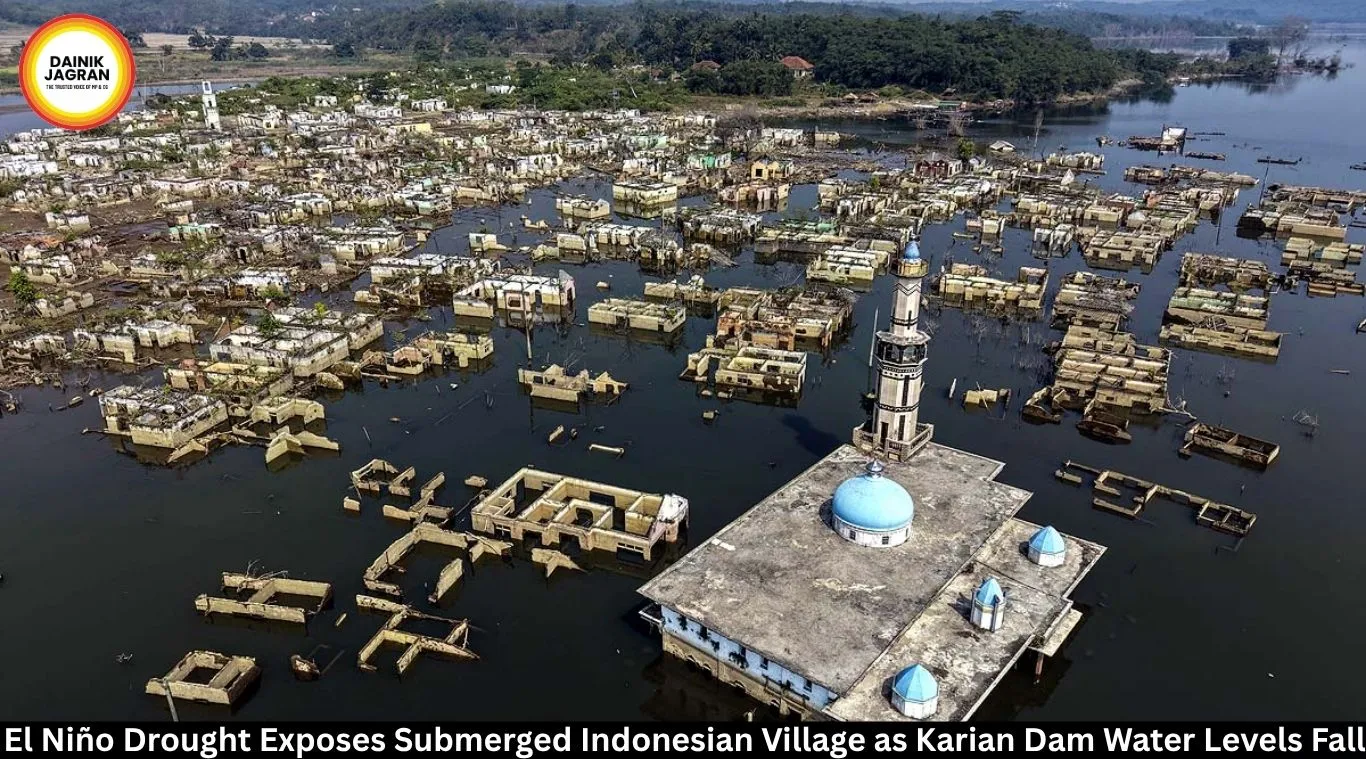
The resurfacing of Somang village, including old houses, a mosque and other structures, has offered a striking glimpse of a settlement that disappeared beneath the reservoir after the Karian Dam project was developed. The development comes amid unusually dry conditions in Indonesia, with the country's weather agency warning of below-normal rainfall across large parts of the country.
Village Reappears as Water Recedes
Somang was once a populated village in Banten before the area was submerged as part of the Karian Dam project. Construction of the project began in 2015, and the reservoir became operational in 2023, after which the village was covered by water and residents were relocated.
As the reservoir's water level dropped during the current dry spell, parts of the old settlement gradually became visible again. Images show remnants of concrete homes, walls, a mosque and other structures emerging from the exposed ground.
The sight has attracted attention because the landscape that had remained hidden underwater for years has suddenly become visible again.
El Niño Linked to Dry Conditions
The falling reservoir level is being reported amid the effects of an El Niño climate pattern, which can alter rainfall patterns across Southeast Asia.
During El Niño, changes in Pacific Ocean temperatures can influence atmospheric circulation and rainfall. In Indonesia, the phenomenon is often associated with reduced rainfall and hotter, drier conditions during the country's dry season.
Recent reporting has also documented worsening drought conditions in parts of Indonesia. Reuters reported that the country is experiencing widespread dry weather linked to an intensifying El Niño pattern, with agricultural communities facing water shortages even as some salt producers benefit from the prolonged sunshine.
Rainfall Deficit Across Indonesia
Indonesia's weather agency, BMKG, had forecast below-normal rainfall across significant parts of the country in 2026.
According to the Aaj Tak report, BMKG estimated in June that around 64.5 per cent of Indonesia could receive below-normal rainfall, while approximately 57.2 per cent could experience a longer-than-usual dry season. The first part of July also saw rainfall below normal across a large portion of the country.
BMKG subsequently indicated that El Niño had become active and could strengthen, raising concerns over prolonged dry conditions, water availability, agriculture and the risk of forest and land fires.
Karian Reservoir’s Importance
The Karian Reservoir is an important water infrastructure project serving the wider Greater Jakarta region. Its water resources are intended to support the needs of a large and densely populated area.
The current decline in reservoir levels therefore carries significance beyond the appearance of the submerged village. A prolonged shortage of rainfall could put additional pressure on water resources, particularly if dry conditions continue for several months.
The re-emergence of Somang provides a visible indication of just how far the reservoir level has fallen.
What Happened to Somang?
Before the dam was constructed, Somang was a functioning village where families lived and worked. The construction of the reservoir required the settlement to be cleared and its residents relocated.
Once the reservoir filled, the village disappeared beneath the water. For years, there was little visible evidence of the settlement from the surface.
Now, with the water retreating, parts of the old village have returned to view. The exposed structures serve as a reminder of the communities that once occupied the land before it became part of the reservoir.
Drought Raises Wider Concerns
The resurfacing of Somang is visually striking, but the underlying reason is a matter of concern. Falling water levels can affect drinking-water supplies, farming and other activities dependent on reservoirs.
Indonesia is also dealing with an elevated risk of wildfires during the current dry period. Recent reports have highlighted fires across parts of the country amid exceptionally dry conditions.
If rainfall remains below normal, pressure on water resources could increase further.
For now, the remains of Somang stand exposed as an unusual consequence of the drought — a village hidden beneath a reservoir for years has temporarily returned to the surface as Indonesia confronts a prolonged period of dry weather.
El Niño Drought Reveals Submerged Indonesian Village Beneath Karian Dam
Digital desk
A prolonged dry spell in Indonesia has caused water levels in the Karian Reservoir in Banten province to fall sharply, revealing the remains of a village that had been submerged for years after the construction of the dam.
The resurfacing of Somang village, including old houses, a mosque and other structures, has offered a striking glimpse of a settlement that disappeared beneath the reservoir after the Karian Dam project was developed. The development comes amid unusually dry conditions in Indonesia, with the country's weather agency warning of below-normal rainfall across large parts of the country.
Village Reappears as Water Recedes
Somang was once a populated village in Banten before the area was submerged as part of the Karian Dam project. Construction of the project began in 2015, and the reservoir became operational in 2023, after which the village was covered by water and residents were relocated.
As the reservoir's water level dropped during the current dry spell, parts of the old settlement gradually became visible again. Images show remnants of concrete homes, walls, a mosque and other structures emerging from the exposed ground.
The sight has attracted attention because the landscape that had remained hidden underwater for years has suddenly become visible again.
El Niño Linked to Dry Conditions
The falling reservoir level is being reported amid the effects of an El Niño climate pattern, which can alter rainfall patterns across Southeast Asia.
During El Niño, changes in Pacific Ocean temperatures can influence atmospheric circulation and rainfall. In Indonesia, the phenomenon is often associated with reduced rainfall and hotter, drier conditions during the country's dry season.
Recent reporting has also documented worsening drought conditions in parts of Indonesia. Reuters reported that the country is experiencing widespread dry weather linked to an intensifying El Niño pattern, with agricultural communities facing water shortages even as some salt producers benefit from the prolonged sunshine.
Rainfall Deficit Across Indonesia
Indonesia's weather agency, BMKG, had forecast below-normal rainfall across significant parts of the country in 2026.
According to the Aaj Tak report, BMKG estimated in June that around 64.5 per cent of Indonesia could receive below-normal rainfall, while approximately 57.2 per cent could experience a longer-than-usual dry season. The first part of July also saw rainfall below normal across a large portion of the country.
BMKG subsequently indicated that El Niño had become active and could strengthen, raising concerns over prolonged dry conditions, water availability, agriculture and the risk of forest and land fires.
Karian Reservoir’s Importance
The Karian Reservoir is an important water infrastructure project serving the wider Greater Jakarta region. Its water resources are intended to support the needs of a large and densely populated area.
The current decline in reservoir levels therefore carries significance beyond the appearance of the submerged village. A prolonged shortage of rainfall could put additional pressure on water resources, particularly if dry conditions continue for several months.
The re-emergence of Somang provides a visible indication of just how far the reservoir level has fallen.
What Happened to Somang?
Before the dam was constructed, Somang was a functioning village where families lived and worked. The construction of the reservoir required the settlement to be cleared and its residents relocated.
Once the reservoir filled, the village disappeared beneath the water. For years, there was little visible evidence of the settlement from the surface.
Now, with the water retreating, parts of the old village have returned to view. The exposed structures serve as a reminder of the communities that once occupied the land before it became part of the reservoir.
Drought Raises Wider Concerns
The resurfacing of Somang is visually striking, but the underlying reason is a matter of concern. Falling water levels can affect drinking-water supplies, farming and other activities dependent on reservoirs.
Indonesia is also dealing with an elevated risk of wildfires during the current dry period. Recent reports have highlighted fires across parts of the country amid exceptionally dry conditions.
If rainfall remains below normal, pressure on water resources could increase further.
For now, the remains of Somang stand exposed as an unusual consequence of the drought — a village hidden beneath a reservoir for years has temporarily returned to the surface as Indonesia confronts a prolonged period of dry weather.

Recommended For You
--------
🚨 Beat the News Rush – Join Now!
Get breaking alerts, hot exclusives, and game-changing stories instantly on your phone. No delays, no fluff – just the edge you need. ⚡
Tap to join:
🟢 WhatsApp Channel: Dainik Jagran MP CG
Crave more?
🅕 Facebook: Dainik Jagran MP CG English
🅧 Twitter (X): Dainik Jagran MP CG
🅘 Instagram: Dainik Jagran MP CG
Share the fire – keep your crew ahead! 🗞️🔥