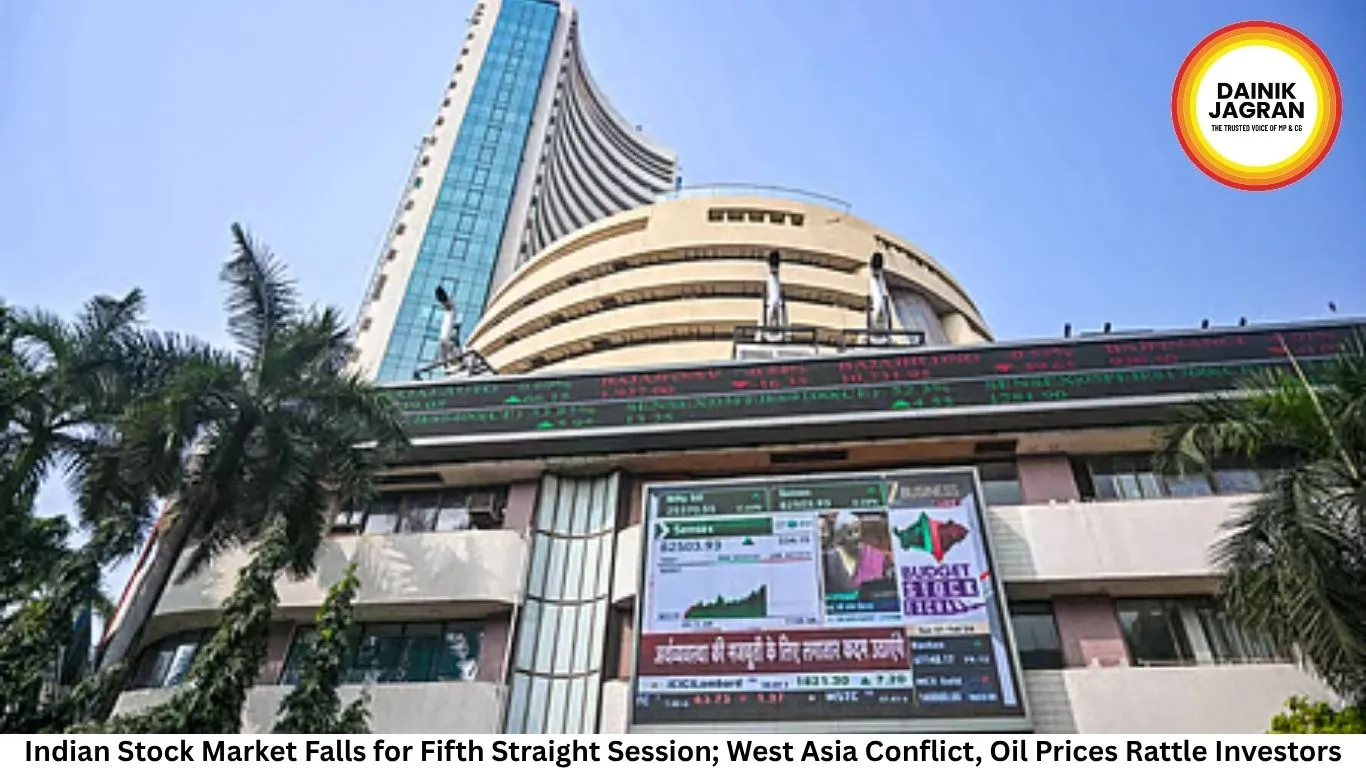
Indian Stock Market Falls for Fifth Straight Session; West Asia Conflict, Oil Prices Rattle Investors
Digital Desk
Indian benchmark indices fell for the fifth consecutive session as escalating geopolitical tensions in West Asia and surging crude oil prices weighed on investor sentiment. Rising Brent crude above $100 per barrel, persistent foreign investor selling, and weakness across global markets added to the pressure.
Indian equity markets remained under pressure on Friday, extending losses for the fifth consecutive trading session as investors turned cautious amid escalating geopolitical tensions in West Asia. Concerns over the expanding US-Iran conflict, a sharp rise in crude oil prices, and continued foreign fund outflows triggered broad-based selling across sectors.
The BSE Sensex declined 331.62 points to close at 76,059.77, while the NSE Nifty 50 slipped 102.15 points to 23,767.45. Market sentiment remained fragile as investors assessed the potential economic fallout of rising global uncertainty.
Crude Oil Surge Raises Inflation Concerns
One of the biggest concerns for investors is the sharp increase in crude oil prices.
Brent crude crossed the $100 per barrel mark for the first time in months as fears of supply disruptions intensified due to the ongoing conflict in West Asia. Market analysts warn that if tensions escalate further, crude prices could rise towards $120 per barrel, increasing inflationary pressures worldwide.
For India, which imports nearly 85% of its crude oil requirement, higher oil prices could widen the trade deficit, increase import bills, and put pressure on government finances. Rising fuel costs may also affect transportation, manufacturing, and consumer prices in the coming months.
Foreign Investors Continue to Exit
Foreign Institutional Investors (FIIs) remained net sellers, reflecting cautious global sentiment.
According to market data, FIIs have sold equities worth ₹3,289 crore over the past seven trading sessions and ₹11,359 crore during the last month. On Friday alone, foreign investors sold shares worth nearly ₹2,999 crore.
Domestic Institutional Investors (DIIs), however, continued to provide some support by purchasing equities worth ₹2,947 crore, helping limit deeper losses.
Realty Sector Leads the Decline
Selling pressure was visible across almost all major sectors.
The Nifty Realty Index emerged as the biggest loser, declining nearly 1.9%, while banking, financial services, IT, automobile, and metal stocks also traded in negative territory.
Defensive sectors such as pharmaceuticals and FMCG witnessed relatively lower volatility, although gains remained limited.
Market experts believe investors are shifting towards safer assets until geopolitical uncertainty subsides.
Global Markets Reflect Similar Weakness
The weakness was not limited to Indian equities.
Asian markets also traded sharply lower following growing concerns over the conflict.
- South Korea's KOSPI fell more than 5%.
- Japan's Nikkei declined nearly 3%.
- Hong Kong's Hang Seng also ended in negative territory.
US markets had already closed lower on Thursday, with the Dow Jones, Nasdaq, and S&P 500 all registering losses as investors reacted to rising geopolitical risks and fears of slower global economic growth.
Rupee Shows Resilience
Despite volatility in equity markets, the Indian rupee strengthened by 15 paise to 96.58 against the US dollar.
Currency analysts attribute the appreciation to improved central bank liquidity management and selective dollar selling, although sustained gains could remain challenging if crude oil prices continue rising.
What Should Investors Watch Next?
Market participants are closely monitoring developments in West Asia, particularly any escalation involving major oil-producing nations.
Investors will also track:
- Movement in crude oil prices.
- Foreign institutional investment flows.
- Global central bank commentary.
- Corporate earnings announcements.
- Inflation and economic growth indicators.
Analysts believe volatility could remain elevated until geopolitical tensions ease.
Market Outlook
While the current correction reflects short-term uncertainty, analysts suggest that long-term investors should avoid panic-driven decisions.
Historically, geopolitical events have triggered temporary market corrections, but fundamentals such as corporate earnings, domestic consumption, infrastructure spending, and economic reforms continue to support India's long-term growth story.
However, sustained high crude prices and continued foreign capital outflows could keep markets under pressure in the near term.
For now, investor sentiment remains cautious as financial markets across the world respond to one of the most uncertain geopolitical environments in recent years.
--------
🚨 Beat the News Rush – Join Now!
Get breaking alerts, hot exclusives, and game-changing stories instantly on your phone. No delays, no fluff – just the edge you need. ⚡
Tap to join:
🟢 WhatsApp Channel: Dainik Jagran MP CG
Crave more?
🅕 Facebook: Dainik Jagran MP CG English
🅧 Twitter (X): Dainik Jagran MP CG
🅘 Instagram: Dainik Jagran MP CG
Share the fire – keep your crew ahead! 🗞️🔥
Indian Stock Market Falls for Fifth Straight Session; West Asia Conflict, Oil Prices Rattle Investors
Digital Desk
Indian equity markets remained under pressure on Friday, extending losses for the fifth consecutive trading session as investors turned cautious amid escalating geopolitical tensions in West Asia. Concerns over the expanding US-Iran conflict, a sharp rise in crude oil prices, and continued foreign fund outflows triggered broad-based selling across sectors.
The BSE Sensex declined 331.62 points to close at 76,059.77, while the NSE Nifty 50 slipped 102.15 points to 23,767.45. Market sentiment remained fragile as investors assessed the potential economic fallout of rising global uncertainty.
Crude Oil Surge Raises Inflation Concerns
One of the biggest concerns for investors is the sharp increase in crude oil prices.
Brent crude crossed the $100 per barrel mark for the first time in months as fears of supply disruptions intensified due to the ongoing conflict in West Asia. Market analysts warn that if tensions escalate further, crude prices could rise towards $120 per barrel, increasing inflationary pressures worldwide.
For India, which imports nearly 85% of its crude oil requirement, higher oil prices could widen the trade deficit, increase import bills, and put pressure on government finances. Rising fuel costs may also affect transportation, manufacturing, and consumer prices in the coming months.
Foreign Investors Continue to Exit
Foreign Institutional Investors (FIIs) remained net sellers, reflecting cautious global sentiment.
According to market data, FIIs have sold equities worth ₹3,289 crore over the past seven trading sessions and ₹11,359 crore during the last month. On Friday alone, foreign investors sold shares worth nearly ₹2,999 crore.
Domestic Institutional Investors (DIIs), however, continued to provide some support by purchasing equities worth ₹2,947 crore, helping limit deeper losses.
Realty Sector Leads the Decline
Selling pressure was visible across almost all major sectors.
The Nifty Realty Index emerged as the biggest loser, declining nearly 1.9%, while banking, financial services, IT, automobile, and metal stocks also traded in negative territory.
Defensive sectors such as pharmaceuticals and FMCG witnessed relatively lower volatility, although gains remained limited.
Market experts believe investors are shifting towards safer assets until geopolitical uncertainty subsides.
Global Markets Reflect Similar Weakness
The weakness was not limited to Indian equities.
Asian markets also traded sharply lower following growing concerns over the conflict.
- South Korea's KOSPI fell more than 5%.
- Japan's Nikkei declined nearly 3%.
- Hong Kong's Hang Seng also ended in negative territory.
US markets had already closed lower on Thursday, with the Dow Jones, Nasdaq, and S&P 500 all registering losses as investors reacted to rising geopolitical risks and fears of slower global economic growth.
Rupee Shows Resilience
Despite volatility in equity markets, the Indian rupee strengthened by 15 paise to 96.58 against the US dollar.
Currency analysts attribute the appreciation to improved central bank liquidity management and selective dollar selling, although sustained gains could remain challenging if crude oil prices continue rising.
What Should Investors Watch Next?
Market participants are closely monitoring developments in West Asia, particularly any escalation involving major oil-producing nations.
Investors will also track:
- Movement in crude oil prices.
- Foreign institutional investment flows.
- Global central bank commentary.
- Corporate earnings announcements.
- Inflation and economic growth indicators.
Analysts believe volatility could remain elevated until geopolitical tensions ease.
Market Outlook
While the current correction reflects short-term uncertainty, analysts suggest that long-term investors should avoid panic-driven decisions.
Historically, geopolitical events have triggered temporary market corrections, but fundamentals such as corporate earnings, domestic consumption, infrastructure spending, and economic reforms continue to support India's long-term growth story.
However, sustained high crude prices and continued foreign capital outflows could keep markets under pressure in the near term.
For now, investor sentiment remains cautious as financial markets across the world respond to one of the most uncertain geopolitical environments in recent years.