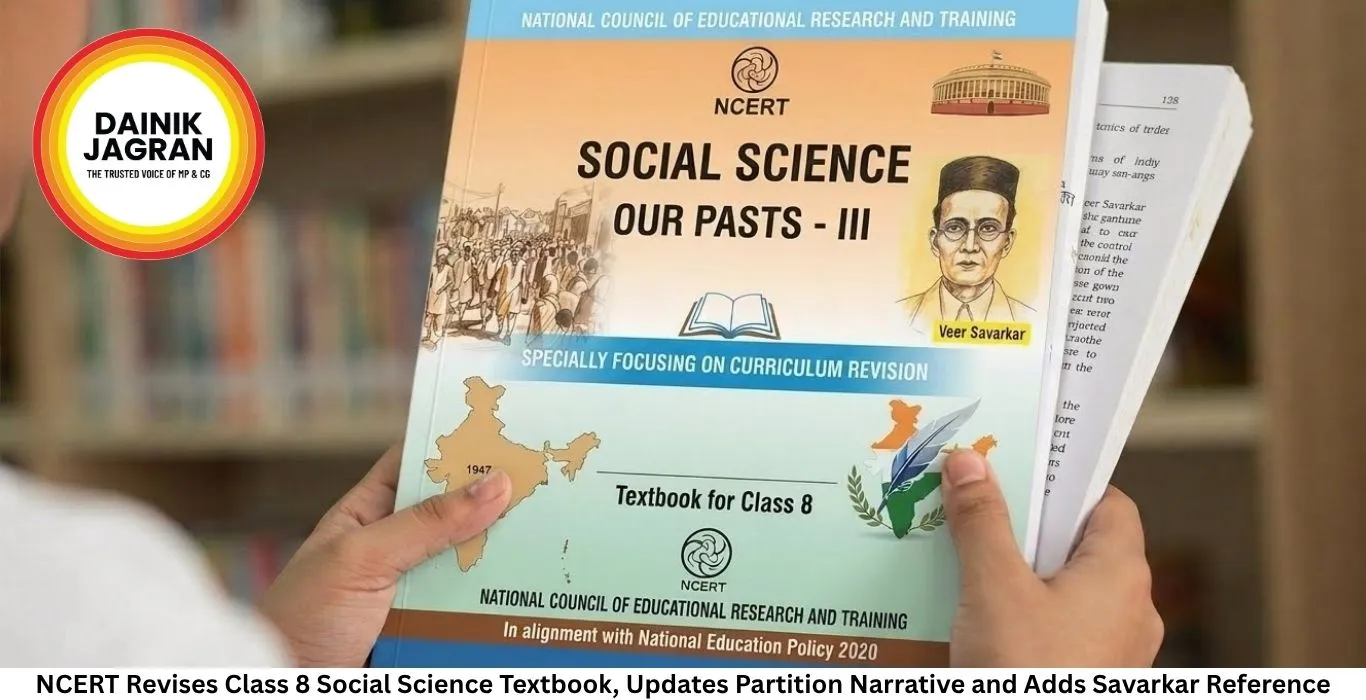
NCERT Revises Class 8 Social Science Textbook, Updates Partition Narrative and Adds Savarkar Reference

Digital desk

NCERT Revises Class 8 Social Science Textbook, Updates Partition Narrative and Adds Savarkar Reference

New Delhi: The National Council of Educational Research and Training (NCERT) has released a revised version of its Class 8 Social Science textbook, introducing several changes to historical content, including references to the Partition of India, freedom movement narratives and political figures associated with the independence era.

The revised textbook, titled Exploring Society: India and Beyond, had already drawn public attention in recent weeks following controversy over a chapter that referred to corruption in the judiciary. That section was subsequently withdrawn after objections were raised, and NCERT recalled both digital and printed copies before issuing the updated edition.

Among the most discussed changes in the new version is the revised description of the Indian National Congress's position on Partition in 1947. The chapter India’s Long Road to Independence now states that Partition was widely opposed by the Congress and that whether accepting Partition was the only available option remains a matter of historical debate.

The revised text no longer includes an earlier passage that suggested Congress leaders were compelled to accept Partition amid widespread communal violence in the subcontinent.

In the previous edition, the textbook had stated that although Mahatma Gandhi and most Congress leaders opposed Partition, they ultimately accepted it as the only viable solution. The updated version presents the issue with greater emphasis on ongoing historical discussions surrounding the circumstances that led to the decision.

Another notable addition is the inclusion of a reference to Vinayak Damodar Savarkar, commonly known as Veer Savarkar. The revised text mentions that Savarkar had advocated the idea of Swaraj in 1925, expanding the discussion on demands for complete independence during the freedom struggle.

The change comes as debates over the representation of historical personalities in school textbooks continue to attract attention from academics, political groups and education experts.

The revised edition has also altered content related to World War II and the activities of Subhas Chandra Bose. References to Adolf Hitler and Nazi ideology that appeared in the earlier version have been removed.

Previously, the textbook had explained that Bose sought support from Hitler while forming military efforts against British rule and described the German leader’s racist Nazi ideology and expansionist ambitions that contributed to World War II.

In the updated version, the discussion has been shortened. It now states that Bose sought support from forces opposed to British rule, without specifically mentioning Hitler or Nazi ideology.

The revisions come after NCERT faced scrutiny over content included in the earlier edition. Following concerns raised before the Supreme Court regarding the chapter on judicial corruption, the council apologised and withdrew copies of the textbook pending review and correction.

The newly released edition contains additional editorial changes as part of that review process.

There have also been modifications to the list of contributors associated with the textbook. While the earlier version carried the names of 51 contributors, the revised edition lists 48. Reports indicate that the names of Michel Danino, Suparna Diwakar and Alok Prasanna Kumar are no longer included among the contributors to the updated textbook.

The changes have reignited discussions about how Indian history is presented in school curricula, particularly on subjects such as Partition, the freedom movement and the role of historical figures. Education experts say textbook revisions often generate debate because they shape how future generations understand major national events.

NCERT has not indicated whether further revisions are planned, but the latest update reflects the continuing effort to align school textbooks with the framework being implemented under the National Education Policy.
--------

🚨 Beat the News Rush – Join Now!

Get breaking alerts, hot exclusives, and game-changing stories instantly on your phone. No delays, no fluff – just the edge you need. ⚡

Tap to join: 

🟢 WhatsApp Channel: Dainik Jagran MP CG

Crave more?

🅕 Facebook: Dainik Jagran MP CG English

🅧 Twitter (X): Dainik Jagran MP CG

🅘 Instagram: Dainik Jagran MP CG

Share the fire – keep your crew ahead! 🗞️🔥

english.dainikjagranmpcg.com
08 Jul 2026 By Priyanshu.Jha

NCERT Revises Class 8 Social Science Textbook, Updates Partition Narrative and Adds Savarkar Reference

Digital desk

The revised textbook, titled Exploring Society: India and Beyond, had already drawn public attention in recent weeks following controversy over a chapter that referred to corruption in the judiciary. That section was subsequently withdrawn after objections were raised, and NCERT recalled both digital and printed copies before issuing the updated edition.

Among the most discussed changes in the new version is the revised description of the Indian National Congress's position on Partition in 1947. The chapter India’s Long Road to Independence now states that Partition was widely opposed by the Congress and that whether accepting Partition was the only available option remains a matter of historical debate.

The revised text no longer includes an earlier passage that suggested Congress leaders were compelled to accept Partition amid widespread communal violence in the subcontinent.

In the previous edition, the textbook had stated that although Mahatma Gandhi and most Congress leaders opposed Partition, they ultimately accepted it as the only viable solution. The updated version presents the issue with greater emphasis on ongoing historical discussions surrounding the circumstances that led to the decision.

Another notable addition is the inclusion of a reference to Vinayak Damodar Savarkar, commonly known as Veer Savarkar. The revised text mentions that Savarkar had advocated the idea of Swaraj in 1925, expanding the discussion on demands for complete independence during the freedom struggle.

The change comes as debates over the representation of historical personalities in school textbooks continue to attract attention from academics, political groups and education experts.

The revised edition has also altered content related to World War II and the activities of Subhas Chandra Bose. References to Adolf Hitler and Nazi ideology that appeared in the earlier version have been removed.

Previously, the textbook had explained that Bose sought support from Hitler while forming military efforts against British rule and described the German leader’s racist Nazi ideology and expansionist ambitions that contributed to World War II.

In the updated version, the discussion has been shortened. It now states that Bose sought support from forces opposed to British rule, without specifically mentioning Hitler or Nazi ideology.

The revisions come after NCERT faced scrutiny over content included in the earlier edition. Following concerns raised before the Supreme Court regarding the chapter on judicial corruption, the council apologised and withdrew copies of the textbook pending review and correction.

The newly released edition contains additional editorial changes as part of that review process.

There have also been modifications to the list of contributors associated with the textbook. While the earlier version carried the names of 51 contributors, the revised edition lists 48. Reports indicate that the names of Michel Danino, Suparna Diwakar and Alok Prasanna Kumar are no longer included among the contributors to the updated textbook.

The changes have reignited discussions about how Indian history is presented in school curricula, particularly on subjects such as Partition, the freedom movement and the role of historical figures. Education experts say textbook revisions often generate debate because they shape how future generations understand major national events.

NCERT has not indicated whether further revisions are planned, but the latest update reflects the continuing effort to align school textbooks with the framework being implemented under the National Education Policy.
https://english.dainikjagranmpcg.com/education/6a4e2306c2828/article-21406

Trending News