Beyond ABC and 123: What Else to Teach Your 3-to-6-Year-Old
Digital desk
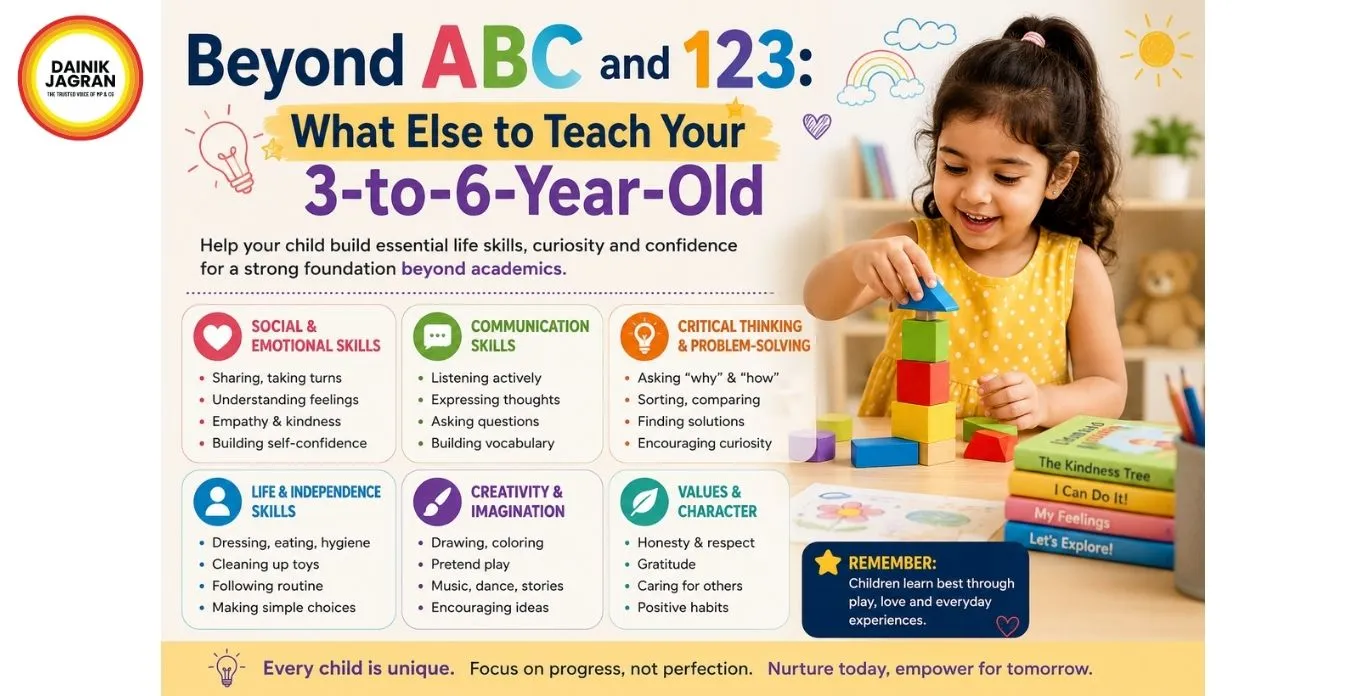
Letters and numbers get most of the parental attention in the early years — but child development experts consistently point out that a preschooler's real readiness for school depends on a much broader set of skills. Here's what deserves equal time on the learning list.
Fine motor skills
Before a child can write neatly, their hands need practice with the basic movements that lead there — holding a crayon or pencil correctly, cutting along a line with safety scissors, stringing beads, and colouring within a shape. These small-motor skills develop hand-eye coordination and pencil control, both of which make actual handwriting far easier once it's introduced.
Shapes, colours and sorting
Recognising basic shapes and colours isn't just decorative knowledge — it builds early categorisation and comparison skills that later feed directly into math reasoning. Everyday activities work best here: sorting toy blocks or cars by colour, grouping stuffed animals by size, or picking out "the red one" during a game all reinforce this without feeling like a lesson.
Counting with real objects, not just reciting numbers
There's a real difference between a child who can sing "1, 2, 3, 4" and one who understands that four actually means four separate things. Practical counting — asking for "3 crackers" at snack time, counting steps while climbing stairs, or counting toys during cleanup — builds genuine number sense rather than memorised recitation.
Social skills
Sharing, taking turns, cooperating during group play, and communicating needs clearly are often the actual gatekeepers of a smooth kindergarten transition — far more so than knowing extra letters early. These skills develop through structured playdates, group games, and consistent, calm reinforcement at home when conflicts naturally come up.
Listening and following instructions
The ability to follow a two- or three-step instruction ("put your shoes on, then get your bag, then wait by the door") is a foundational classroom skill that's easy to overlook at home, where parents often repeat or simplify instructions without noticing.
Basic self-care and independence
Skills like washing hands properly, buttoning a shirt, packing away toys, and using the toilet independently might feel unrelated to "learning," but they directly affect how confidently and smoothly a child settles into a classroom environment away from constant adult help.
Curiosity and questions over correct answers
Perhaps the most overlooked skill of all: encouraging a child to ask "why" and explore an answer together, rather than just supplying the correct fact immediately. This builds the kind of problem-solving instinct that formal alphabet or number drilling doesn't touch, and tends to matter far more for long-term learning than an early head start on letters.
The bigger point
Letters and numbers matter, and most children pick them up naturally with regular exposure through books, songs and everyday conversation. But experts consistently note that direct instruction should stay playful rather than pressured at this age — what actually predicts a smooth start to formal schooling is a well-rounded mix of motor skills, social confidence, and curiosity, not how early a child can recite the alphabet.
--------
๐จ Beat the News Rush โ Join Now!
Get breaking alerts, hot exclusives, and game-changing stories instantly on your phone. No delays, no fluff โ just the edge you need. โก
Tap to join:ย
๐ข WhatsApp Channel: Dainik Jagran MP CG
Crave more?
๐ Facebook: Dainik Jagran MP CG English
๐ ง Twitter (X): Dainik Jagran MP CG
๐ Instagram: Dainik Jagran MP CG
Share the fire โ keep your crew ahead! ๐๏ธ๐ฅ
Beyond ABC and 123: What Else to Teach Your 3-to-6-Year-Old
Digital desk
Fine motor skills
Before a child can write neatly, their hands need practice with the basic movements that lead there — holding a crayon or pencil correctly, cutting along a line with safety scissors, stringing beads, and colouring within a shape. These small-motor skills develop hand-eye coordination and pencil control, both of which make actual handwriting far easier once it's introduced.
Shapes, colours and sorting
Recognising basic shapes and colours isn't just decorative knowledge — it builds early categorisation and comparison skills that later feed directly into math reasoning. Everyday activities work best here: sorting toy blocks or cars by colour, grouping stuffed animals by size, or picking out "the red one" during a game all reinforce this without feeling like a lesson.
Counting with real objects, not just reciting numbers
There's a real difference between a child who can sing "1, 2, 3, 4" and one who understands that four actually means four separate things. Practical counting — asking for "3 crackers" at snack time, counting steps while climbing stairs, or counting toys during cleanup — builds genuine number sense rather than memorised recitation.
Social skills
Sharing, taking turns, cooperating during group play, and communicating needs clearly are often the actual gatekeepers of a smooth kindergarten transition — far more so than knowing extra letters early. These skills develop through structured playdates, group games, and consistent, calm reinforcement at home when conflicts naturally come up.
Listening and following instructions
The ability to follow a two- or three-step instruction ("put your shoes on, then get your bag, then wait by the door") is a foundational classroom skill that's easy to overlook at home, where parents often repeat or simplify instructions without noticing.
Basic self-care and independence
Skills like washing hands properly, buttoning a shirt, packing away toys, and using the toilet independently might feel unrelated to "learning," but they directly affect how confidently and smoothly a child settles into a classroom environment away from constant adult help.
Curiosity and questions over correct answers
Perhaps the most overlooked skill of all: encouraging a child to ask "why" and explore an answer together, rather than just supplying the correct fact immediately. This builds the kind of problem-solving instinct that formal alphabet or number drilling doesn't touch, and tends to matter far more for long-term learning than an early head start on letters.
The bigger point
Letters and numbers matter, and most children pick them up naturally with regular exposure through books, songs and everyday conversation. But experts consistently note that direct instruction should stay playful rather than pressured at this age — what actually predicts a smooth start to formal schooling is a well-rounded mix of motor skills, social confidence, and curiosity, not how early a child can recite the alphabet.