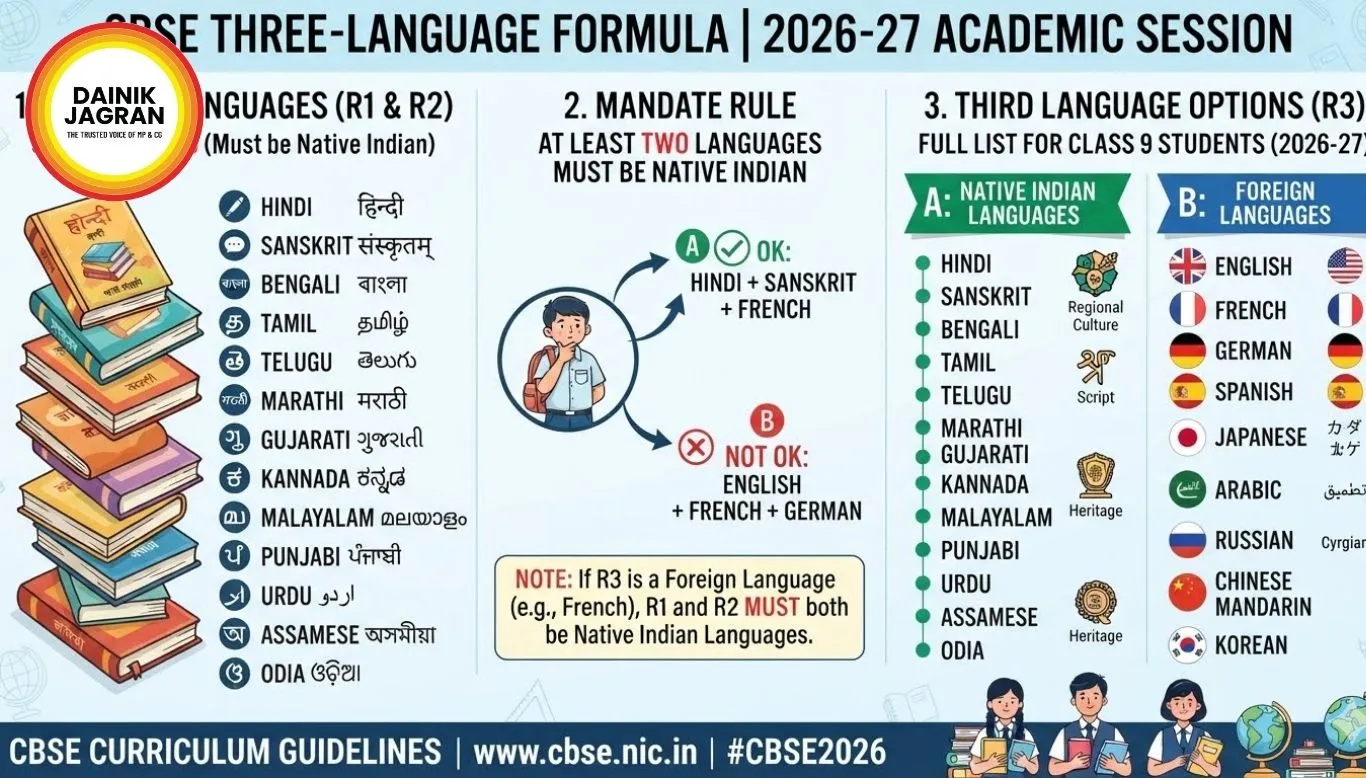
CBSE Three-Language Formula 2026-27: Full List of Third Language Options for Students

Digital desk

CBSE Three-Language Formula 2026-27: Full List of Third Language Options for Students

CBSE schools across the country are rolling out a genuinely structural change this academic session — three compulsory languages instead of two, organised under a new R1-R2-R3 framework. Here's what students and parents actually need to know.

What's changing
Starting with the 2026-27 academic session, CBSE has made a third language mandatory at two entry points: Class 6, where the requirement kicks in fresh for students entering that grade, and Class 9, where the board has issued a formal circular making three languages (R1, R2, R3) compulsory from July 1, 2026. The policy draws directly from the National Education Policy 2020 and the National Curriculum Framework for School Education 2023, both of which push for greater multilingualism in Indian classrooms.

The core rule: two must be Indian languages
Whatever combination a student picks, at least two of the three languages must be native to India, as defined under the Eighth Schedule of the Constitution. In most English-medium schools, that typically works out to English filling one slot, Hindi filling a second, and a third Indian language — commonly Sanskrit, but also Punjabi, Tamil, Bengali, Marathi, or any of the roughly 22 scheduled Indian languages CBSE has listed — completing the requirement.

Where foreign languages still fit
Students hoping to study French, German or Spanish haven't been completely shut out, but the rules are stricter than before. A foreign language can only be chosen as the third language (R3) if the other two languages picked are both native Indian languages. A student cannot combine English with two foreign languages under any circumstance. Students determined to study a foreign language alongside a full Indian-language combination can do so, but only as an additional fourth subject rather than a substitute for one of the three mandatory ones.

No duplicate languages
Whatever a student picks for R1 cannot be repeated at R2 or R3 — each of the three slots must be a genuinely distinct language.

How R3 is assessed
Unlike R1 and R2, the third language will not carry a Class 10 board exam. It will be assessed internally by the school instead, with the result recorded on the CBSE certificate. Crucially, CBSE has clarified that no student can be barred from appearing in or clearing Class 10 boards based on their R3 performance — the internal assessment carries no pass/fail consequence for board eligibility.

Timeline and rollout
Schools were required to notify their chosen R3 language offerings and update them on CBSE's official OASIS portal by June 30, 2026. Because dedicated Secondary Stage textbooks for many R3 languages are still being developed by NCERT, Class 9 students are expected to use the existing Class 6 R3 textbooks as a stopgap until proper secondary-level material is published, given the substantial overlap in core language skills between the two stages.

Exemptions and special cases
General exemptions apply to certain categories of students under the policy, and CBSE has said students whose parents relocate to another state can continue with their existing R3 combination from middle stage through Class 9, provided the new school makes adequate arrangements to support that choice.

For most families, the practical takeaway is straightforward: check with your child's school on exactly which R3 languages are being offered, since the specific combination available can vary depending on teacher availability and each school's own resources — CBSE's rule sets the boundaries, but the actual choice on the ground still comes down to what each school can support.


--------

๐Ÿšจ Beat the News Rush โ€“ Join Now!

Get breaking alerts, hot exclusives, and game-changing stories instantly on your phone. No delays, no fluff โ€“ just the edge you need. โšก

Tap to join:ย 

๐ŸŸข WhatsApp Channel: Dainik Jagran MP CG

Crave more?

๐Ÿ…• Facebook: Dainik Jagran MP CG English

๐Ÿ…ง Twitter (X): Dainik Jagran MP CG

๐Ÿ…˜ Instagram: Dainik Jagran MP CG

Share the fire โ€“ keep your crew ahead! ๐Ÿ—ž๏ธ๐Ÿ”ฅ

english.dainikjagranmpcg.com
15 Jul 2026 By Priyanshu.Jha

CBSE Three-Language Formula 2026-27: Full List of Third Language Options for Students

Digital desk

What's changing
Starting with the 2026-27 academic session, CBSE has made a third language mandatory at two entry points: Class 6, where the requirement kicks in fresh for students entering that grade, and Class 9, where the board has issued a formal circular making three languages (R1, R2, R3) compulsory from July 1, 2026. The policy draws directly from the National Education Policy 2020 and the National Curriculum Framework for School Education 2023, both of which push for greater multilingualism in Indian classrooms.

The core rule: two must be Indian languages
Whatever combination a student picks, at least two of the three languages must be native to India, as defined under the Eighth Schedule of the Constitution. In most English-medium schools, that typically works out to English filling one slot, Hindi filling a second, and a third Indian language — commonly Sanskrit, but also Punjabi, Tamil, Bengali, Marathi, or any of the roughly 22 scheduled Indian languages CBSE has listed — completing the requirement.

Where foreign languages still fit
Students hoping to study French, German or Spanish haven't been completely shut out, but the rules are stricter than before. A foreign language can only be chosen as the third language (R3) if the other two languages picked are both native Indian languages. A student cannot combine English with two foreign languages under any circumstance. Students determined to study a foreign language alongside a full Indian-language combination can do so, but only as an additional fourth subject rather than a substitute for one of the three mandatory ones.

No duplicate languages
Whatever a student picks for R1 cannot be repeated at R2 or R3 — each of the three slots must be a genuinely distinct language.

How R3 is assessed
Unlike R1 and R2, the third language will not carry a Class 10 board exam. It will be assessed internally by the school instead, with the result recorded on the CBSE certificate. Crucially, CBSE has clarified that no student can be barred from appearing in or clearing Class 10 boards based on their R3 performance — the internal assessment carries no pass/fail consequence for board eligibility.

Timeline and rollout
Schools were required to notify their chosen R3 language offerings and update them on CBSE's official OASIS portal by June 30, 2026. Because dedicated Secondary Stage textbooks for many R3 languages are still being developed by NCERT, Class 9 students are expected to use the existing Class 6 R3 textbooks as a stopgap until proper secondary-level material is published, given the substantial overlap in core language skills between the two stages.

Exemptions and special cases
General exemptions apply to certain categories of students under the policy, and CBSE has said students whose parents relocate to another state can continue with their existing R3 combination from middle stage through Class 9, provided the new school makes adequate arrangements to support that choice.

For most families, the practical takeaway is straightforward: check with your child's school on exactly which R3 languages are being offered, since the specific combination available can vary depending on teacher availability and each school's own resources — CBSE's rule sets the boundaries, but the actual choice on the ground still comes down to what each school can support.

https://english.dainikjagranmpcg.com/education/cbse-three-language-formula-2026-27-full-list-of-third-language-options/article-22288

Trending News