China's Missile Test Raises Indo-Pacific Security Concerns, India Strengthens Maritime Vigilance
Digital Desk
China's submarine-launched ballistic missile (SLBM) test has intensified regional security concerns, prompting renewed focus on India's maritime defence preparedness.
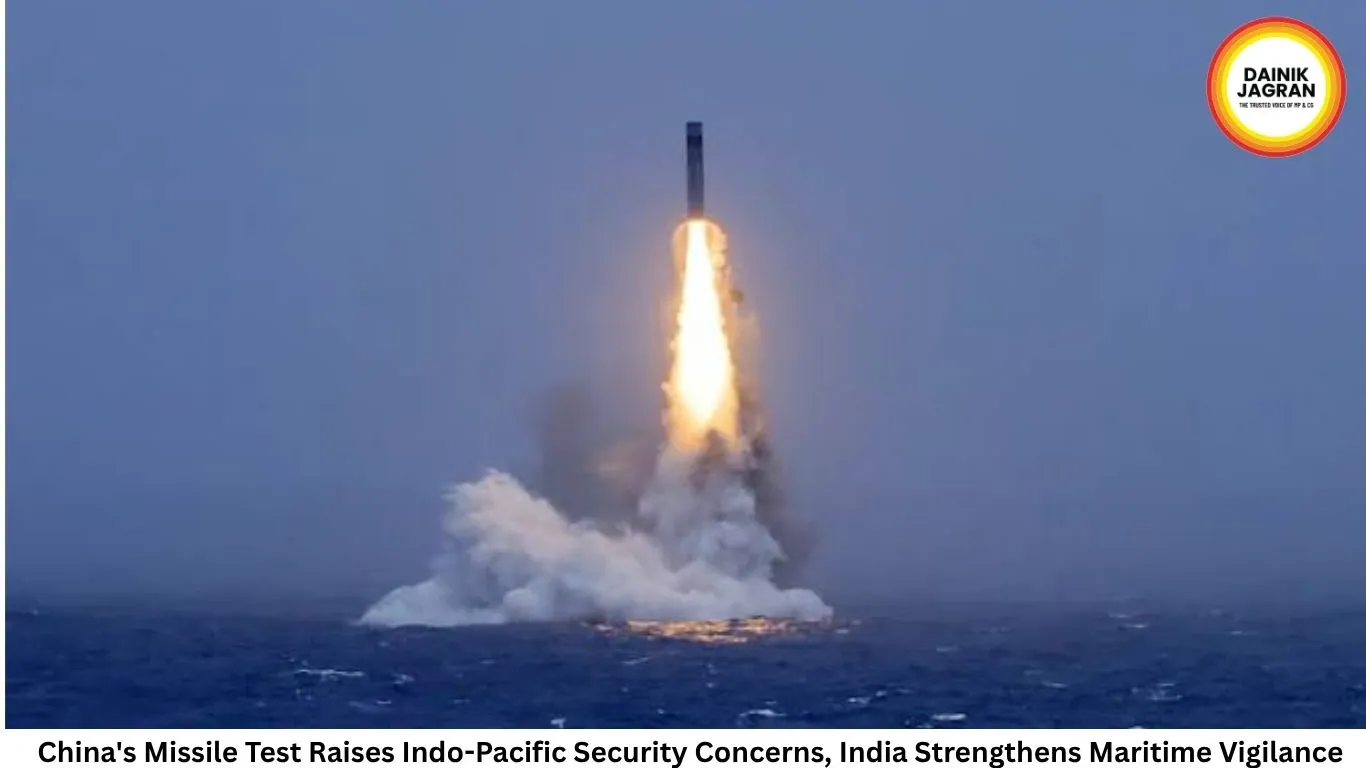
China reportedly tested a new-generation SLBM capable of carrying nuclear warheads and striking targets thousands of kilometres away. Unlike land-based missiles, submarine-launched ballistic missiles are fired from stealthy nuclear submarines operating deep underwater, making them significantly harder to detect and intercept. This strengthens a country's second-strike nuclear capability, a key component of strategic deterrence.
China Expands Sea-Based Nuclear Capability
Military analysts say China has been steadily modernising its naval forces over the past decade, with particular emphasis on expanding its nuclear-powered submarine fleet and long-range missile systems. While Beijing's strategic focus was once concentrated on the South China Sea and Taiwan Strait, its naval operations have increasingly extended into the Indian Ocean and the wider Indo-Pacific region.
The latest missile test is viewed as another step in China's long-term effort to establish a stronger and more credible sea-based nuclear deterrent.
Why It Matters for India
The development is particularly significant for India, as Chinese naval vessels and submarines have been increasingly active in the Indian Ocean Region (IOR). China's military base in Djibouti, its strategic presence at Pakistan's Gwadar Port, and growing influence at Sri Lanka's Hambantota Port have already raised security concerns in New Delhi.
If China deploys a larger fleet of quieter, more advanced nuclear submarines equipped with long-range ballistic missiles, its strategic footprint in the Indian Ocean could expand substantially, requiring India to strengthen its maritime surveillance and defence posture.
India May Need to Strengthen Maritime Deterrence
India follows the doctrine of "Credible Minimum Deterrence" and a "No First Use" nuclear policy. Defence experts argue that evolving regional security challenges may require India to further enhance its sea-based nuclear deterrent.
This could involve accelerating the induction of additional nuclear-powered submarines, expanding the deployment of indigenous K-4 and K-5 submarine-launched ballistic missiles, and strengthening maritime surveillance capabilities through advanced reconnaissance systems and underwater monitoring networks.
Strategic Importance of Andaman & Nicobar Command
The Andaman and Nicobar Command is expected to play an increasingly critical role in India's maritime security strategy. Located near the strategically vital Strait of Malacca—one of the world's busiest shipping lanes—the command provides India with a significant advantage in monitoring naval movements across the Indo-Pacific.
Should Chinese submarine activity increase in the region, India may further strengthen anti-submarine warfare capabilities by deploying additional P-8I maritime patrol aircraft, advanced sonar systems, unmanned surveillance platforms and underwater detection technologies.
Greater Role for QUAD Cooperation
China's expanding military presence is also likely to reinforce cooperation among the QUAD countries—India, the United States, Japan and Australia. The four nations have been enhancing collaboration on maritime domain awareness, intelligence sharing and joint naval exercises aimed at maintaining a free, open and rules-based Indo-Pacific.
Defence observers expect multilateral exercises such as the Malabar naval exercise to become even more important in strengthening regional security cooperation.
A Changing Strategic Balance
Experts believe China is using its growing sea-based nuclear capability not only to strengthen deterrence around Taiwan but also to challenge the strategic influence of the United States across the Pacific while projecting itself as a global military power.
India, meanwhile, continues to modernise its naval forces through indigenous defence programmes, enhanced maritime surveillance and deeper strategic partnerships with friendly nations. As geopolitical competition intensifies, strengthening naval preparedness and regional security cooperation is expected to remain central to India's defence strategy.

--------
๐จ Beat the News Rush โ Join Now!
Get breaking alerts, hot exclusives, and game-changing stories instantly on your phone. No delays, no fluff โ just the edge you need. โก
Tap to join:ย
๐ข WhatsApp Channel: Dainik Jagran MP CG
Crave more?
๐ Facebook: Dainik Jagran MP CG English
๐ ง Twitter (X): Dainik Jagran MP CG
๐ Instagram: Dainik Jagran MP CG
Share the fire โ keep your crew ahead! ๐๏ธ๐ฅ
China's Missile Test Raises Indo-Pacific Security Concerns, India Strengthens Maritime Vigilance
Digital Desk
China reportedly tested a new-generation SLBM capable of carrying nuclear warheads and striking targets thousands of kilometres away. Unlike land-based missiles, submarine-launched ballistic missiles are fired from stealthy nuclear submarines operating deep underwater, making them significantly harder to detect and intercept. This strengthens a country's second-strike nuclear capability, a key component of strategic deterrence.
China Expands Sea-Based Nuclear Capability
Military analysts say China has been steadily modernising its naval forces over the past decade, with particular emphasis on expanding its nuclear-powered submarine fleet and long-range missile systems. While Beijing's strategic focus was once concentrated on the South China Sea and Taiwan Strait, its naval operations have increasingly extended into the Indian Ocean and the wider Indo-Pacific region.
The latest missile test is viewed as another step in China's long-term effort to establish a stronger and more credible sea-based nuclear deterrent.
Why It Matters for India
The development is particularly significant for India, as Chinese naval vessels and submarines have been increasingly active in the Indian Ocean Region (IOR). China's military base in Djibouti, its strategic presence at Pakistan's Gwadar Port, and growing influence at Sri Lanka's Hambantota Port have already raised security concerns in New Delhi.
If China deploys a larger fleet of quieter, more advanced nuclear submarines equipped with long-range ballistic missiles, its strategic footprint in the Indian Ocean could expand substantially, requiring India to strengthen its maritime surveillance and defence posture.
India May Need to Strengthen Maritime Deterrence
India follows the doctrine of "Credible Minimum Deterrence" and a "No First Use" nuclear policy. Defence experts argue that evolving regional security challenges may require India to further enhance its sea-based nuclear deterrent.
This could involve accelerating the induction of additional nuclear-powered submarines, expanding the deployment of indigenous K-4 and K-5 submarine-launched ballistic missiles, and strengthening maritime surveillance capabilities through advanced reconnaissance systems and underwater monitoring networks.
Strategic Importance of Andaman & Nicobar Command
The Andaman and Nicobar Command is expected to play an increasingly critical role in India's maritime security strategy. Located near the strategically vital Strait of Malacca—one of the world's busiest shipping lanes—the command provides India with a significant advantage in monitoring naval movements across the Indo-Pacific.
Should Chinese submarine activity increase in the region, India may further strengthen anti-submarine warfare capabilities by deploying additional P-8I maritime patrol aircraft, advanced sonar systems, unmanned surveillance platforms and underwater detection technologies.
Greater Role for QUAD Cooperation
China's expanding military presence is also likely to reinforce cooperation among the QUAD countries—India, the United States, Japan and Australia. The four nations have been enhancing collaboration on maritime domain awareness, intelligence sharing and joint naval exercises aimed at maintaining a free, open and rules-based Indo-Pacific.
Defence observers expect multilateral exercises such as the Malabar naval exercise to become even more important in strengthening regional security cooperation.
A Changing Strategic Balance
Experts believe China is using its growing sea-based nuclear capability not only to strengthen deterrence around Taiwan but also to challenge the strategic influence of the United States across the Pacific while projecting itself as a global military power.
India, meanwhile, continues to modernise its naval forces through indigenous defence programmes, enhanced maritime surveillance and deeper strategic partnerships with friendly nations. As geopolitical competition intensifies, strengthening naval preparedness and regional security cooperation is expected to remain central to India's defence strategy.