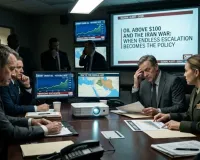
The Middle East is in the most dangerous moment of this century. What began as a joint US-Israel military strike on February 28, 2026 has now spiralled into a widening regional conflict — and this weekend, Tehran crossed a new line.
Iran's Islamic Revolutionary Guard Corps publicly vowed to pursue and kill Israeli Prime Minister Benjamin Netanyahu, with Iran's state news agency posting a chilling statement on X — calling Netanyahu a "child-killer" and threatening his life directly. The statement came after rumours spread over the weekend that Netanyahu had already been killed, forcing his office to release a statement calling the reports entirely false.
This is the war nobody fully predicted — and it is not over.
How It Started: Operation Roaring Lion
On February 28, 2026, Israel and the United States jointly launched Operation Roaring Lion, with Netanyahu announcing that the aim was to put a permanent end to the threat from the Iranian regime. The IDF struck targets of the Revolutionary Guards and the Basij paramilitary force, alongside US military strikes on ballistic missile sites threatening both Israel and American forces across the region.
Netanyahu declared the goal was to remove the existential threat posed by the Iranian regime, stating that the joint action would create the conditions for the Iranian people to take their destiny into their own hands.
This was not a sudden decision. Israeli Defence Minister Israel Katz disclosed on March 4 that Israel had initially planned to strike Iran in mid-2026, but moved the timeline forward. Katz also revealed that Netanyahu had set an objective of targeting Supreme Leader Ali Khamenei as far back as November 2025.
Where Things Stand Right Now — March 16, 2026
The conflict has now entered its third week and shows no sign of slowing down.
Iran has continued firing missiles at Israel. Israel in return targeted key members of Iran's leadership, and the IDF confirmed it had eliminated two senior Iranian intelligence officials from the Khatam al-Anbiya Emergency Command.
Despite US and Israeli attacks against Iran's missile launchers and stockpiles, Iran has continued striking Israel with round-the-clock ballistic missile and drone attacks, also hitting Arab neighbours in the Gulf region, driving a sharp spike in global oil prices.
Netanyahu held his first press conference since the war began on March 12. He confirmed Israel had killed a senior Iranian nuclear scientist and said the campaign was going better than expected. When asked whether Israel would target Iran's new Supreme Leader Mojtaba Khamenei, Netanyahu said he would not rule anything out.
The Regime Change Question
The central strategic question of this war is what victory actually looks like.
Netanyahu's messaging has remained fixated on regime change in Iran since day one. Analysts note that for Netanyahu — seeking to recover politically from the October 7, 2023 Hamas attack — anything less than regime change could be seen as a failure by the Israeli public.
But analysts are increasingly sceptical. With no evidence of a popular Iranian uprising and the Trump administration appearing to back away from its own regime change demands, it remains unclear whether Israel has a clear endgame plan or what its fallback position might be.
A former Israeli national security adviser noted that if Israel and the US drop regime change as a stated goal, they will instead pursue objectives easier to define and measure — such as further degrading Iran's missile systems and nuclear programme.
The Nuclear Problem Is Not Solved Yet
The US-Israeli operations in February 2026 confirmed that earlier strikes had not succeeded in destroying the Iranian nuclear programme entirely. Iran still holds approximately 450 kilograms of highly enriched uranium stored in underground tunnels and refused, in pre-war talks with the United States, to export its stockpiles.
The thinking in Jerusalem was clear — waiting would only allow Iran to rebuild its nuclear and missile capabilities to a point of no return. The window to act was now or never.
Kharg Island and the Global Oil Risk
The war is no longer just a Middle Eastern conflict. It is a global economic threat.
US Ambassador to the UN Mike Waltz confirmed that President Trump is weighing strikes on oil infrastructure at Kharg Island, Iran's key oil export hub, saying Trump is not going to take any options off the table. Trump previously directed US Central Command to bomb Kharg Island's military infrastructure while leaving oil facilities intact — but that position could change quickly.
If that calculation shifts, global oil markets face a shock of historic proportions.
What Happens Next
Israel's army chief Eyal Zamir has said the war will likely continue for a long time. A March 2026 survey found that 82 percent of the Israeli public supports ongoing military operations, giving Netanyahu significant domestic political cover to continue.
But a former IDF strategic planning director has warned that neither the US nor Israel has set out a realistic exit strategy — and that without one, there is no exit.
The Iran-Israel war of 2026 is no longer a regional skirmish. It is a conflict with the potential to reshape the entire Middle East and the global economy alongside it. The IRGC's threat to kill Netanyahu this weekend is the latest reminder that this war has entered deeply personal and dangerously unpredictable territory.
The world is watching. And nobody knows how this ends.