


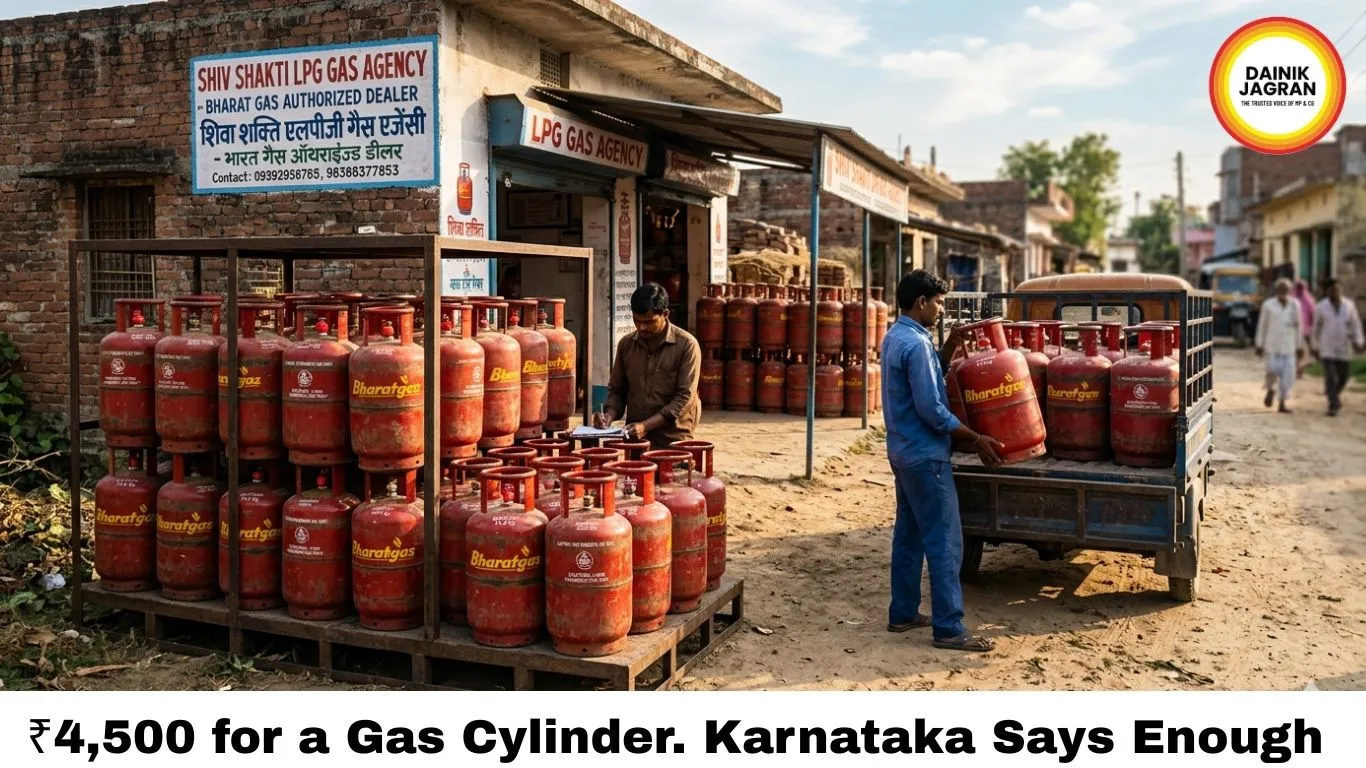
₹4,500 for a Gas Cylinder. Karnataka Says Enough — and Pulls Out the Goondas Act
Digital Desk
The Price That Crossed a Line
₹4,500. For a single commercial LPG cylinder whose government rate is approximately ₹1,750. In Bengaluru's grey market, in Tamil Nadu's illegal godowns, on the WhatsApp networks of distributors who decided that a war in Iran was a profit opportunity — cylinders that should be cooking food in restaurants and hospital canteens are being sold at more than two and a half times their official price. In Tamil Nadu, traders have reported commercial cylinders being sold for as high as ₹4,000. In Delhi, residents have been quoted prices of ₹3,000 — and in some cases ₹5,000 — for domestic cylinders on the informal market. Wikipedia The arithmetic of exploitation is simple and devastating: find the thing people most desperately need, control its supply, and extract the maximum they will pay when no alternative exists. India's governments have finally decided the answer to that arithmetic is not a press conference. It is a raid, a sealed godown, and a case under the Essential Commodities Act.
Karnataka Moves First — With Teeth
Karnataka Chief Secretary Shalini Rajneesh has ordered strict action against black marketing and illegal stocking of LPG cylinders amid the supply crisis. She called a high-level meeting and directed district administrations to act immediately. Business Standard District Collectors across Karnataka have been directed to take action under the Essential Commodities Act, 1955 against violators. The district administration will also initiate legal proceedings against illegal refilling, hoarding or unauthorised transport of LPG cylinders. National Herald India Food and Civil Supplies Minister K.H. Muniyappa convened a parallel high-level meeting at Vidhana Soudha — pulling in senior officials from IOC, BPCL, HPCL and GAIL simultaneously — to get a ground-level picture of how bad the situation actually is. Hotel Owners' Association president P.C. Rao told reporters after the meeting: "The supply of commercial cylinders has completely stopped. We requested at least 50% supply. She asked us to submit a letter with all the data and said she will examine it and help us as much as possible." Business Standard The Chief Secretary also noted that some hotel owners are buying more cylinders than they usually need out of panic — making the problem worse — and asked them to be mindful of this. Business Standard The message is calibrated: the government will pursue genuine hoarders aggressively while acknowledging that panic among legitimate businesses is itself creating an artificial shortage that punishes the very people it is supposed to protect.
Tamil Nadu: The Goondas Act Enters the Chat
If Karnataka's response has been firm, Tamil Nadu's has been extraordinary — deploying one of India's most powerful preventive detention laws against cylinder hoarders for the first time in the state's history. Two persons were arrested and detained under the Goondas Act in Madurai for allegedly hoarding 398 LPG cylinders for black marketing — marking the first time such stringent action has been taken in Tamil Nadu for cylinder hoarding. Wikipedia 398 cylinders. Hidden at an open plot near a residential area in Kovilpappakudi — domestic subsidised cylinders diverted for commercial resale, stripped of their purpose as affordable cooking fuel for ordinary households and converted into instruments of profit for men who calculated, correctly, that desperation makes the best customer. The Civil Supplies Criminal Investigation Department Madurai zone issued a stern warning that illegal hoarding of essential commodities will be met with severe legal consequences. Tamil Nadu traders added: "Due to the cylinder shortage, items like dosa, poori and parotta are becoming unavailable in hotels. While we are doing our best to feed the people, some agencies are hoarding cylinders and selling them for as high as ₹4,000." Wikipedia Dosa and poori — the most democratic, most everyday food on Tamil Nadu's streets — disappearing from plates because someone decided their gas cylinder was worth more as a black market asset than as a cooking fuel. The Goondas Act, typically reserved for organised criminals and gang members, has been invoked. It was the right call.
The National Crackdown: State by State
Karnataka and Tamil Nadu are not acting alone. Across the country, every state government is now racing to demonstrate that it is not asleep while its citizens pay ₹5,000 for a gas cylinder. In Jhansi, police recovered a truckload of stolen LPG cylinders. In Hapur, a distributor's godown was sealed after cylinders were found stored illegally in a house. Similar raids were conducted in Karnataka and Madhya Pradesh. Officials also activated inspection teams from public sector oil marketing companies to conduct surprise checks. India TV News A Chief Minister issued strict directions stating that if any distributor agency or individual is found involved in black marketing or hoarding, an immediate FIR should be filed and strict action should be taken. He also directed that police personnel may be deployed at LPG distribution centres if necessary so that no disorder occurs. Social News XYZ Prime Minister Narendra Modi himself cautioned against attempts to spread panic about LPG availability and warned that strict action would be taken against black marketing and hoarding, urging state governments to strengthen monitoring mechanisms to prevent unscrupulous elements from exploiting the situation. Business Standard When the Prime Minister personally calls out black marketers in an LPG crisis, the signal is unambiguous: this is a national emergency and the state machinery is expected to respond accordingly — not with press releases alone, but with FIRs, sealed godowns and, where necessary, the Goondas Act.
The People Paying the Price That Hoarders Are Pocketing
Every cylinder sitting in an illegal godown in Madurai or a sealed warehouse in Hapur represents a family that could not cook its meals, a dhaba that served no food that day, a hospital kitchen that had to manage on reduced gas, a daily wage worker who could not eat the ₹20 meal that normally fuels his working day. Chole Bhature has begun disappearing from plates in Delhi as the gas shortage continues to affect food businesses. Street vendors have put up posters announcing that Chole Bhature will no longer be available due to the lack of gas cylinders. A famous shop in Connaught Place also displayed a notice stating that the dish cannot be prepared because gas cylinders are not available. New Kerala Chole Bhature in Connaught Place. Dosa in Tamil Nadu. Poha in Indore. Chappan Dukan in Indore on induction stoves. The cultural and culinary identity of Indian street food — built entirely on the affordable, reliable availability of cooking gas — is being dismantled, plate by plate, stall by stall, by a combination of a foreign war and domestic opportunism. In some cases, commercial cylinders have reportedly been sold for as high as ₹4,500 in the informal market. Reports indicate that nearly 20% of hotels and restaurants in some areas have temporarily closed due to cylinder shortages. Black marketing of LPG cylinders has emerged as a serious concern across multiple states. Zee News Twenty per cent of restaurants in some areas. Temporarily closed. Not because of the Strait of Hormuz. Because someone in their supply chain decided that scarcity was a business model.
What the Law Actually Allows — And Why It's Enough
The Essential Commodities Act, 1955 is not a gentle statute. It gives state and central governments sweeping powers to control the production, supply, distribution and pricing of essential goods — and its penalties for violations include imprisonment of up to seven years. The Goondas Act, deployed in Tamil Nadu, allows preventive detention of up to one year without bail for individuals deemed a threat to public order. Combined, these two legal instruments give India's enforcement machinery everything it needs to shut down LPG black markets with genuine, lasting consequences. The question has never been whether the law is strong enough. It has always been whether the will to enforce it is present. "Any person or business entity found engaging in hoarding and black marketing thereby creating artificial scarcity may face strict action under the Essential Commodities Act, 1955 and other relevant regulations," a state minister warned, adding that people should not fall prey to rumour mongers or share unverified, alarming messages on social media. Twitter
The Honest Admission Hiding Inside "No Shortage"
Every government statement on the LPG crisis contains a formulation that deserves scrutiny: "there is no shortage." Karnataka's government issued it. Arunachal's minister said it. The Petroleum Ministry's officials repeated it. And simultaneously, every one of those statements was accompanied by enforcement actions, raid orders, godown sealings and Goondas Act detentions that only make sense if there is, in fact, a shortage — or at minimum, a severe enough supply disruption that ordinary people cannot access cylinders at their official price. Despite concerns linked to disruptions near the Strait of Hormuz, Petroleum Ministry officials said no distributor among the country's 25,000 LPG outlets had reported running out of stock. India TV News No distributor has run out of stock. The stock exists — somewhere in the distribution system. It is just not reaching the customer at the official price, on the official timeline, through the official channel. That gap — between stock existing and stock being accessible at its legal price — is the precise definition of a distribution crisis enabled by hoarding and black marketing. The government is not wrong to say "no shortage." It is just describing a reality that is considerably more qualified than its press releases suggest.
Conclusion: Arrest More. Warn Less.
The LPG crisis of 2026 has two enemies: the Strait of Hormuz and the cylinder hoarder. India cannot bomb the first. It absolutely can arrest the second — and it is finally beginning to do so with the seriousness the scale of exploitation demands. Enforcement actions have already been carried out in several states. Raids have sealed illegal godowns, recovered stolen cylinders and put distributors who violated their licensing terms on notice. India TV News But 398 cylinders seized in Madurai, a sealed godown in Hapur and a truckload recovered in Jhansi are the beginning of accountability — not its completion. For every godown that has been raided, there are dozens that have not yet been found. For every ₹4,500 cylinder sale that has been prosecuted, hundreds of others happened without consequence. Karnataka's Chief Secretary has given the order. Tamil Nadu has invoked the Goondas Act. The Prime Minister has issued the warning. The Essential Commodities Act is on the statute books with seven-year imprisonment provisions. Every enforcement tool required is available and deployed. Now the question is simple: will the raids continue after the crisis passes — or will the black marketers return to business the moment the Strait of Hormuz reopens and the pressure on governments to act visibly is relieved? The answer to that question will determine whether India's LPG distribution system learns anything permanent from 2026 — or simply waits for the next crisis to exploit.
.jpg)




