


AK-47, Three Glocks, ISI Handlers on WhatsApp — Punjab Police Just Busted Another Pakistan Terror Cell
Digital Desk
Same Border. Same Playbook. Same Enemy. Punjab Police Foils It Again.
This is not the first time. It will not be the last. But every time Punjab Police dismantles a module like the one arrested this morning in Amritsar — every time they pull an AK-47 and three Glock pistols out of the hands of men receiving instructions from Pakistani handlers through social media — it is worth stopping and reading the details carefully. Because the details are the story. And the story is one that India cannot afford to stop paying attention to.
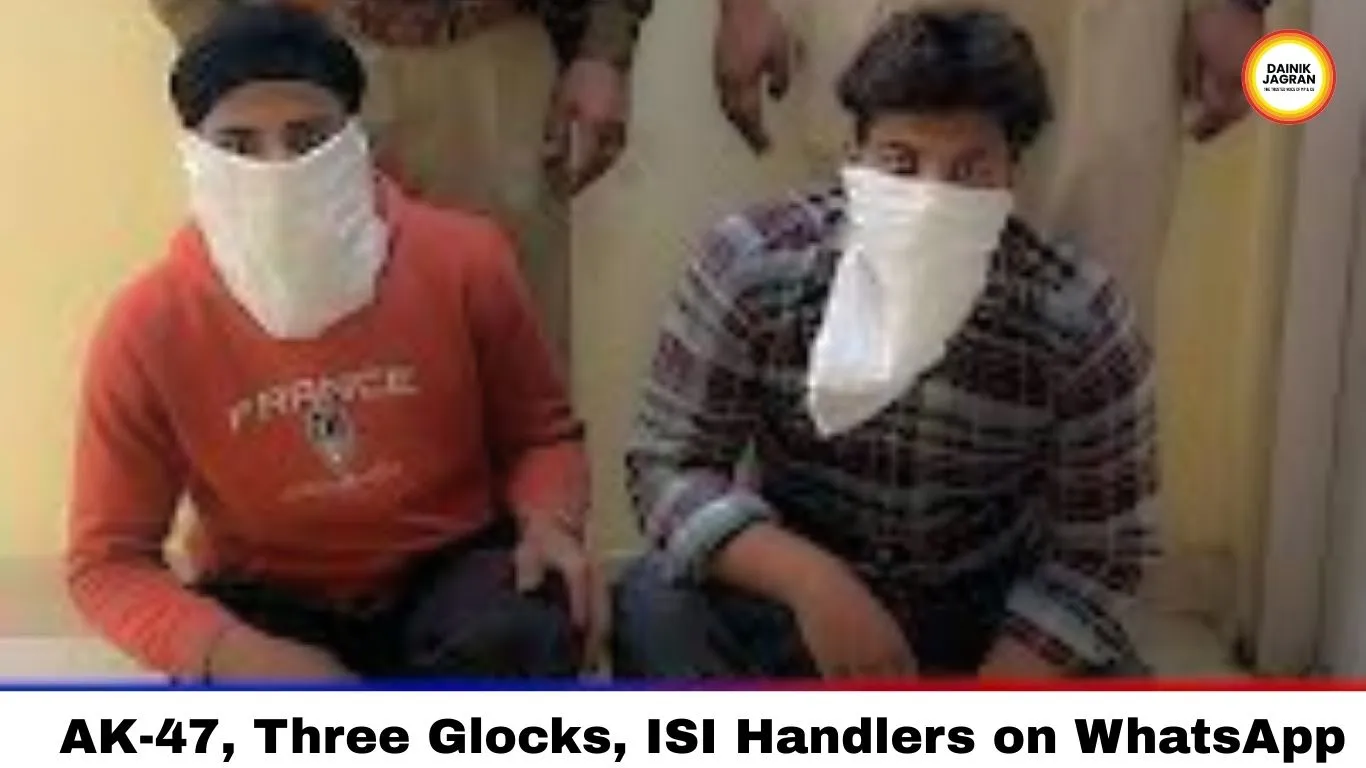
Amritsar Rural Police has busted an ISI-sponsored terror and cross-border arms smuggling module, arresting two accused and recovering a cache of sophisticated weapons. The operation led to the recovery of one AK-47 rifle along with two magazines and 36 live cartridges. In addition, three sophisticated Glock 9mm pistols were also seized. DGP Gaurav Yadav described the development as a significant success in the ongoing efforts of Punjab Police to dismantle terror networks and curb cross-border arms smuggling in the state.
One AK-47. Thirty-six live cartridges. Three Glock 9mm pistols — the sidearm of choice for professional operatives worldwide, accurate, reliable and expensive. This is not improvised criminality. This is a funded, equipped, professionally managed operation run by foreign handlers with the specific objective of destabilising Punjab.
The Social Media Pipeline That Replaced the Courier
Preliminary investigations have revealed that the accused were in direct contact with foreign-based handlers through social media platforms. Twitter
This single line — buried in the official police statement — is the most important detail in the entire case. Not the weapons. Not the arrests. The social media platforms.
Pakistan's ISI has learned, over years of watching its physical courier networks intercepted and its ground-level operatives arrested, that the most dangerous weapon it can deploy against Punjab is not a gun smuggled across the border. It is a smartphone. A WhatsApp message. An encrypted Telegram channel. A carefully cultivated relationship between a foreign handler sitting safely in Lahore or Rawalpindi and a young man in rural Punjab who is economically frustrated, socially disconnected, and susceptible to the seductive language of grievance and purpose that radicalisers deploy with practised, patient precision.
The accused were reportedly radicalising youth and spreading anti-India narratives online. Zee News Two roles simultaneously: receiving weapons and instructions from across the border, and recruiting and radicalising the next generation of operatives from within. The module was not just a weapons cache. It was a production line — for ideology as much as for violence.
This is the modern architecture of ISI-sponsored terror in Punjab. No longer primarily dependent on physical infiltration across a heavily guarded international border. Instead: encrypted apps, cultivated social media relationships, small financial inducements that grow into larger obligations, and eventually a young man who finds himself holding a Glock pistol and wondering how he got here.
The Nalagarh Connection: A Network Wider Than Two Arrests
Today's bust does not exist in isolation. It is a node in a network that Punjab Police has been systematically dismantling over the past several months — and the connections between cases reveal a pattern of operational coordination that should concern every security analyst watching the India-Pakistan border.
Earlier on February 22, Counter Intelligence Jalandhar, in a joint operation with Counter Intelligence SAS Nagar, successfully apprehended two key perpetrators involved in the IED-RDX blast at Nalagarh Police Station in Himachal Pradesh on January 1, 2026. The arrested accused have been identified as Mahavir alias Kaka and Manpreet alias Mani, both residents of SBS Nagar, Punjab.
A Glock module in Amritsar. An RDX blast at a Himachal Pradesh police station on New Year's Day. Suspects from SBS Nagar connected to both. The geography of this network stretches from Amritsar Rural to Jalandhar to SBS Nagar to Himachal Pradesh — a multi-district, multi-state terror infrastructure with a single common thread: ISI handlers issuing instructions from across the border.
Further investigation is underway to establish forward and backward linkages and dismantle the entire network.
"Forward and backward linkages." The language of counter-terrorism investigation — mapping the chain of command upward toward the handlers and downward toward the foot soldiers. The two men arrested today are almost certainly not the architects of this network. They are, in all probability, operationally dispensable — recruited precisely because their loss would not collapse the wider structure. The real work of dismantling begins now, in the interrogation rooms and the digital forensics labs where investigators will work through the phones, the social media accounts, the WhatsApp histories and the financial transactions of the arrested men to trace every connection they made and everyone who made them.
The Weapons Inventory: What It Tells You About Who Is Behind This
The specific weapons recovered from today's module deserve careful attention — because weapons do not lie about their origins, their cost, or the seriousness of the operation they were intended to supply.
An AK-47 rifle with two magazines and 36 live cartridges is an assault weapon capable of sustained automatic fire. It is not a weapon of opportunity or desperation. It is a weapon of planned, sustained violence — the kind used not to commit a single targeted attack but to suppress return fire, hold a position, or execute a complex operation with multiple phases.
Three Glock 9mm pistols. The Glock is one of the world's most widely produced and distributed handguns — used by police forces, military units and intelligence operatives across more than a hundred countries. Its presence in a cross-border arms module is significant precisely because it suggests procurement from professional supply chains, not improvised manufacturing or petty criminal markets. Someone with access to international arms networks sourced these weapons and moved them across the India-Pakistan border.
The sophistication of the weapons recovered — particularly the Glock pistols — points to a well-funded operation. Zee News Well-funded. That means state sponsorship — or at minimum, state facilitation. The ISI does not only recruit; it equips. The weapons recovered in Amritsar today did not materialise from thin air. They were procured, packaged, smuggled and distributed through a supply chain that exists because a foreign intelligence agency decided to invest in the destabilisation of an Indian state.
DGP Gaurav Yadav: The Man Holding the Line
DGP Gaurav Yadav reaffirmed Punjab Police's zero-tolerance approach against terrorism, illegal arms trafficking and organised crime. An FIR has been registered at PS Gharinda, Amritsar Rural. Further investigation is underway to establish forward and backward linkages and dismantle the entire network.
DGP Gaurav Yadav has been the public face of Punjab Police's counter-terror operations for over a year — and the frequency and consistency of busted modules under his tenure reflects an intelligence and operational capability that has been quietly, methodically built up over years of painful lessons learned from Punjab's troubled history.
In a previous operation, Amritsar Rural Police in close coordination with central agencies apprehended two terror operatives and recovered one Rocket Propelled Grenade — an RPG — with preliminary investigation revealing the accused were in contact with Pakistan's ISI operative who had sent the weapon.
An RPG. Recovered in Amritsar. From operatives in contact with an ISI handler. Today's AK-47 and three Glocks follow that in a sequence that describes an ISI programme of weapons escalation — testing Punjab's defences with progressively more sophisticated armaments, probing for the weaknesses in surveillance, the gaps in intelligence networks, the recruitable youth who can be turned into delivery mechanisms for whatever comes next.
Punjab Police is catching them. The question that demands honest examination is: how many are not being caught? Every successful bust reveals the existence of a network. Every network that exists but has not yet been busted represents an unknown risk. The zero-tolerance approach is essential — but zero tolerance is a policy statement, not a guarantee.
The Radicalisation Pipeline: Punjab's Most Dangerous Import
Punjab's youth are getting radicalised. The socio-economic factors — unemployment, drug addiction recovery, a sense of cultural dislocation, the feeling of being left behind by a state that has not delivered on its promises — create the conditions in which foreign handlers can operate. Foreign handlers sitting safely abroad ruin the lives of young people. BKI, ISI — they don't care about Punjab or its people. They just want to create chaos.
This is the dimension of the terror threat that an AK-47 seizure press release cannot fully capture. The weapons are symptoms. The radicalisation is the disease. And the disease has a specific pathology in Punjab: a young man, economically marginalised, possibly recovering from drug addiction, carrying a sense of grievance about his own prospects and his community's treatment — encountered online by a handler in Lahore who speaks his language, validates his grievances, provides small amounts of money, creates a sense of belonging and purpose, and gradually, incrementally converts his frustration into operational compliance.
The handler never crosses the border. He never touches a weapon. He never appears in an FIR. He sits in a safe house in Rawalpindi or a comfortable apartment in a Western city and types encrypted messages — and somewhere in rural Amritsar, a young man opens a phone and becomes the next node in a network that began on the other side of an international border.
Until Punjab Police knocks on his door at 3 AM with an intelligence input and a search warrant.
What Must Follow: Beyond the Press Release
Every terror module bust generates a press release, a DGP statement, an FIR at a local police station, and a commitment to trace "forward and backward linkages." Those are the right procedural responses. They are not sufficient by themselves.
What Punjab's counter-terror architecture needs — and what the frequency of these busts suggests is still incomplete — is a genuinely comprehensive social media monitoring and intervention capability that identifies radicalisation before it reaches the weapons acquisition stage. Not surveillance of political opinion — the precise, intelligence-driven identification of individuals in active contact with known foreign handlers, before the Glock has been procured and the magazine has been loaded.
It also needs an economic and social answer to the vulnerability that the ISI exploits. Just arresting people isn't a permanent solution. We need to address the root causes in Punjab — employment, drug recovery, community belonging, a sense of stake in the state's future.
Those are not policing problems. They are governance problems. And their solution requires more than zero-tolerance statements — it requires the kind of sustained, adequately funded, politically committed investment in Punjab's rural economy and young men's futures that has, historically, been easier to promise than to deliver.
Conclusion: Punjab Is Winning Battles. The War Continues.
Punjab Police remains steadfast in its zero-tolerance approach against terrorism, illegal arms trafficking and organised crime. National Herald India
It does. And it is winning — in the sense that busts like today's prevent attacks that would have happened, weapons that would have been used, lives that would have been lost. DGP Gaurav Yadav and the officers of Amritsar Rural Police deserve unreserved credit for an operation that, conducted correctly and on today's intelligence, almost certainly prevented violence.
But zero tolerance is not zero threat. The ISI's programme of destabilisation in Punjab did not begin with today's module and will not end with today's arrests. It is a long-running, well-funded, institutionally patient programme that has survived decades of Indian counter-operations and will adapt to today's setback within weeks.
The AK-47 has been seized. The Glocks are in an evidence locker in Gharinda police station. The two accused are in custody. The investigation into forward and backward linkages has begun.
And somewhere across the border — in a safe house, on an encrypted phone — a handler is already looking for the next recruit.
Punjab Police is watching. India must make sure it never stops.
.jpg)




