


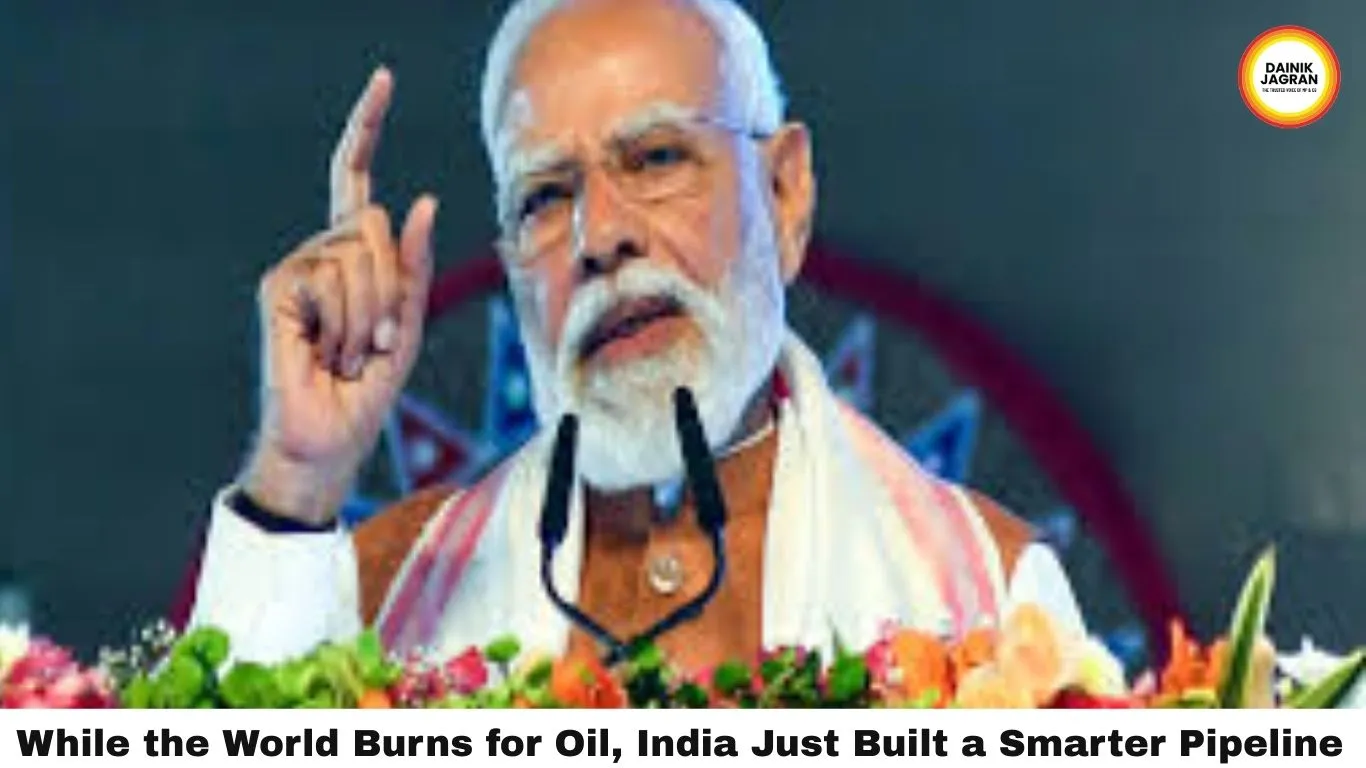
While the World Burns for Oil, India Just Built a Smarter Pipeline — And It's a Master Stroke
Digital Desk
Perfect Timing. Perfect Location. The Infrastructure Story Nobody Is Telling.
While the world's attention has been consumed by burning oil fields in Iran, tankers stranded outside the Strait of Hormuz, and LPG queues stretching outside gas agencies across India — Prime Minister Narendra Modi stood in Guwahati on March 13, 2026 and inaugurated something that quietly, powerfully addresses the most fundamental cause of India's energy vulnerability: domestic infrastructure that moves fuel without depending on a single foreign strait.
The Prime Minister inaugurated and laid foundation stones for development projects worth around ₹19,480 crore in Guwahati — with the centrepiece being the Numaligarh-Siliguri Product Pipeline capacity augmentation project of Oil India Limited.
The timing of this inauguration — on Day 14 of the Iran War, at the height of India's worst LPG crisis since the 1970s — is not coincidental. It is the most vivid possible illustration of the gap between what India's energy infrastructure currently is and what it needs to become. And the NSPL upgrade, modest in its cost and extraordinary in its strategic significance, is exactly the kind of project that closes that gap — one pipeline, one refinery, one Northeast corridor at a time.
The Numbers That Make This Project Remarkable
The Numaligarh-Siliguri Product Pipeline is a 654-km long, 16-inch diameter cross-country multi-product pipeline. Originally designed and operated for a capacity of 1.72 Million Metric Tonnes Per Annum, it has now been upgraded to 5.5 MMTPA — supporting the expansion of Numaligarh Refinery Limited from 3.0 MMTPA to 9.0 MMTPA under the Government of India's Hydrocarbon Vision 2030 for the North-East.
Three numbers define the audacity of this project. The first is the capacity leap: from 1.72 MMTPA to 5.5 MMTPA — a 220% increase in throughput. The second is the cost: completed as a brownfield initiative for approximately ₹750 crore, saving significantly from the approved ₹860 crore budget. Wikipedia A government infrastructure project that came in ₹110 crore under budget is, in the annals of Indian public works, an event worth marking with something larger than a press release. The third is the employment generated: around 4.1 million man-hours of employment over three years in Assam and West Bengal DNA India — 4.1 million hours of paid work for engineers, welders, project managers, logistics workers and daily labourers across two states.
Under budget. Three times the original capacity. 4.1 million hours of employment. If this were a private sector project, it would be studied in management schools.
How They Did It — Without Laying a Single New Pipe
The most impressive engineering dimension of the NSPL upgrade is precisely what it did not require.
The capacity enhancement was achieved through upgrading existing infrastructure — including conversion of pigging stations at Sekoni, Guwahati, Bongaigaon and Madarihat into Intermediate Pumping Stations, augmentation of pumping facilities at Numaligarh Dispatch Terminal, and upgrading of facilities at Siliguri Receipt Terminal for enhanced operational efficiency and safety.
No new 654-kilometre pipeline was dug. No new right-of-way was negotiated across two states. No new environmental clearances for a fresh corridor were required. Oil India's engineers looked at the existing pipeline — laid at considerable cost and effort across the hills and valleys of Assam and West Bengal — and asked a different, more elegant question: what if we made this pipe work harder instead of building another one?
The answer was the conversion of routine maintenance stations into active pumping nodes — injecting additional pressure into the existing system at strategic intervals along the 654-kilometre route, effectively transforming a single-pump pipeline into a multi-stage, high-throughput petroleum highway. It is the brownfield infrastructure philosophy at its most refined: squeeze maximum value from existing assets before spending on new ones.
What This Means for Northeast India — Right Now
The practical consequences of the NSPL upgrade for the seven sister states and their 46 million residents are immediate, tangible and deeply connected to the crisis India is currently navigating.
The pipeline upgrade facilitates the expansion of the Numaligarh Refinery from 3 MMTPA to 9 MMTPA — enabling the evacuation of additional petroleum products from the refinery to markets across the Northeast.
The Northeast has historically been India's most energy-vulnerable region. Cut off from the national pipeline grid by the narrow Siliguri Corridor — the so-called Chicken's Neck — and dependent on road and rail transport for fuel that travels enormous distances before reaching the consumer, the region has suffered fuel shortages, price volatility and supply disruptions at a frequency that flatland India rarely experiences. The NSPL is the artery that connects Assam's refinery output to the distribution network that feeds the entire region.
Tripling that artery's capacity — from 1.72 to 5.5 MMTPA — means that when a global energy crisis strikes, as one has in March 2026, the Northeast does not go to the back of the queue waiting for road tankers navigating mountain passes. It draws from a domestic refinery, through a domestic pipeline, independently of the Strait of Hormuz, independently of oil tanker insurance premiums, independently of whatever is happening in Tehran on any given night.
As one observer commented: "Energy security for the North-East is long overdue. My father used to talk about fuel shortages in Siliguri during winters. Hope such stories become a thing of the past."
The Bigger Assam Picture — ₹47,600 Crore in Two Days
The NSPL inauguration was the headline infrastructure event of PM Modi's Guwahati visit — but it was far from the only one.
PM Modi's two-day Assam visit involved launching and inaugurating development projects of around ₹47,600 crore across Kokrajhar, Guwahati and Silchar. Projects announced include the ₹2,300-crore Kopili Hydro-Electric Project; railway electrification of the Rangiya-Murkongselek line covering 558 km and the Chaparmukh-Dibrugarh line covering 571 km; the foundation stone for the Furkating-Tinsukia rail line doubling project worth over ₹3,600 crore; cruise terminals at Bishwanath Ghat and Neamati; a regional maritime centre at Bogibeel; and the Pandu Jetty approach road.
In Silchar, Modi will lay the bhoomi poojan for the Shillong-Silchar four-lane greenfield corridor — a 166-km project worth about ₹22,860 crore aimed at cutting travel time between Guwahati and Silchar significantly.
Modi also distributed land pattas — documents confirming land ownership — to tea garden workers in Guwahati, and released the 22nd instalment of the PM-KISAN scheme to over 93 million farmers across the country from the same venue.
₹47,600 crore across two days. Rail, road, river, energy, agriculture, land rights — the entire spectrum of development infrastructure deployed simultaneously across a state that has, for most of independent India's history, been treated as a peripheral priority rather than a strategic one.
The Electoral Elephant in the Room
This visit — PM Modi's fourth to Assam in the last four months — comes ahead of Assembly elections expected to be held in April. Social News XYZ
The political context is not separable from the developmental one. ₹47,600 crore of projects inaugurated and announced in two days, four visits in four months, land pattas to tea garden workers, PM-KISAN disbursements from Guwahati soil — the BJP's electoral strategy in Assam is written in infrastructure announcements as clearly as in campaign speeches.
That observation does not diminish the genuine value of what was inaugurated. The NSPL upgrade is real infrastructure that will deliver real energy security benefits to real residents of the Northeast for decades. The Kopili Hydro-Electric Project will generate real power. The railway electrification projects will enable real freight and passenger movement. The Shillong-Silchar corridor will cut real travel times.
But in the weeks before an election, the timing and the volume of announcements carries its own political logic — and voters are entitled to hold the government accountable not just for what was announced on March 13, 2026 in Guwahati, but for what is actually built, on budget and on time, in the months and years that follow.
India's Real Answer to the Iran War — Built Underground in Assam
The NSPL upgrade's deepest significance in the context of the 2026 Iran War is also its least discussed one.
Every barrel of petroleum product that travels through the Numaligarh-Siliguri pipeline is a barrel that did not need to travel through the Strait of Hormuz. Every litre of fuel produced at the expanded Numaligarh Refinery and pumped south through the NSPL to West Bengal and the Northeast corridor is a litre that India produced itself — from its own soil, refined in its own facility, transported through its own infrastructure, priced in its own currency, immune to the whims of a war 4,000 kilometres away.
India recorded 200 million tonnes of coal production by March 11 — another milestone in domestic energy self-sufficiency announced the same week as the NSPL inauguration.
This is what genuine energy security looks like. Not press conferences about no-shortage assurances. Not 30-day waivers negotiated with the US Treasury. Not desperate calls to Iran to let tankers through the strait. Pipes in the ground. Refineries at capacity. Pumping stations converted into arteries. The quiet, unglamorous, essential infrastructure of a nation that is slowly, systematically reducing the number of foreign chokepoints between its economy and its citizens' daily lives.
The Pipeline That Deserved More Attention
The world was watching Tehran burn on March 13, 2026. In Guwahati, under considerably less global attention, a Prime Minister was inaugurating a pipeline that represented exactly the kind of answer India needs to build — permanently, not just in moments of crisis — to the vulnerability that Tehran's burning has exposed.
The NSPL upgrade was completed on time, under the approved budget of ₹860 crore at a final cost of ₹750 crore, generating 4.1 million man-hours of employment and tripling the pipeline's capacity to support Northeast India's energy needs for the next decade.
Under budget. On time. Triple capacity. 4.1 million working hours. And inaugurated at the precise moment when India most needed to be reminded that its energy future cannot be entirely dependent on what happens in a strait it does not control.
The Numaligarh-Siliguri pipeline is 654 kilometres long. It runs through hills and forests and river plains that most Indians will never see. It carries no famous name and generates no viral moment.
But in the year that the Strait of Hormuz reminded India of its most dangerous vulnerability — it is precisely the kind of infrastructure that will determine whether the next crisis finds this country more prepared than the last one did.
Build more pipes. Refine more oil at home. Depend less on one strait.
That is the only energy policy India ultimately needs — and Guwahati just took one more step toward it.
.jpg)




